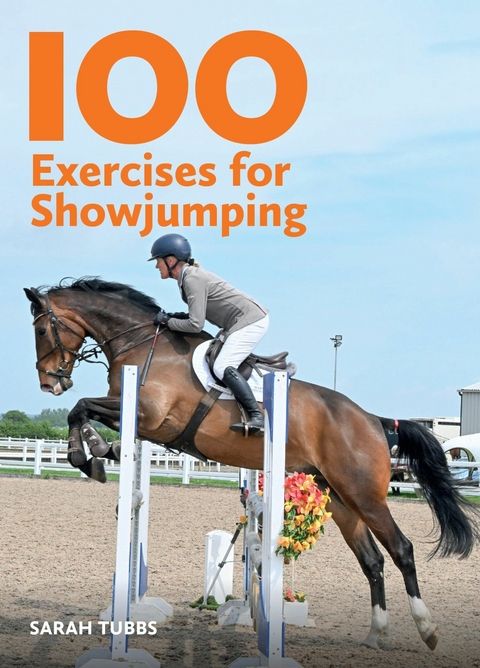
100 Exercises for Showjumping (eBook)
160 Seiten
The Crowood Press (Verlag)
978-0-7198-3510-0 (ISBN)
SARAH TUBBS is a professional coach who has worked in the equestrian industry for over 25 years. She has a Master's degree in sports coaching and is a Level 4 British Showjumping Coach and Coach Educator who works with riders at all levels, including providing national training for para showjumpers. She was British Showjumping Coach of the Year in 2015
From guiding the showjumping horse through flatwork and the initial stages of training, to the collecting ring and competitions, 100 Exercises for Showjumping aims to cover all aspects of training with a wide range of exercises for all types of showjumping horses and ponies.
FLATWORK FOR JUMPING
Around 90 per cent of a showjumping track is ridden on the flat, and how your horse performs in the areas between the fences can significantly affect his performance over the jumps.
In terms of the development of the young horse, there are several exercises that can help with strengthening the hind leg and creating the suppleness and engagement required as the horse steps up the levels in his jumping; these are covered in this section. Other exercises in this section address the general rideability needed for a good showjumping round, as well as other areas that are key to the jumping exercises later in the book.
EXERCISE 1
The Scales of Training
All aspects of developing a horse are encompassed within the Scales of Training. Showjumping is made much easier by having a rideable horse for the areas between the fences, and this section aims to provide flatwork exercises that help to educate and improve your horse’s way of going on the flat to improve his rideability to the fences.
Aim
The aim is to provide a description of the Scales of Training and explain how these can guide your work with your horse on the flat.
The scales of training.
The Principles of the Scales of Training
The Scales of Training originated in Germany and some of the meanings do not translate well into English, so I have tried to combine the two in the outline below.
Takt: Translates as ‘rhythm and tempo’. The evenness of the horse’s footfalls within a gait and the speed of those footfalls is the first and most essential building block. These two factors are a key judging element in dressage, and are essential to a good showjumping round.
Losgelassenheit: There is no direct English translation for this German word, and the usual interpretation is ‘suppleness’; however, I think this can be misleading. The German ‘Gelassenheit’ translates as ‘serenity’, and ‘gelassen’ as ‘calmly’, so the ‘suppleness’ we refer to in English is really about your horse moving in a relaxed and calm manner, with no tension – it is sometimes interpreted as ‘relaxation’. Although this comes after rhythm and tempo, it is hard to achieve a good rhythm when your horse is tense, so to some extent these two go hand in hand.
Anlehnung: This means ‘rein contact’. As your horse develops in his balance, he should become able to stay consistently in a gentle rein contact whilst maintaining the other factors already mentioned. Often when the contact is not good, the rhythm and tempo can be affected, and relaxation is most definitely impacted – and these three elements work together as part of the initial training phase of your horse, where he is understanding and gaining confidence in what is being asked of him.
Schwung: This is a brilliant word that sounds like its meaning! We interpret it as ‘impulsion’, and combined with contact and the next element in the Scales of Training, it is part of the development of the horse’s pushing power, which is fundamental to showjumping.
Geraderichtung: This is ‘straightness’. This might sound simple to achieve, but its position so far up the Scales of Training reflects how difficult it is to achieve true straightness through turns as well as straight lines, and to have all four feet travelling correctly with the right amount of alignment through the head, neck and spine. All horses begin with some level of asymmetry, and then we add a rider (who may not be that symmetrical!) to the equation. Then add in all the other requirements of the Scales of Training, particularly impulsion, and perhaps it becomes more obvious why true straightness can be difficult to achieve. From the perspective of showjumping, this element can be hugely influential in the ability to take off in a balanced manner. It is also easier to judge the take-off point if the horse is straight on the approach.
Versammlung: This means ‘collection’. Although the level of collection needed for showjumping is very different from that required for dressage, being able to shorten and lengthen the canter is essential at the higher levels, whilst maintaining impulsion, rhythm and straightness.
How to Ride It
• When you are schooling your horse, the Scales of Training are a great reference point and inspiration for those days when you need to find something to focus on in your training.
• Depending on the age of your horse and his level of training, review the appropriate aspects of the Scales of Training and see if you can identify which area could be worked on that day. As you work your horse, keep noticing which areas are working well or improving and where you can still work to improve, or add in the next level of the Scales of Training and see if you can maintain the other areas still – for example, can you add impulsion and maintain rhythm and tempo?
• Many of the exercises outlined in this book provide techniques that will improve performance in relation to the Scales of Training.
TIP: THE VALUE OF VIDEO
If you are not sure where your horse needs to improve in relation to the Scales of Training, it can be helpful to get a friend to video you riding in all three paces so that you can review it and think about the various aspects later, without time pressure or the distraction of being on your horse and addressing issues in that moment.
EXERCISE 2
The Half Halt
Aim
This is such a fundamental element of riding that it is almost certainly familiar; however, riding it well in relation to showjumping is worth practising, as the key is to be able to retain power whilst adjusting your horse’s balance.
The half halt needs the hind leg to be engaged and creating power to help elevate the shoulders.
How to Ride It
• Riding a half halt is like changing down a gear in a car or on a bike, in that it should maintain or increase the power ratio but not change the pace (unless you use that change of gear to then accelerate!). By increasing engagement, it also allows the horse to lighten in the shoulders and take the weight more on to the hind legs, which helps with the balance on the approach to a fence.
• The half halt should therefore be ridden from the hind leg first, so close the lower leg before asking anything else so that the hind leg is stepping under the body and retaining energy.
• Think of then growing tall in your upper body and engaging your core muscles to ask the horse to momentarily come up through the shoulders, and think of a split-second pause in forward momentum before closing the leg and riding forwards again.
• If your horse does not react to your change in body position, you can slightly increase the pressure on the outside rein or both reins for a stride. Hopefully as your horse becomes accustomed to the sequence of aids you will need less rein aid, but if not, you can repeat the half-halt aids again until he understands what is being asked of him. Try to avoid a continuous pull to get the half halt as this is likely to lead to a tug of war with your horse, which doesn’t tend to be won by the rider!
• Practise riding the half halt within the canter, and ride a few strides afterwards, noticing how the balance and power has improved as a result.
• When riding to a fence, try riding a half halt about six to eight strides before the jump to prepare your horse by gaining his attention and improving his balance and engagement in the canter. This is often further away from the jump than people think!
EXERCISE 3
Lengthening and Shortening the Stride
Aim
Although maintaining an even rhythm round a track of showjumps is a basic principle of a fluent round, there are often occasions when you will need to slightly lengthen or shorten the stride in a related distance as a result of the preceding jump. At the more advanced levels, the course-builder might also make the distance a little shorter or longer to challenge the adjustability of the horse and the effectiveness of the rider, so being able to adjust the length of stride without losing power or gaining speed is relevant at all levels.
Lengthening the stride by slightly lightening your seatbones and flexing your hips towards the back of the saddle whilst keeping your chest up.
How to Ride It
• It is much easier to shorten the canter round a turn because this is when the horse will naturally look to shorten his stride. So initially it will be easier to introduce this exercise by lengthening down the long sides of an arena and shortening on the short sides.
• To lengthen the canter, slightly lighten your seatbones and flex your hips towards the back of the saddle and your shoulders very slightly forwards, but keep your chest up (be careful not to drop down and forwards, as this will make the horse more likely to run on to the forehand). Close your leg to ask the horse to move forwards, but maintain a contact down the rein so that the energy is contained and the horse doesn’t become flat and run on to his shoulders. The aim is to lengthen the stride, and not to get...
| Erscheint lt. Verlag | 11.3.2025 |
|---|---|
| Verlagsort | London |
| Sprache | englisch |
| Themenwelt | Sachbuch/Ratgeber ► Sport ► Reiten / Pferde |
| Schlagworte | Arena • Coach • Competitions • equestrian • Equine • equipment • exercise • Exercises • fence • fences • flatwork • gridwork • ground poles • horse • Indoor • Jump • Jumping • Outdoor • Performance. • Poles • pole work • Problem Solving • Rider • riding • round poles • safety cups • Showjumping • tape measure • WINGS |
| ISBN-10 | 0-7198-3510-0 / 0719835100 |
| ISBN-13 | 978-0-7198-3510-0 / 9780719835100 |
| Informationen gemäß Produktsicherheitsverordnung (GPSR) | |
| Haben Sie eine Frage zum Produkt? |
 EPUB (Wasserzeichen)
DRM: Digitales Wasserzeichen
Dieses eBook enthält ein digitales Wasserzeichen und ist damit für Sie personalisiert. Bei einer missbräuchlichen Weitergabe des eBooks an Dritte ist eine Rückverfolgung an die Quelle möglich.
Dateiformat: EPUB (Electronic Publication)
EPUB ist ein offener Standard für eBooks und eignet sich besonders zur Darstellung von Belletristik und Sachbüchern. Der Fließtext wird dynamisch an die Display- und Schriftgröße angepasst. Auch für mobile Lesegeräte ist EPUB daher gut geeignet.
Systemvoraussetzungen:
PC/Mac: Mit einem PC oder Mac können Sie dieses eBook lesen. Sie benötigen dafür die kostenlose Software Adobe Digital Editions.
eReader: Dieses eBook kann mit (fast) allen eBook-Readern gelesen werden. Mit dem amazon-Kindle ist es aber nicht kompatibel.
Smartphone/Tablet: Egal ob Apple oder Android, dieses eBook können Sie lesen. Sie benötigen dafür eine kostenlose App.
Geräteliste und zusätzliche Hinweise
Buying eBooks from abroad
For tax law reasons we can sell eBooks just within Germany and Switzerland. Regrettably we cannot fulfill eBook-orders from other countries.
aus dem Bereich