


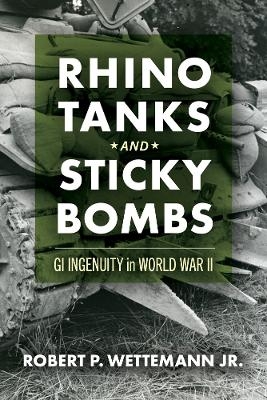
Rhino Tanks and Sticky Bombs Volume 79
GI Ingenuity in World War II
Seiten
2025
University of Oklahoma Press (Verlag)
978-0-8061-9539-1 (ISBN)
University of Oklahoma Press (Verlag)
978-0-8061-9539-1 (ISBN)
Coming of age during the Great Depression, the American boys who fought in World War II had, through necessity, developed a unique brand of technological resourcefulness. This proficiency, Robert P. Wettemann Jr. contends, provided GIs with another weapon in a distinctly American way of war. Rhino Tanks and Sticky Bombs is Wettemann’s eminently readable account of how this hard-won “use it up, wear it out, make it do, or do without” mentality was critical to America’s success, giving servicemen the know-how and can-do spirit to creatively engineer solutions to wartime problems.
More than all the other soldiers in the conflict, American servicemen grew up in a society where the machine was ubiquitous—where enduring an unparalleled period of financial distress meant learning to keep their Model Ts, Fordson tractors, or other machinery operational. Wettemann describes how this tinkerer’s mentality promoted a technical aptitude and willingness to adapt unmatched by other armies fielded during World War II. At the same time, the US command structure demonstrated a willingness to evaluate, accept, and employ such efforts to improve both fighting capacity and the general comfort of US servicemen. Seamlessly blending social, military, intellectual, and technological history, Rhino Tanks and Sticky Bombs weaves an engaging narrative about the roots of American ingenuity during WWII—and makes a compelling case for a specific instance of American distinctiveness that proved crucial to Allied victory.
More than all the other soldiers in the conflict, American servicemen grew up in a society where the machine was ubiquitous—where enduring an unparalleled period of financial distress meant learning to keep their Model Ts, Fordson tractors, or other machinery operational. Wettemann describes how this tinkerer’s mentality promoted a technical aptitude and willingness to adapt unmatched by other armies fielded during World War II. At the same time, the US command structure demonstrated a willingness to evaluate, accept, and employ such efforts to improve both fighting capacity and the general comfort of US servicemen. Seamlessly blending social, military, intellectual, and technological history, Rhino Tanks and Sticky Bombs weaves an engaging narrative about the roots of American ingenuity during WWII—and makes a compelling case for a specific instance of American distinctiveness that proved crucial to Allied victory.
Robert P. Wettemann, Jr. is Associate Professor in the Department of History at the United States Air Force Academy.
| Erscheinungsdatum | 02.06.2025 |
|---|---|
| Reihe/Serie | Campaigns and Commanders Series |
| Zusatzinfo | 30 b&w illus., 3 tables |
| Verlagsort | Oklahoma |
| Sprache | englisch |
| Maße | 152 x 229 mm |
| Themenwelt | Natur / Technik ► Fahrzeuge / Flugzeuge / Schiffe ► Militärfahrzeuge / -flugzeuge / -schiffe |
| Geschichte ► Allgemeine Geschichte ► Neuzeit (bis 1918) | |
| Geschichte ► Allgemeine Geschichte ► 1918 bis 1945 | |
| Geschichte ► Teilgebiete der Geschichte ► Militärgeschichte | |
| ISBN-10 | 0-8061-9539-8 / 0806195398 |
| ISBN-13 | 978-0-8061-9539-1 / 9780806195391 |
| Zustand | Neuware |
| Informationen gemäß Produktsicherheitsverordnung (GPSR) | |
| Haben Sie eine Frage zum Produkt? |
Mehr entdecken
aus dem Bereich
aus dem Bereich
von der frühen Neuzeit bis ins Computerzeitalter
Buch | Hardcover (2025)
De Gruyter (Verlag)
CHF 83,90
rockets, missiles, and drones as instruments of fear and coercion
Buch | Softcover (2025)
Oxford University Press Inc (Verlag)
CHF 34,90


