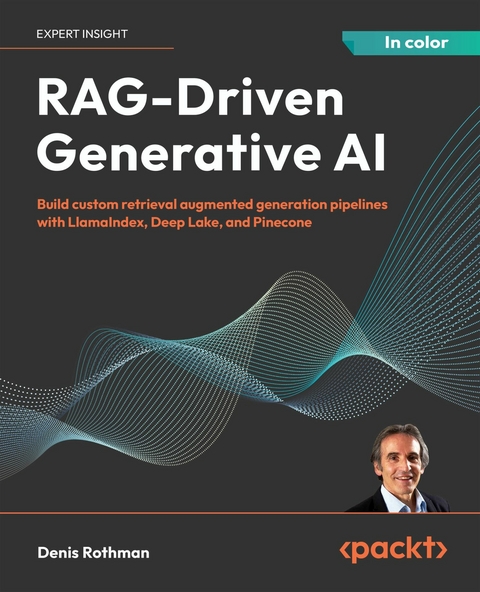
RAG-Driven Generative AI (eBook)
338 Seiten
Packt Publishing (Verlag)
978-1-83620-090-1 (ISBN)
Minimize AI hallucinations and build accurate, custom generative AI pipelines with RAG using embedded vector databases and integrated human feedback Get With Your Book: PDF Copy, AI Assistant, and Next-Gen Reader FreeKey Features
• Implement RAG’s traceable outputs, linking each response to its source document to build reliable multimodal conversational agents
• Deliver accurate generative AI models in pipelines integrating RAG, real-time human feedback improvements, and knowledge graphs
• Balance cost and performance between dynamic retrieval datasets and fine-tuning static dataBook DescriptionRAG-Driven Generative AI provides a roadmap for building effective LLM, computer vision, and generative AI systems that balance performance and costs. This book offers a detailed exploration of RAG and how to design, manage, and control multimodal AI pipelines. By connecting outputs to traceable source documents, RAG improves output accuracy and contextual relevance, offering a dynamic approach to managing large volumes of information. This AI book shows you how to build a RAG framework, providing practical knowledge on vector stores, chunking, indexing, and ranking. You’ll discover techniques to optimize your project’s performance and better understand your data, including using adaptive RAG and human feedback to refine retrieval accuracy, balancing RAG with fine-tuning, implementing dynamic RAG to enhance real-time decision-making, and visualizing complex data with knowledge graphs. You’ll be exposed to a hands-on blend of frameworks like LlamaIndex and Deep Lake, vector databases such as Pinecone and Chroma, and models from Hugging Face and OpenAI. By the end of this book, you will have acquired the skills to implement intelligent solutions, keeping you competitive in fields from production to customer service across any project.What you will learn
• Scale RAG pipelines to handle large datasets efficiently
• Employ techniques that minimize hallucinations and ensure accurate responses
• Implement indexing techniques to improve AI accuracy with traceable and transparent outputs
• Customize and scale RAG-driven generative AI systems across domains
• Find out how to use Deep Lake and Pinecone for efficient and fast data retrieval
• Control and build robust generative AI systems grounded in real-world data
• Combine text and image data for richer, more informative AI responsesWho this book is forThis book is ideal for data scientists, AI engineers, machine learning engineers, and MLOps engineers. If you are a solutions architect, software developer, product manager, or project manager looking to enhance the decision-making process of building RAG applications, then you’ll find this book useful.
No detailed description available for "e;RAG-Driven Generative AI"e;.
Preface
Designing and managing controlled, reliable, multimodal generative AI pipelines is complex. RAG-Driven Generative AI provides a roadmap for building effective LLM, computer vision, and generative AI systems that will balance performance and costs.
From foundational concepts to complex implementations, this book offers a detailed exploration of how RAG can control and enhance AI systems by tracing each output to its source document. RAG’s traceable process allows human feedback for continual improvements, minimizing inaccuracies, hallucinations, and bias. This AI book shows you how to build a RAG framework from scratch, providing practical knowledge on vector stores, chunking, indexing, and ranking. You’ll discover techniques in optimizing performance and costs, improving model accuracy by integrating human feedback, balancing costs with when to fine-tune, and improving accuracy and retrieval speed by utilizing embedded-indexed knowledge graphs.
Experience a blend of theory and practice using frameworks like LlamaIndex, Pinecone, and Deep Lake and generative AI platforms such as OpenAI and Hugging Face.
By the end of this book, you will have acquired the skills to implement intelligent solutions, keeping you competitive in fields from production to customer service across any project.
Who this book is for
This book is ideal for data scientists, AI engineers, machine learning engineers, and MLOps engineers, as well as solution architects, software developers, and product and project managers working on LLM and computer vision projects who want to learn and apply RAG for real-world applications. Researchers and natural language processing practitioners working with large language models and text generation will also find the book useful.
What this book covers
Chapter 1, Why Retrieval Augmented Generation?, introduces RAG’s foundational concepts, outlines its adaptability across different data types, and navigates the complexities of integrating the RAG framework into existing AI platforms. By the end of this chapter, you will have gained a solid understanding of RAG and practical experience in building diverse RAG configurations for naïve, advanced, and modular RAG using Python, preparing you for more advanced applications in subsequent chapters.
Chapter 2, RAG Embedding Vector Stores with Deep Lake and OpenAI, dives into the complexities of RAG-driven generative AI by focusing on embedding vectors and their storage solutions. We explore the transition from raw data to organized vector stores using Activeloop Deep Lake and OpenAI models, detailing the process of creating and managing embeddings that capture deep semantic meanings. You will learn to build a scalable, multi-team RAG pipeline from scratch in Python by dissecting the RAG ecosystem into independent components. By the end, you’ll be equipped to handle large datasets with sophisticated retrieval capabilities, enhancing generative AI outputs with embedded document vectors.
Chapter 3, Building Index-Based RAG with LlamaIndex, Deep Lake, and OpenAI, dives into index-based RAG, focusing on enhancing AI’s precision, speed, and transparency through indexing. We’ll see how LlamaIndex, Deep Lake, and OpenAI can be integrated to put together a traceable and efficient RAG pipeline. Through practical examples, including a domain-specific drone technology project, you will learn to manage and optimize index-based retrieval systems. By the end, you will be proficient in using various indexing types and understand how to enhance the data integrity and quality of your AI outputs.
Chapter 4, Multimodal Modular RAG for Drone Technology, raises the bar of all generative AI applications by introducing a multimodal modular RAG framework tailored for drone technology. We’ll develop a generative AI system that not only processes textual information but also integrates advanced image recognition capabilities. You’ll learn to build and optimize a Python-based multimodal modular RAG system, using tools like LlamaIndex, Deep Lake, and OpenAI, to produce rich, context-aware responses to queries.
Chapter 5, Boosting RAG Performance with Expert Human Feedback, introduces adaptive RAG, an innovative enhancement to standard RAG that incorporates human feedback into the generative AI process. By integrating expert feedback directly, we will create a hybrid adaptive RAG system using Python, exploring the integration of human feedback loops to refine data continuously and improve the relevance and accuracy of AI responses.
Chapter 6, Scaling RAG Bank Customer Data with Pinecone, guides you through building a recommendation system to minimize bank customer churn, starting with data acquisition and exploratory analysis using a Kaggle dataset. You’ll move onto embedding and upserting large data volumes with Pinecone and OpenAI’s technologies, culminating in developing AI-driven recommendations with GPT-4o. By the end, you’ll know how to implement advanced vector storage techniques and AI-driven analytics to enhance customer retention strategies.
Chapter 7, Building Scalable Knowledge-Graph-Based RAG with Wikipedia API and LlamaIndex, details the development of three pipelines: data collection from Wikipedia, populating a Deep Lake vector store, and implementing a knowledge graph index-based RAG. You’ll learn to automate data retrieval and preparation, create and query a knowledge graph to visualize complex data relationships, and enhance AI-generated responses with structured data insights. You’ll be equipped by the end to build and manage a knowledge graph-based RAG system, providing precise, context-aware output.
Chapter 8, Dynamic RAG with Chroma and Hugging Face Llama, explores dynamic RAG using Chroma and Hugging Face’s Llama technology. It introduces the concept of creating temporary data collections daily, optimized for specific meetings or tasks, which avoids long-term data storage issues. You will learn to build a Python program that manages and queries these transient datasets efficiently, ensuring that the most relevant and up-to-date information supports every meeting or decision point. By the end, you will be able to implement dynamic RAG systems that enhance responsiveness and precision in data-driven environments.
Chapter 9, Empowering AI Models: Fine-Tuning RAG Data and Human Feedback, focuses on fine-tuning techniques to streamline RAG data, emphasizing how to transform extensive, non-parametric raw data into a more manageable, parametric format with trained weights suitable for continued AI interactions. You’ll explore the process of preparing and fine-tuning a dataset, using OpenAI’s tools to convert data into prompt and completion pairs for machine learning. Additionally, this chapter will guide you through using OpenAI’s GPT-4o-mini model for fine-tuning, assessing its efficiency and cost-effectiveness.
Chapter 10, RAG for Video Stock Production with Pinecone and OpenAI, explores the integration of RAG in video stock production, combining human creativity with AI-driven automation. It details constructing an AI system that produces, comments on, and labels video content, using OpenAI’s text-to-video and vision models alongside Pinecone’s vector storage capabilities. Starting with video generation and technical commentary, the journey extends to managing embedded video data within a Pinecone vector store.
To get the most out of this book
You should have basic Natural Processing Language (NLP) knowledge and some experience with Python. Additionally, most of the programs in this book are provided as Jupyter notebooks. To run them, all you need is a free Google Gmail account, allowing you to execute the notebooks on Google Colaboratory’s free virtual machine (VM). You will also need to generate API tokens for OpenAI, Activeloop, and Pinecone.
The following modules will need to be installed when running the notebooks:
| Modules | Version |
|
|
|
|
|
|
|
|
|
|
|
|
|
|
|
|
|
|
|
|
|
| Erscheint lt. Verlag | 14.10.2024 |
|---|---|
| Sprache | englisch |
| Themenwelt | Sachbuch/Ratgeber ► Freizeit / Hobby ► Sammeln / Sammlerkataloge |
| Mathematik / Informatik ► Informatik ► Datenbanken | |
| Informatik ► Theorie / Studium ► Künstliche Intelligenz / Robotik | |
| ISBN-10 | 1-83620-090-0 / 1836200900 |
| ISBN-13 | 978-1-83620-090-1 / 9781836200901 |
| Informationen gemäß Produktsicherheitsverordnung (GPSR) | |
| Haben Sie eine Frage zum Produkt? |
 EPUB (Ohne DRM)
Digital Rights Management: ohne DRM
Dieses eBook enthält kein DRM oder Kopierschutz. Eine Weitergabe an Dritte ist jedoch rechtlich nicht zulässig, weil Sie beim Kauf nur die Rechte an der persönlichen Nutzung erwerben.
Dateiformat: EPUB (Electronic Publication)
EPUB ist ein offener Standard für eBooks und eignet sich besonders zur Darstellung von Belletristik und Sachbüchern. Der Fließtext wird dynamisch an die Display- und Schriftgröße angepasst. Auch für mobile Lesegeräte ist EPUB daher gut geeignet.
Systemvoraussetzungen:
PC/Mac: Mit einem PC oder Mac können Sie dieses eBook lesen. Sie benötigen dafür die kostenlose Software Adobe Digital Editions.
eReader: Dieses eBook kann mit (fast) allen eBook-Readern gelesen werden. Mit dem amazon-Kindle ist es aber nicht kompatibel.
Smartphone/Tablet: Egal ob Apple oder Android, dieses eBook können Sie lesen. Sie benötigen dafür eine kostenlose App.
Geräteliste und zusätzliche Hinweise
Buying eBooks from abroad
For tax law reasons we can sell eBooks just within Germany and Switzerland. Regrettably we cannot fulfill eBook-orders from other countries.
aus dem Bereich