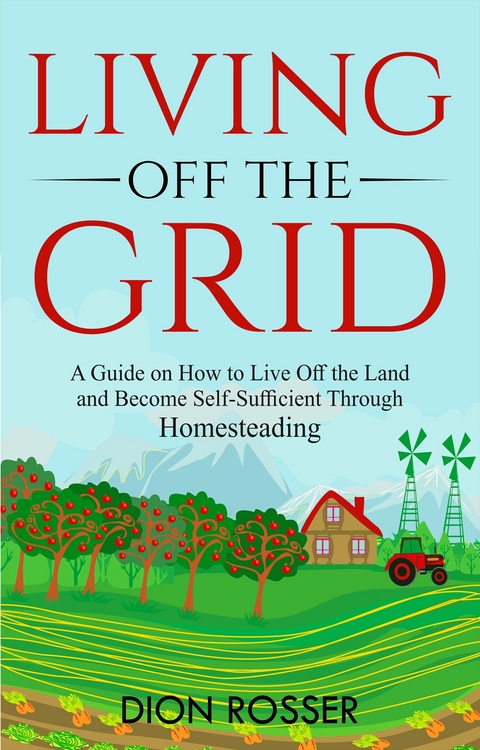
Living off The Grid (eBook)
115 Seiten
Dion Rosser (Verlag)
978-1-393-35676-9 (ISBN)
Dion Rosser is renowned for his enlightening publications centered around homesteading, self-sufficiency, and sustainable living. With a profound passion for the land and its resources, Dion delves into the intricacies of achieving harmony with nature through gardening, animal husbandry, and crafting a productive homestead. His deep-rooted love for cultivating vibrant gardens and raising diverse livestock extends far beyond mere hobbies; it truly embodies a way of life.
Dion Rosser is renowned for his enlightening publications centered around homesteading, self-sufficiency, and sustainable living. With a profound passion for the land and its resources, Dion delves into the intricacies of achieving harmony with nature through gardening, animal husbandry, and crafting a productive homestead. His deep-rooted love for cultivating vibrant gardens and raising diverse livestock extends far beyond mere hobbies; it truly embodies a way of life.
Are You Aware of the Challenges of Living Off the Grid?
Because let's be honest, as popular and appealing off-grid living is, it comes with its own sets of challenges and considerations. Know beforehand if this is something you're cut out for or not. Before jumping right into this lifestyle, let's consider a few of the challenges in detail.
An important statistic to consider here is that upwards of 200,000 Americans now live off-grid.
There's a steep learning curve to this way of living, but once you're past that curve, things will start to fall in rhythm.
- The Location
Location does not just pertain to people who live in the city. As someone working to live an off-grid life, you must consider that the land you pick is just about rural enough that there are no utilities available, such as electricity and gas. Now, second, consider the land that you need for your homestead. What are the essentials you need to sustain yourself? Are you planning on raising livestock? If so, you must get land that offers shelter, stores their food, and allows them to graze. You will also need a water source such as a well. Last, you’ll need space and land for your waste management, recycling system, and your garden.
There's also the issue that many municipalities don't allow you to dwell as an off-gridder, requiring that you hook your home up with the power grid. In certain cases (in a few cities), they'll allow you to go off-grid with the added caveat you supplement your power with alternatives and don't cut off completely. All this calls for buying land that's nowhere near a city or a municipality.
- The Power Source
The next important bit to consider is the power source. Yes, you can go into ye olde times by cutting yourself off completely and not relying on any power sources, but if you do decide to have a power source, it'll make your life a bit easier. The easiest route here is getting solar panels. It's a long-term investment with a decent ROI (return on investment). Another option is a generator. There are a dozen alternative sources at your disposal, and they all depend on what's your budget, what's your location, and how much power you need. For a starting point, check your electricity bill and see how much energy you are using. Now, plan accordingly.
Once you’ve set up your power, you will quickly realize that you are consuming more energy than needed. Consider this as a withdrawal symptom from your days living on the grid. Conserving energy will be beneficial here. Try running only one appliance at a time and do that when it’s daytime so you can get the most out of your power source if it is solar energy. Don’t rely all that much on your energy source, though. You are , going off-grid. Ease yourself in with alternative methods, such as using a stove to heat your food and home and using gas instead of an electric stove.
- The Food
As an off-gridder, you’ll be sourcing your food. This means growing everything you need to eat, raising cattle and livestock, and getting a garden established. The kitchen garden you establish in your homestead must expand gradually, as you will start producing more food than you need so you can sell it and generate income to supplement your lifestyle.
Possibly, the biggest issue you’ll face in terms of food is a balanced diet. You need to have variety in your food since it’s just impossible for everyone to raise livestock at the start of their homesteading. So, what do they rely on in the initial phase? Veggies. That’s right. You can produce vegetables in your garden.
Another challenge that you’ll be facing is cooking and preserving food. Both these skills are essential in homesteading and require diligence for the offseason in which your garden isn’t producing as much.
Many homesteaders go the hunting route. If you’re the sort who likes to hunt, this will be an excellent opportunity for you to hunt game, skin them using a tactical knife, butcher them, prepare them, eat them, and preserve them.
- Water Supply
You must have a water supply nearby. It should be a reliable water supply and one you can depend on when things go awry. Trust me, things can go awry fast when living on your own in a rural setting with nothing to rely on but yourself. Add to that the unavailability of water, and you’ll have a complex situation with no harvest, no cattle, and nothing to sustain you. Some lands are located near freshwater sources such as rivers, but they are rare to find.
Instead, bore a well and use a hand pump to draw the water out whenever needed.
Another important thing to consider when making the shift from your “normal” lifestyle to an off-grid lifestyle is that you shall miss running water. It’s a commodity that we take for granted, and when it’s not available to us, such as in the case of being off the grid, we’ll feel out of place. A workaround includes getting a generator so you have running water at hand, but one factor about generators is that you need to keep buying diesel for them. Is this something you see yourself doing, or would you rather save costs on fuel?
Last, you must keep the legal aspect of it all in mind. Are you allowed to use the water on the land that you've bought? Usually you can use the water in your property for your personal use with no issue, but, say, if you are using water for livestock and farming, keep in mind the laws of the municipality. Consult a lawyer beforehand, if necessary.
- Time Management
Think of living this way as having multiple jobs all simultaneously. From harvesting food to cleaning the outhouse, tasks are abundant at hand. You're going to have to manage your time expertly so that everything goes forward smoothly. There's no room for procrastination here. If you're sowing seeds, they should be sown in the correct season. If you have animals, you must feed them regularly and milk them on schedule. To protect your homestead, you must set up fences. To store your harvest and food, you must build shelters.
All that work will keep you more than occupied and on your toes. It gets tiring and gets jarring at times too, but overall, once you've picked up a rhythm, you’ll thank your past self for it. What's the secret to it all? Time management. You can keep a journal or a to-do list with you. If you still have a phone, you can store your schedule in that.
To find time to do all the above-mentioned stuff and more, you must become an early riser. Also plan out the next few months or a year for long-term projects. Besides keeping track of your time, also keep track of the weather patterns.
- Budget
Let's get one thing straight—this is not a cheaper option. That false image is the romanticized stuff fit for movies and books, where the protagonist moves out of the burbs and heads into the wilderness where he finds internal peace. The last part is not exaggerated. You'll get your fair share of internal peace, but it will come at a cost. There will be a slew of upfront investments that you must make to succeed. Also, you shall have to keep up with the present rates for livestock and their feed, and the cost of growing your crops.
The most important thing where a considerable amount of your budget will go is the power source. Setting it up will require you to make a huge investment in solar panels or generators. If we're realistic here, this will cost you tens of thousands of dollars, especially considering that you will have to set up between 15 to 30 solar panels to support the needs of your homestead.
If that sounds like too huge of investment, start with baby steps. First, grow your food and cooking it, then move on to reducing your carbon footprint, and then become more conscious of your power consumption. By taking these measures, you'll end up not only saving money for your new lifestyle but also get in the essential habits needed to survive.
- Isolation
Let's consider the hypothetical protagonist who found inner peace by heading off into the wilderness and cutting all ties with society. That's not always going to be the case. A lack of human interaction will serve as a challenge to you if you're a social and extroverted person. Yes, most homesteaders do start their new lifestyle to escape from the city and its hectic life, but it need not be a solo venture. Contact other like-minded people and form an off-grid community where you can go whenever you feel alone and isolated.
If there isn't a community nearby you don't fret. There are dozens of communities online where veteran off-gridders share their advice with newbies, and people share their tips, tricks and experiences. Consider joining them.
Are You Ready for an Off-Grid Lifestyle?
- Your Mindset
You should have a conservation mindset to pursue this lifestyle. In our regular homes, we become accustomed to a lifestyle of excess. Running water is available whenever we want it for washing, laundry, and taking baths. There's always electricity to rely on for our gadgets, for changing the temperature of our rooms, and for running practically everything ranging from stoves to garage doors. You and I pay our bills every month, never once considering where all our resources are going and where they come from.
There's a need for a radical shift in your mindset when you decide to go off-grid, especially in terms of resources because they are limited and deplete the more you rely...
| Erscheint lt. Verlag | 31.12.2020 |
|---|---|
| Verlagsort | Njurunda |
| Sprache | englisch |
| Themenwelt | Sachbuch/Ratgeber ► Natur / Technik ► Naturführer |
| Schlagworte | homesteading • Independent living • living off the grid • Living off the Land • Off-grid homestead • off-grid living • renewable resources • rural lifestyle • Self-Sufficiency • Sustainable living |
| ISBN-10 | 1-393-35676-1 / 1393356761 |
| ISBN-13 | 978-1-393-35676-9 / 9781393356769 |
| Informationen gemäß Produktsicherheitsverordnung (GPSR) | |
| Haben Sie eine Frage zum Produkt? |
 EPUB (Wasserzeichen)
DRM: Digitales Wasserzeichen
Dieses eBook enthält ein digitales Wasserzeichen und ist damit für Sie personalisiert. Bei einer missbräuchlichen Weitergabe des eBooks an Dritte ist eine Rückverfolgung an die Quelle möglich.
Dateiformat: EPUB (Electronic Publication)
EPUB ist ein offener Standard für eBooks und eignet sich besonders zur Darstellung von Belletristik und Sachbüchern. Der Fließtext wird dynamisch an die Display- und Schriftgröße angepasst. Auch für mobile Lesegeräte ist EPUB daher gut geeignet.
Systemvoraussetzungen:
PC/Mac: Mit einem PC oder Mac können Sie dieses eBook lesen. Sie benötigen dafür die kostenlose Software Adobe Digital Editions.
eReader: Dieses eBook kann mit (fast) allen eBook-Readern gelesen werden. Mit dem amazon-Kindle ist es aber nicht kompatibel.
Smartphone/Tablet: Egal ob Apple oder Android, dieses eBook können Sie lesen. Sie benötigen dafür eine kostenlose App.
Geräteliste und zusätzliche Hinweise
Buying eBooks from abroad
For tax law reasons we can sell eBooks just within Germany and Switzerland. Regrettably we cannot fulfill eBook-orders from other countries.
aus dem Bereich