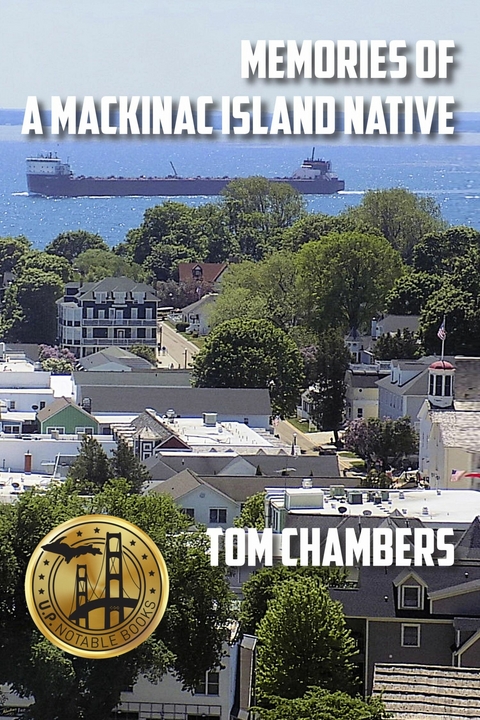
Memories of a Mackinac Island Native (eBook)
144 Seiten
Modern History Press (Verlag)
978-1-61599-833-3 (ISBN)
Join me on a trip to Mackinac Island's past, from the late 1940s to the present day. These are my memories of growing up on the Island, as well as some earthshaking changes that happened to affect everyone: the end of steamship visits, the building of the Mackinac Bridge, the increasing size and speed of passenger ferries, the introduction of new transportation (from 10-speeds to snowmobiles) and much more. On a more personal level, I'll share stories of how I earned my living on the Island, from house painting, cooking and bartending to delivering ferries from the factory. I'l also share my love for music and just plain having fun in rock-and-roll bands. This book includes many of my own photos that allow you to peek behind the curtains of the Jewel of the Great Lakes.
'Finally a book written about the Island, by a man who's lived here his whole life. A true, first-hand account of the history and nuances of Mackinac that cannot be found in any other tome. This is the first of what--I hope--becomes a collection.'
--Jason St. Onge, Mackinac native, fire chief, councilman and businessman.
'Tom Chambers' lifetime first-hand knowledge of Mackinac Island business history (especially ferries), local characters and fascinating Island lore make him a valued go-to resource for residents, as well as anyone interested in the Island. His deep family ties and experiences growing up and working on the Island always inform any discussion of Mackinac. I learn more about our beloved Island every time we speak.'
--Marta Olson, Mackinac Island author, Mintaka Designs.
'This is a true, born-and-raised Islander perspective. Teen years on a snowmobile (when no one knew what they were), beach parties with a guitar, bike relays with competitors that turned into friends. An avid photographer and lifelong collector of memorabilia and stories, Tom Chambers has catalogued life on Mackinac for the last 50 years and now has a story, or two, to tell.'
--Becki McIntire Barnwell, Islander and former co-owner of Hotel Iroquois.
From Modern History Press
Join me on a trip to Mackinac Island's past, from the late 1940s to the present day. These are my memories of growing up on the Island, as well as some earthshaking changes that happened to affect everyone: the end of steamship visits, the building of the Mackinac Bridge, the increasing size and speed of passenger ferries, the introduction of new transportation (from 10-speeds to snowmobiles) and much more. On a more personal level, I'll share stories of how I earned my living on the Island, from house painting, cooking and bartending to delivering ferries from the factory. I'l also share my love for music and just plain having fun in rock-and-roll bands. This book includes many of my own photos that allow you to peek behind the curtains of the Jewel of the Great Lakes. "e;Finally a book written about the Island, by a man who's lived here his whole life. A true, first-hand account of the history and nuances of Mackinac that cannot be found in any other tome. This is the first of what--I hope--becomes a collection."e; --Jason St. Onge, Mackinac native, fire chief, councilman and businessman. "e;Tom Chambers' lifetime first-hand knowledge of Mackinac Island business history (especially ferries), local characters and fascinating Island lore make him a valued go-to resource for residents, as well as anyone interested in the Island. His deep family ties and experiences growing up and working on the Island always inform any discussion of Mackinac. I learn more about our beloved Island every time we speak."e; --Marta Olson, Mackinac Island author, Mintaka Designs. "e;This is a true, born-and-raised Islander perspective. Teen years on a snowmobile (when no one knew what they were), beach parties with a guitar, bike relays with competitors that turned into friends. An avid photographer and lifelong collector of memorabilia and stories, Tom Chambers has catalogued life on Mackinac for the last 50 years and now has a story, or two, to tell."e; --Becki McIntire Barnwell, Islander and former co-owner of Hotel Iroquois. From Modern History Press
Mackinac of the 1940s and 1950s
For this memoir, I will not attempt to cover a detailed Mackinac Island history. Others have already done that, and better than I could. I will give just a bit of background on the decade I was born, and the one preceding it. Visitors always like to comment that Mackinac Island “looks the same” as it did in a previous time, but I notice changes every few years or even every year. Every few decades there is an earthshaking change that really alters the complexion of the Island.
One of the biggest differences was the means of getting to the Island. From about 1870 through the early 1950s, the primary way was via large steamship, originating at ports such as Detroit, Cleveland and Chicago. There were several major steamship lines, and over twenty vessels, which stopped at the Island, docking at the Arnold Dock and Coal Dock. Ships also had routes to Sault Ste Marie and Lake Superior, after the Soo Locks were built. The lines were Northern Steamship Co., Anchor Line, Lake Michigan & Lake Superior Transportation Co., Northern Michigan Transportation Co., Cleveland & Buffalo Transit Co., Great Lakes Transit, Detroit & Cleveland Navigation Co., (they had the most ships), Georgian Bay Transit, and a rare trip by Canada Steamship Lines.
My grandfather, Ed, visited during most summers in the 1950s, taking the SS North American from Chicago. The highway system was primitive in those days, as were cars. Before the Mackinac Bridge was built in the mid-1950s, the only way across the Straits of Mackinac way by large white State of Michigan car-ferries. Airlines didn’t really serve our area, but there were two Air Force bases in the Upper Peninsula. As highways got better, the era of the steamers went into a slow decline, in the late 1940s. Detroit & Cleveland Line’s massive “Greater Detroit” last called here in 1950.
From 1951 on, it was just the North and South Americans. The North’s last season was 1964, and the South’s, 1967. The big game-changer came in the late 1950s, when President Ike
City of Detroit III at Mackinac Island (1949) Photo by Tom Chambers’ mom
Eisenhower introduced the Interstate Highway system of modern 4-lane divided highways. Travel and tourism in our area benefited greatly by the north/south running “I-75.”
There were small high-speed ferries running to the Island then, but they were of natural mahogany instead of aluminum. Most of them docked at small wooden docks between the Coal Dock and Iroquois. These all slowly went out of business, the last one being the 48’ Fairy Isle, which moored at the Arnold Dock until the mid 1960s. Their legacy was carried on by William “Cap” Shepler with his 30’ and 36’ wooden speedboats, Miss Margy and Billy Dick. They docked at the Welch/Straits Transit dock on the east end of town.
Home heating was also much different in the 1940s and 1950s. Nobody had electric heat. There were oil stoves and oil furnaces, coal stoves and coal furnaces, fireplaces and wood stoves. It was always nice walking around town on a winter evening and smelling wood smoke coming out of the chimneys. If you had a central oil or coal furnace, usually in the basement, chances are the rooms of the house each contained a radiator, filled with hot water and having a valve at the bottom and a steam release nozzle at the top. I recall my great aunt Ann and uncle Tom had large Jungers oil stoves in two rooms. These were about the size of a refrigerator and had a small glass door where you could see a glowing orange burner. Drays would deliver oil for furnaces carried in a four-wheeled tank wagon. Oil was then pumped by hose to the furnace. It was similar to gassing up your car.
If you burned coal, drays also delivered that, from the Coal Dock. There were two heaping piles of coal on the dock, one hard coal (anthracite) and one soft coal (bituminous). Soft coal chunks were about the size of a softball and burned in open stoves. Hard coal was just smaller than a golf ball, and burned in a furnace. The coal was shoveled down a coal chute into the basement (these could be seen all over town). Somebody in the household then had the job of “stoking” the coal furnace, shoveling coal into it, as you would on a steamer type ship. Later, waste product, “clinkers” had to be removed from the furnace when it was cool. I remember having clinker duty at our big two-story house at British Landing, 1966-67.
Wood for your fireplace or kitchen wood stove could be delivered by drayload also. It was often pre-split and delivered in quantities called a cord, which was equal to 128 cubic feet cordwood. It was still possible to go out and cut your own wood, as in the very old days, either on Mackinac or Bois Blanc Island.
It goes without saying there were no air conditioners in town those days either. Even in the early 1970s they were rare. Now, in the 2020s, every summer employee has one.
There were a lot more trees on Market Street and in town. Green space was more abundant too, even into the 1960s. In addition to the small park behind the Carriage Tours booth, there was one at the head of the Arnold Dock, between the Chuck Wagon and McNally’s, and west of the liquor store, all the way to Iroquois.
The types of shops along Main Street have changed over time. Around the turn of the century, there were a half dozen rug merchant establishments. In the early 20th Century, you could find a dentist’s office and three drug stores: Bogan’s, Bailey’s, and Central Drug Store. Some of them, especially Central, included a “fountain” counter, with seats for customers to get beverages. The type of gift shops has changed over time also. I feel in general there were more quality shops when I was growing up, than there are now.
I often patronized Bill Cooper’s Balsam shop to buy fancy toy soldiers, and his wife Doris’ Copper’s Perfume Shop, which was much more than perfume. She also carried a variety of turquoise jewelry. Maria Moeller’s Imports shop was also excellent. When the Doud family bought it and renamed it Windermere Imports, it carried on the tradition. There were a few shops in town that carried the famous Hummel figurines. I remember Frank Shama’s did. Clarice McKeever
Main Street slide winter 1959-60. Photo by Jack Chambers
Haynes had a nice art studio. At least there is still an art gallery today, the Little Gallery on Market Street.
In the early 1900s, merchants from all over the world found their way to Mackinac. In the 1950s and 60s there were a few ethnic restaurants along Main Street. Harry Stamas had a Greek Restaurant, and Sam Brocato had an Italian one, with a dancing marionette in the window. My favorite was Iggy and Catherine Palermo’s “Chatterbox” restaurant, located where the Lilac Tree courtyard is now. It featured homemade Italian bread and Spaghetti dinners. My family also patronized Wandrie’s Restaurant in late 1959 and early 1960s. My godfather and family friend, Dennis Brodeur, was running it. The chicken dinners were spectacular. Little Bob’s on Astor Street was also popular, with Islanders and tourists alike. It was known for the giant cinnamon roll.
Some other restaurants I remember, the Buggy Whip and the Carriage Lantern, went out of business. I also recall the Arab and Jewish merchants along Main Street, Edward and May Sultan of Edward’s Gifts, and Roben Arbib, who had The Thunderbird at the head of the Arnold Dock. Tom Shamy had a linen shop for many years in the current Mighty Mac location. There were far less fudge shops in the old days, too, and two shops from the 1960s even were bought out and renamed, these being Mary’s Fudge owned by Florian Czarnecki and Suzanne’s Fudge owned by Mary and Ray Summerfield. Frank Nephew acquired them both, and they are now Joann’s Fudge. Nowadays, Main Street is dominated by Sweatshirt and Tee-shirt shops, and of course fudge. Somewhere along the line the term “Junk Shop” came into being. It referred to the newer, low-end gift and souvenir shops.
Some quality clothing stores in the 1950s went out of business. “The Scotch House” in the Murray Hotel building featured wool and plaid Pendleton clothing. It was run by Joe and Letty Abbey. “Neary’s” was located where the Pancake House is now, and it had quality apparel. The family had a house on the East Bluff, and would winter in Arizona. Before Neary’s the whole two-shop Dennany building was Herpolsheimer’s Department Store, in the 1940s. I also remember “Angel’s” clothing store in the Chippewa Hotel building. It was run by mustachioed Freddie Ashton, who always sported an ascot.
Boat docks along the waterfront were everchanging as well. In the old days, the big Arnold/Star Line dock was called Hoban’s wharf. The Coal Dock was (James) Bennett’s wharf, and for many years it had a large steam crane on it. There was also a third large dock, just east of the Arnold Dock, called the Government Dock. It was quite active in the 1870s, but late in the 1800s it was torn down. Some piling stumps remained for several years.
In the 1930s and 40s, there were several small wooden docks between the Coal Dock and Iroquois Hotel for the high-speed ferries, in the age of the small mahogany cruisers. They included the Couchois Dock, Bird’s Dock, and others. They were all discontinued at the end of the 1940s, and that area was empty beach for twenty years. Shepler’s started building their “new” dock in 1966, and Harry Ryba built a dock across from the Lake View in 1967-68. There was a medium-sized dock behind Bennett Hall until around 1950. The dock behind Bay View Cottage went through many names in 120 years. The first version was called the Bailey dock,...
| Erscheint lt. Verlag | 1.8.2024 |
|---|---|
| Sprache | englisch |
| Themenwelt | Literatur ► Biografien / Erfahrungsberichte |
| Literatur ► Romane / Erzählungen | |
| Sachbuch/Ratgeber ► Geschichte / Politik ► Regional- / Landesgeschichte | |
| Natur / Technik ► Fahrzeuge / Flugzeuge / Schiffe ► Schiffe | |
| Reisen ► Reiseführer | |
| Geisteswissenschaften ► Geschichte ► Regional- / Ländergeschichte | |
| Geschichte ► Teilgebiete der Geschichte ► Technikgeschichte | |
| Schlagworte | East north central • History • Ia • IL • In • KS • Local • mi • Midwest • MN • Mo • Nd • Ne • Oh • SD • Shipbuilding • Ships • State • Transportation • Travel • United States • WI |
| ISBN-10 | 1-61599-833-0 / 1615998330 |
| ISBN-13 | 978-1-61599-833-3 / 9781615998333 |
| Informationen gemäß Produktsicherheitsverordnung (GPSR) | |
| Haben Sie eine Frage zum Produkt? |
 EPUB (Ohne DRM)
Digital Rights Management: ohne DRM
Dieses eBook enthält kein DRM oder Kopierschutz. Eine Weitergabe an Dritte ist jedoch rechtlich nicht zulässig, weil Sie beim Kauf nur die Rechte an der persönlichen Nutzung erwerben.
Dateiformat: EPUB (Electronic Publication)
EPUB ist ein offener Standard für eBooks und eignet sich besonders zur Darstellung von Belletristik und Sachbüchern. Der Fließtext wird dynamisch an die Display- und Schriftgröße angepasst. Auch für mobile Lesegeräte ist EPUB daher gut geeignet.
Systemvoraussetzungen:
PC/Mac: Mit einem PC oder Mac können Sie dieses eBook lesen. Sie benötigen dafür die kostenlose Software Adobe Digital Editions.
eReader: Dieses eBook kann mit (fast) allen eBook-Readern gelesen werden. Mit dem amazon-Kindle ist es aber nicht kompatibel.
Smartphone/Tablet: Egal ob Apple oder Android, dieses eBook können Sie lesen. Sie benötigen dafür eine kostenlose App.
Geräteliste und zusätzliche Hinweise
Buying eBooks from abroad
For tax law reasons we can sell eBooks just within Germany and Switzerland. Regrettably we cannot fulfill eBook-orders from other countries.
aus dem Bereich