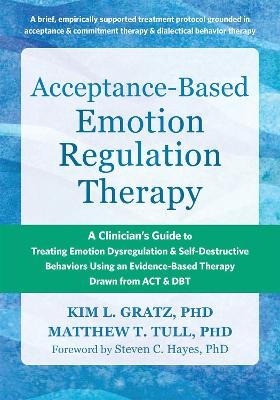
Acceptance-Based Emotion Regulation Therapy
New Harbinger Publications (Verlag)
978-1-64848-362-2 (ISBN)
Efficiently target all dimensions of your clients' emotion dysregulation for improved treatment outcomes.
There is extensive evidence highlighting the role of emotion dysregulation in numerous forms of psychopathology and maladaptive behaviors including depression, anxiety, PTSD, personality disorders, self-injury, disordered eating behaviors, and substance use, among others. Originally developed for treating self-injury among women with borderline personality disorder, research shows that acceptance-based emotion regulation therapy is powerfully effective in treating emotion dysregulation and related psychiatric symptoms and self-destructive behaviors in a wide range of clients.
Acceptance-Based Emotion Regulation Therapy offers an empirically supported protocol that addresses all key dimensions of emotion regulation using evidence-based strategies drawn from dialectical behavior therapy (DBT), acceptance and commitment therapy (ACT), and emotion-focused therapy (EFT), as well as basic behavioral principles-resulting in a treatment that is more targeted and far briefer than comprehensive DBT. After providing an overview of the conceptual and empirical underpinnings of this therapy, as well as the therapeutic stance underlying this treatment, this step-by-step guide will walk you through each of the fourteen sessions of this therapy, reviewing key concepts and specific strategies for teaching clients key emotion regulation skills.
Each chapter includes handouts and outside-of-session practice exercises and monitoring forms to help clients practice the skills and integrate them into their lives. Chapters also include discussion of common sticking points or challenges that can arise when teaching clients these skills, as well as tips for addressing these in an effective, treatment consistent manner. You'll also learn strategies for helping clients maintain treatment gains and prevent relapse. With this comprehensive protocol, you'll be fully equipped to treat psychiatric symptoms stemming from emotion dysregulation, self-destructive behaviors serving an emotion-regulating function, and emotion dysregulation more broadly.
If you've been searching for an emotion regulation therapy that efficiently and effectively targets all the core dimensions of emotion dysregulation driving your clients' symptoms and clinical difficulties, this comprehensive guide has everything you need to help your clients improve their emotion regulation, maintain treatment gains, prevent relapse, and build meaningful lives.
Kim L. Gratz, PhD, is a senior clinical quality manager and clinical lead of the dialectical behavior therapy (DBT) program at Lyra Health. She also holds an appointment in the department of psychology at the University of Toledo, where she previously served as professor and chair. She has received multiple awards for her research on personality disorders and self-injury, and has authored more than 250 peer-reviewed publications and eight books on borderline personality disorder (BPD), self-injury, and DBT. Matthew T. Tull, PhD, is a clinical quality supervisor at Lyra Health, and he also holds an appointment in the department of psychology at the University of Toledo. Tull's research and clinical work emphasize the role of emotion regulation in anxiety disorders, trauma and stressor-related disorders, and high-risk behaviors such as substance use, self-injury, and suicide. His work has been recognized through awards from the Association for Behavioral and Cognitive Therapies and the International Society for Traumatic Stress Studies.
| Erscheinungsdatum | 16.05.2025 |
|---|---|
| Verlagsort | Oakland, CA |
| Sprache | englisch |
| Maße | 176 x 252 mm |
| Gewicht | 460 g |
| Themenwelt | Sachbuch/Ratgeber ► Gesundheit / Leben / Psychologie ► Alternative Heilverfahren |
| Sachbuch/Ratgeber ► Gesundheit / Leben / Psychologie ► Krankheiten / Heilverfahren | |
| Geisteswissenschaften ► Psychologie ► Klinische Psychologie | |
| Geisteswissenschaften ► Psychologie ► Persönlichkeitsstörungen | |
| ISBN-10 | 1-64848-362-3 / 1648483623 |
| ISBN-13 | 978-1-64848-362-2 / 9781648483622 |
| Zustand | Neuware |
| Informationen gemäß Produktsicherheitsverordnung (GPSR) | |
| Haben Sie eine Frage zum Produkt? |
aus dem Bereich