


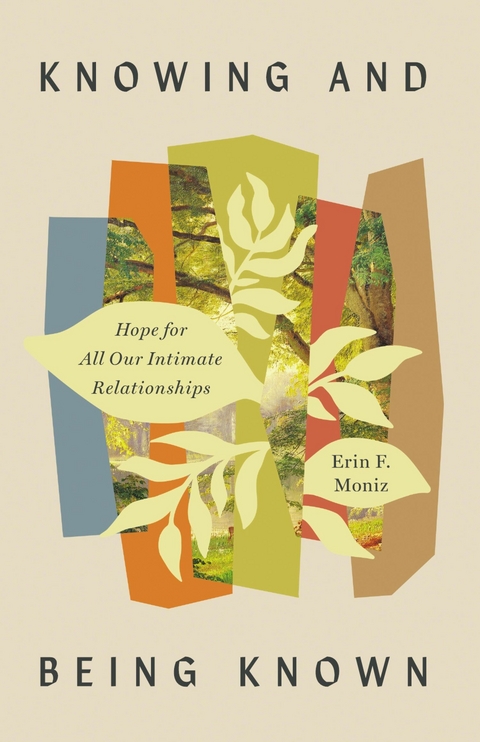
Knowing and Being Known (eBook)
240 Seiten
IVP (Verlag)
978-1-5140-1004-4 (ISBN)
Rev. Erin F. Moniz (DMin, Trinity School for Ministry) is a deacon in the Anglican Church in North America and associate chaplain and director for chapel at Baylor University, where she disciples emerging adults and journeys with them toward healthy, gospel-centered relationships. She is a trained conciliator, mediator, and conflict coach. She enjoys content creation, playing music, being outdoors, and narrating the inner monologue of her two cats. She lives in Waco, Texas, with her husband, Michael.
Rev. Erin F. Moniz (DMin, Trinity School for Ministry) is a deacon in the Anglican Church in North America and associate chaplain and director for chapel at Baylor University, where she disciples emerging adults and journeys with them toward healthy, gospel-centered relationships. She is a trained conciliator, mediator, and conflict coach. She enjoys content creation, playing music, being outdoors, and narrating the inner monologue of her two cats. She lives in Waco, Texas, with her husband, Michael.
2
How the Western World
Co-opted Our Identities
Their destiny is destruction, their god is their stomach, and their glory is in their shame. Their mind is set on earthly things.
By attaching autonomy, perhaps America’s most valued virtue, to sexual activity, secular America has marked sexual activity not only as a sign of true adulthood but, more importantly, as the sign of true humanity.
I grew up loving the outdoors. When I was young we would go camping—my parents taught me everything I needed to know. We would go hiking in beautiful but rugged terrain. I was taught how to read maps and use a compass. My parents showed me that I must always be wary of any artificial magnetic fields that might mess with the orientation of the compass. They showed me how the needle is designed to always find the earth’s natural magnetic field and point to magnetic north.
Similarly, as we navigate the landscape of our intimate relationships with our proverbial maps and compasses, we must be aware of the forces at work all around us that attempt to guide and form us. Everyone lives in constant contact with influences from within and without. Everything from our family, ethnicity, geography, technology, education, and media consumption contributes to who we are and how we construct our worldview. These forces often shape us without us even realizing. For our purposes, I’ll use two categories that contain a variety of worldview-shaping forces. One category is traditional Christian formation. I will define and examine this more thoroughly in chapter three.
The other category captures the influence of non-faith-based, secular variables. Christians exist alongside people, messages, and industries that do not share their faith. Regardless of one’s convictions, the saturation of these influences cannot be taken for granted. We still absorb all kinds of ideas from influences outside of our faith. The more we are aware of them, the better we can navigate them and reflect on our own acquiescence. While not an exhaustive list, I point out key narratives and liturgies from outside the faith that contribute to one’s worldview of intimate relationships. I refer to this myriad of influences simply as: the cultural milieu.
Many of us hold a syncretized philosophy of intimacy that fuses our faith and the culture together. There are some distinct reasons why this is so common. I learned in my research that many emerging adults felt like they were working with an incomplete theology of intimacy. Deeply felt gaps existed in what they had learned about intimacy from their faith contexts. As we dug deeper, it was apparent that there was a direct link between the need to fill these gaps and the infusion of cultural values and ideas. Another observation for why this happens is that it just, well, happens. No one should take for granted the power of these forces. We are all surrounded by cultural influences, and we can be as passive as rocks in a stream to the subtle but significant ways the water is shaping us over time. A third and important reason why this syncretism happens is that even our traditional, Christian formation is formed and informed by cultural influences instead of biblical ones.
Just like a magnetic bracelet that will throw off the calibration of my compass, these forces can lead us astray by creating a false magnetic north.
An Evolution of Values
The Western world is built on values of individualization and personal freedom. Patriotism and national pride often contain these ideals. They are certainly fundamental to the founding of the United States, but harken back to streams of Western philosophy that have been flowing for centuries. Acknowledging that every cultural environment will influence us in ways we may not detect, my main critique is of the larger, general influences produced and broadcast in modern North America. A quick inventory of these values would include individual agency, personal and civic responsibility, and personal freedoms to pursue life, liberty, and happiness.
But these values are not static—they have evolved over time. The offshoots of individualization, freedom, and responsibility are autonomy, entitlement, and productivity. Why and how these values are exhibited in North American culture is key to knowing how they might be recalibrating our compasses. Each of these offshoots contains significant threats to one’s desire for healthy, sustainable, intimate relationships.
In recent times, scholars have noticed that “responsibility for oneself” is singularly focused on a new standard, which is “more psychological than sociological” and points “less to an ability to take responsibility for others . . . than to growing a sense of autonomy” and entitlement.1 Instead of leveraging our freedom for community wealth and health, the fruits of progress have made us entitled, and this shows up in our approach to relationships.
In the wake of the book and film Eat, Pray, Love, there was a debate about whether leaving an unhappy marriage to go on a spiritual journey is self-care or just selfish.2 Elizabeth Gilbert was certainly not the first to raise this question, but her media content, both personal and fictitious, certainly sparked a debate. So long as I am following my bliss and remaining true to my heart, is it okay if I use this as justification for poor decisions that may hurt people? How far can self-efficacy and self-reliance be stretched, despite how it might negatively affect others?
A sense of entitlement is a cultural value anyone can claim, often without even thinking about it. Mixed with the ideal of autonomy, I can turn my entitlement into reasons for breaking my commitment because I feel entitled to seek my own desires regardless of who it may affect. Alternately, I may break a commitment so I can sequester myself with my significant other or my family because I feel an entitlement to my time and energy. So I will abandon friendships or other connections outside of my boyfriend/girlfriend, spouse, or children. These people become my world in an unhealthy way when I convince myself that their companionship is paramount to my happiness and they are the worthiest recipients of my precious time and effort.
But entitlement does not often act out on its own. The lost value of responsibility is coupled with a rise in autonomy. Freedom is a wonderful thing, but when it morphs into autonomy our unlimited agency becomes central to our lives. It is the kind of force that can falsely recalibrate our compasses. And the signs of this are everywhere.
My parents told me about a wedding they attended recently. The couple had already been cohabitating for some time and neither of them were particularly religious. The friend officiating the ceremony was using a service he found and printed off the internet. It began with the usual “Do you take this man/woman . . . I do,” but when he moved to the vows, the couple stopped him in the middle of the ceremony.
“We aren’t doing any vows,” they said.
The puzzled officiant pivoted, “Oh, you mean you wrote your own vows?”
“No,” the couple replied, “We just aren’t doing any vows. You can skip to the ring exchange.”
Friends, I have been to some crazy weddings. But never have I seen a wedding with no vows! It boggles my mind to think that a couple can rationalize this: “Oh, we definitely want to be married to each other! But just to be clear, we commit to nothing.”
The value of autonomy and desire for intimacy pull us in opposite directions. On the one hand, there is a desire for affection and connection. On the other hand, there is a desire to have connection with the least amount of risk or commitment. The cultural value of autonomy has sold a narrative that reads like this: the less encumbered, less accountable I am, the better I am. It is here that I can be my truest self and secure my happiness. As one scholar observes, “The free individual . . . works to be connected with others only through voluntary contracts that secure his interests in order that truth, love, or duty don’t cause him to surrender his own judgment.”3 We eat, pray, love our way to find our least entangled but most true and happy self. We are intent on figuring out how to have both full autonomy and intimate relationships in our own lives.
But what about productivity? This value is good, right? I want to make sure we do not confuse the beauty of vocation with the cultural value of productivity. Cultural scholars and thought leaders such as Peter Lawler and Wendell Berry have written at length about the dichotomy of value and human dignity in a transactional system. Under the threat of becoming part of an exploited group, the true measure of success and worth is given to those who can escape victimization by becoming powerful. Those who can achieve this standard of value are often described as “producers” or “exploiters.” This identity is juxtaposed against its antithesis: the caregiver, nurturer, or cultivator. The producer/exploiters have value, but the nurturers do not because what they do well cannot be measured or commodified. Their goals are antithetical to each other. One seeks efficiency, profits, and monetization. The other seeks care and health. While I may...
| Erscheint lt. Verlag | 6.5.2025 |
|---|---|
| Verlagsort | Lisle |
| Sprache | englisch |
| Themenwelt | Sachbuch/Ratgeber ► Gesundheit / Leben / Psychologie ► Familie / Erziehung |
| Religion / Theologie ► Christentum ► Moraltheologie / Sozialethik | |
| Schlagworte | build • Christ • Christian • Church • Community • Connection • Dating • datingreimagine • Deep • Desire • digital • Family • fear • Framework • Friendship • God • Gospel • Grace • grow • Healthy • Identity • intimacy • Meaningful • Online • reimagine • self-worth • Sex • Shallow • Shame • Sin • Single • Singleness • surface level |
| ISBN-10 | 1-5140-1004-6 / 1514010046 |
| ISBN-13 | 978-1-5140-1004-4 / 9781514010044 |
| Informationen gemäß Produktsicherheitsverordnung (GPSR) | |
| Haben Sie eine Frage zum Produkt? |
 EPUB (Wasserzeichen)
DRM: Digitales Wasserzeichen
Dieses eBook enthält ein digitales Wasserzeichen und ist damit für Sie personalisiert. Bei einer missbräuchlichen Weitergabe des eBooks an Dritte ist eine Rückverfolgung an die Quelle möglich.
Dateiformat: EPUB (Electronic Publication)
EPUB ist ein offener Standard für eBooks und eignet sich besonders zur Darstellung von Belletristik und Sachbüchern. Der Fließtext wird dynamisch an die Display- und Schriftgröße angepasst. Auch für mobile Lesegeräte ist EPUB daher gut geeignet.
Systemvoraussetzungen:
PC/Mac: Mit einem PC oder Mac können Sie dieses eBook lesen. Sie benötigen dafür die kostenlose Software Adobe Digital Editions.
eReader: Dieses eBook kann mit (fast) allen eBook-Readern gelesen werden. Mit dem amazon-Kindle ist es aber nicht kompatibel.
Smartphone/Tablet: Egal ob Apple oder Android, dieses eBook können Sie lesen. Sie benötigen dafür eine kostenlose App.
Geräteliste und zusätzliche Hinweise
Buying eBooks from abroad
For tax law reasons we can sell eBooks just within Germany and Switzerland. Regrettably we cannot fulfill eBook-orders from other countries.
aus dem Bereich


