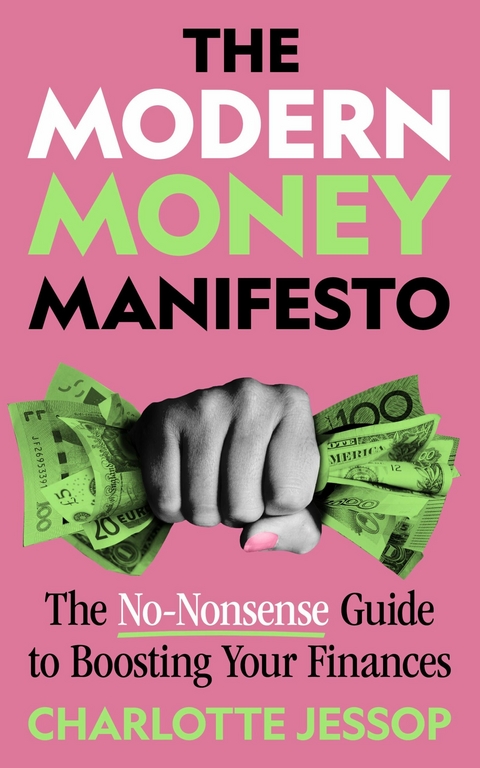
Modern Money Manifesto (eBook)
210 Seiten
Bedford Square Publishers (Verlag)
978-1-83501-064-8 (ISBN)
Charlotte Jessop is a maths teacher who has established a successful career as a financial educator. She has been invited to speak on BBC News, Sky News, BBC radio, and ITV, and her writing has appeared in the Financial Times, Sun, Metro, Telegraph, and i paper.
Written for Millennials and Gen Z readers looking to change their attitude toward money management, The Modern Money Manifesto is a savvy and no-nonsense guide to navigating every step of financial life. Charlotte Jessop combines practical experience as both a maths teacher and the creator of successful multimedia business, Looking After Your Pennies, to bring an exciting new voice in the personal finance industry. From buying property to figuring out working from home, The Modern Money Manifesto is an empowering toolkit for discovering money management options and taking control of your finances in an ever changing economic environment.
Charlotte Jessop is a maths teacher who has established a successful career as a financial educator. She has been invited to speak on BBC News, Sky News, BBC radio, and ITV, and her writing has appeared in the Financial Times, Sun, Metro, Telegraph, and i paper.
Money Then and Now
Sometimes I feel like I wasted my twenties. It wasn’t that I didn’t have fun or achieve great things, it’s just that when I look back that time of my life doesn’t feel very me.
My experience is typical of my generation. In fact, I probably had the textbook definition of a good upbringing, and it screams privilege from many directions. I was raised by boomers with public sector jobs. We had a nice house, I went to a nice school, I had nice friends and was blessed with a brain that would enable me to be whatever I wanted to be when I grew up.
In fact ‘you could be whatever you wanted to be’ was pretty much repeated daily in my house. I believed it to an extent. Going to an all-girls’ school also lit a fire in my heart that told me that I, a woman, had a duty to break through glass ceilings and pave a better future for the women who came after us.
So how on Earth did I end up a teacher, married with two kids and a three-bed end-of-terrace house in the middle of Norfolk before I’d even hit 30?
That was not what I had pictured for myself.
Granted, I’d always wanted a family and a partner that cared for me, but there was supposed to be an exciting career, travel and adventure.
What happened was I had fallen into the boomer financial advice trap.
You might be familiar with it; it goes like this:
• Work hard at school
• Get a good job
• Save
• Buy a house
• Buy a bigger house
• Retire in your early sixties with a final salary pension and, if you’ve worked really hard, a second home in Gran Canaria.
It is easy to see why I was seduced by this plan. It is simple and I was watching my parents execute this strategy with great success. I mean, it worked for them, so why wouldn’t it work for me?
Well, it didn’t. And it wasn’t my fault.
For nearly three decades, I subscribed to the idea that this would work out for me. I left school with good GCSEs and A levels, went to university to study mathematics, and hoped to go on to be either an actuary or a civil engineer.
At this point, I felt kinda burnt out and, coupled with the recession that hit in 2008–09, my dreams of high-flying careers were diminishing. Desperate to salvage some of the Boomer Dream, I decided to go into teaching.
Not only did my love of numbers ooze into my teaching, but I found that I had a way with words. Explaining complicated topics in an easily digestible way came easily to me. Furthermore, I was full of ambition. Determined to make the most of the career that I had stumbled into, I applied for more and more responsibility and enjoyed the increased pay that came with it.
At this point, I had saved up for my first house with my soon-to-be husband using a combination of the money I had saved from working my butt off during university and a small golden hello that I received when I entered the teaching profession.
Sticking to the rules, I got married and then decided to have a couple of kids. This was probably the straw that broke the camel’s back.
When I turned 30, I realised that my life wasn’t like that of my parents. My dad worked full-time and my mum did some part-time work, but was mostly at home. For us though? Well, both my husband and I would need to work to pay the mortgage and bills. On top of that, we would have to work to pay for childcare or find some intricate system where we worked alternative shifts so that we could avoid childcare but also each other.
But this was survival. That’s all that was available to us.
I didn’t want to survive. I wanted to thrive.
For the first time, I took a long hard look at the Boomer Dream, and found that there was no way that it could work for me. Plus, I didn’t even want it to work. I didn’t want that at all. What I wanted was a career that I loved, time with my family, lots of travel, and to feel the joys of financial stability both in retirement and now. Also, I wanted to work a little less hard. Smarter? Sure. Occasionally hard? Yeah maybe. But with lots of time for rest and relaxation? Hells yes!
I know that I am not the only one who feels like this. I see this same exhaustion in the eyes of the other parents on the school run, in the group WhatsApp chats with my friends, and, sadly, I saw it in the faces of my students. They hadn’t even started work but were already tired from the pressure to succeed and conform. To fulfil a destiny that wasn’t designed for them.
I know you feel it too.
Enter the Modern Money Manifesto.
In the blur of sleepless nights while on maternity leave with my youngest, I desperately searched for a different way to live my life. For a set of rules that would work for me, like how the rules my parents had lived by had worked for them.
The realisation soon set in that there were no rules. The expectation was that I would live my life by those same rules, but experience worse outcomes and be miserable for most of my life. Plus, if I dared to complain that I didn’t like the rules or that I wasn’t able to do it any more, I would be met with an army of boomer headlines telling me that avocados were my problem. Eh? I don’t even like avocados.
I needed a new set of rules. But I was going to have to make them myself.
Over the next year or so, I changed my life.
In letting go of the traditional life path, I allowed new rules to show themselves to me. I let them in and magic happened.
This is what went down:
• I started working part-time. My husband did too. Despite a significant reduction in hours, we had more disposable income than if we had both continued to work.
• I paid off chunks of my mortgage. Using some of our savings and surplus cash, we managed to halve our monthly mortgage payments.
• I started a business. With some of the additional free time I had from working part-time, I started a blog. This allowed me to develop skills that would take me away from my teaching job and to create additional income, and eventually a way for my family to escape the constraints of the nine-to-five.
• I took my family on a trip around the world. With our newfound freedom, income, time, and some deep reflection on our life goals, we said goodbye to our jobs and our house and spent seven months hopping from country to country.
The best part was that I didn’t have to compromise. It doesn’t need to be a choice between travel or starting a family. Buying a house or paying into a pension. I was able to find a way to do it all.
Now if you are rolling your eyes and thinking, ‘Sure I could do all that if I had money too,’ well, I am here to tell you that I am probably not as rich as you think. I’m certainly not a millionaire and, at the time of writing, I’ve not even got close to earning six figures. (Although I believe that both of these will come in time.) My husband isn’t the source of my money either. He will happily tell you that I am the money-maker and I have out-earned him my entire life.
Yes, I benefit from some privileges. I am white and I am well educated. I also come from a family that has financial security. Like I said, they have achieved the ultimate boomer goals, by working hard, saving and buying increasingly bigger properties. But I’ll confess that I grew up without worrying about money too much.
Working against me is my womanhood, a hearing loss that means I wear hearing aids, and the fact that somehow I have ended up living in Norfolk which is hardly a hub for career opportunities.
My point is that I’m not some trust fund baby. I am just a person with a fascination with money and dreams above her station and I found a way to make it work. Better still, I found a way to make it work for you too.
Why Should I Trust You?
Fair question! We don’t know each other.
You might be one of the people who follow me on Instagram, TikTok, or YouTube, in which case, ‘Hello old friend.’ But if you’ve randomly picked up this book, then you might not know who I am or have seen one of my many post-run, make-up-down-my-face Instagram story binges where I put the world to rights on the financial issue of the day.
For you, I will start at the beginning.
I am a nerd. I’ve loved maths for as long as I can remember. I came pretty much top of my year group every year throughout high school, which is no mean feat in a grammar school surrounded by other super-intelligent girls. At fourteen, I decided I loved money too and opted to study an economics GCSE, which I followed with an A level. Ultimate nerd move. I continued to study mathematics because I wasn’t convinced whether a career in finance or engineering was for me. To procrastinate on this decision further, I opted to study mathematics at university.
2008 landed with a bang halfway through my studies. The credit crunch and global recession saw graduate banking and finance jobs disappear almost overnight. My post-university options were narrowing and my mum told me that becoming a teacher would be a smart move. Seemingly incapable of making my own decisions, I did what she said and completed a PGCE. What followed was a ten-year career as a...
| Erscheint lt. Verlag | 19.12.2024 |
|---|---|
| Verlagsort | London |
| Sprache | englisch |
| Themenwelt | Sachbuch/Ratgeber ► Beruf / Finanzen / Recht / Wirtschaft ► Geld / Bank / Börse |
| Mathematik / Informatik ► Informatik ► Netzwerke | |
| Wirtschaft ► Betriebswirtschaft / Management | |
| Wirtschaft ► Volkswirtschaftslehre | |
| Schlagworte | Economics • Investments • Money Management • Personal finances |
| ISBN-10 | 1-83501-064-4 / 1835010644 |
| ISBN-13 | 978-1-83501-064-8 / 9781835010648 |
| Informationen gemäß Produktsicherheitsverordnung (GPSR) | |
| Haben Sie eine Frage zum Produkt? |
 EPUB (Adobe DRM)
Kopierschutz: Adobe-DRM
Adobe-DRM ist ein Kopierschutz, der das eBook vor Mißbrauch schützen soll. Dabei wird das eBook bereits beim Download auf Ihre persönliche Adobe-ID autorisiert. Lesen können Sie das eBook dann nur auf den Geräten, welche ebenfalls auf Ihre Adobe-ID registriert sind.
Details zum Adobe-DRM
Dateiformat: EPUB (Electronic Publication)
EPUB ist ein offener Standard für eBooks und eignet sich besonders zur Darstellung von Belletristik und Sachbüchern. Der Fließtext wird dynamisch an die Display- und Schriftgröße angepasst. Auch für mobile Lesegeräte ist EPUB daher gut geeignet.
Systemvoraussetzungen:
PC/Mac: Mit einem PC oder Mac können Sie dieses eBook lesen. Sie benötigen eine
eReader: Dieses eBook kann mit (fast) allen eBook-Readern gelesen werden. Mit dem amazon-Kindle ist es aber nicht kompatibel.
Smartphone/Tablet: Egal ob Apple oder Android, dieses eBook können Sie lesen. Sie benötigen eine
Geräteliste und zusätzliche Hinweise
Buying eBooks from abroad
For tax law reasons we can sell eBooks just within Germany and Switzerland. Regrettably we cannot fulfill eBook-orders from other countries.
aus dem Bereich