


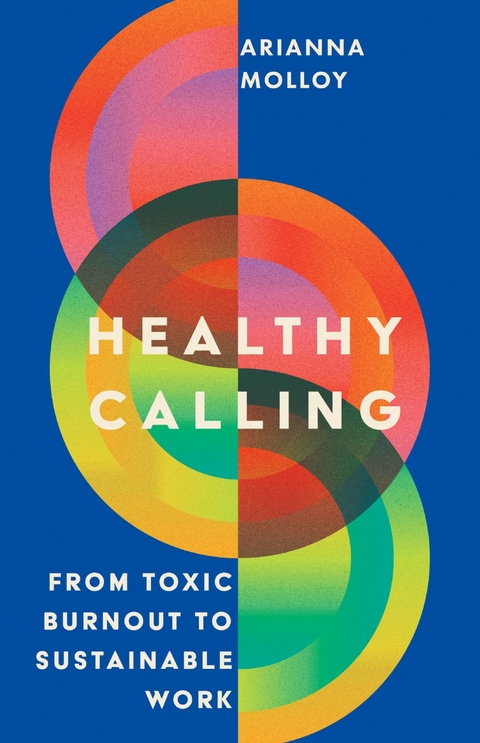
Healthy Calling (eBook)
192 Seiten
IVP (Verlag)
978-1-5140-0841-6 (ISBN)

Arianna Molloy (PhD, University of Denver) is associate professor of organizational communication at Biola University. Her research focuses on meaningful work, work as a calling, and the connection between humility and burnout in the workplace. She is an award-winning scholar and educator who has published in the International Journal of Business Communication, Communication Studies, and Christianity Today. Arianna is also a consultant for organizations, business professionals, and ministries. Arianna and her husband, Allen, have one son and enjoy running half marathons, traveling the world, and drinking good coffee.
Arianna Molloy (PhD, University of Denver) is associate professor of organizational communication at Biola University. Her research focuses on meaningful work, work as a calling, and the connection between humility and burnout in the workplace. She is an award-winning scholar and educator who has published in the International Journal of Business Communication, Communication Studies, and Christianity Today. Arianna is also a consultant for organizations, business professionals, and ministries. Arianna and her husband, Allen, have one son and enjoy running half marathons, traveling the world, and drinking good coffee.
THE PATH TO BURNOUT AND WHY IT MATTERS
Burnout starts with deception.
My dad is one of the wisest, most humble people I know, and he often describes deception as being most powerful in the non-obvious. Think of it this way: deception is like lounging on an inner tube in the water on a sleepy, summertime day. You close your eyes and gently drift along. Then suddenly, you open your eyes and realize you’ve drifted so far away from the shore that you don’t know how to get back.
I know this firsthand.
It was the third year into my job as a full-time professor when I woke up in the middle of the night sweat-soaked, my heart beating like I’d been running instead of sleeping, with my mind alert like it was the middle of the day. This was not the first night such an experience occurred. It was starting to become a pattern.
On this particular night, I began thinking about my recent behavior and interactions: as a communication professor I am trained to focus on what we do and say, and what that means. I mentally checked off the past several weeks, hoping to uncover some reason for this assault on my sleep. Lately, when I’d arrive at work, I would linger in my car longer than normal, mindlessly scrolling social media, photos on my phone, my calendar, or even the Google search bar. Have you ever done that? I just didn’t want to get out of the car. I needed every extra minute I could squeeze out. For what? I didn’t know.
One afternoon, I was so zoned out that I didn’t even notice my friend Sarah coming to knock on the car window. It startled me in a way that could easily fit into a Netflix movie comedy—lecture notes flying all over the dashboard, coffee cup falling over, and me yelping in embarrassment.
She asked with a wry smile, “What are you doing? Are you okay?”
I laughed it off, saying, “Oh yeah, I’m totally fine,” got out of the car, and went to work. But I wasn’t okay.
What else was going on at that time? I was teaching an overload of classes, on too many university service committees, and recently got engaged and was deep into planning a wedding. Despite all of this, I was also continuing to say yes to more—more opportunities, more tasks to add to my ever-growing list, more people to meet. Why? Partly it was because I finally found a meaningful job and most of the opportunities were ones I actually wanted. I know, this is not a bad problem. But it’s still a problem.
Saying yes to good things is often more seductive than saying yes to obviously bad ones. The truth is that I felt called to be a professor, specifically to work with college students. I loved it. It brought me joy. And one of the most disorienting kinds of transitions is when something that once brought anchoring joy loses its meaning. We become adrift without realizing it.
So as I lay in bed with the darkness of the night seeping through the cracks of my curtains, with a mind and body reacting like I’d just run a half marathon and a soul withering in thirst, internal red alarms started going off, sounding a warning I couldn’t ignore. Here’s the thing: I study communication about work as a calling. At its most basic definition, a calling is “the experience of feeling a deep compelling or pull toward a particular life pursuit or dedication.” My dissertation, publications, and talks all focus on the bright and dark sides of experiencing work as a calling.
The bright side of a work calling is powerful! Research shows that those who identify their work as a calling have greater motivation and overall life satisfaction than their peers, can overcome economic shifts and organizational change better, and are major contributors to healthy and positive work climates.1 They are more resilient and can handle economic and organizational change better than their peers. They are willing to stick it out longer when things are hard, and they are often the ones leading others with a sense of perseverance and passion for the work they are doing. So employers want to hire more of these types of people.
I also knew the dark side of calling is dangerous. More than any other peer group at work, those who feel called are also the most prone to workaholism, job idolization, organizational manipulation, and ultimately burnout.2 I knew these implications of the dark side, but now I was living it. I was burned out.
I recalled my dad’s words about deception. Despite all my training, I hadn’t seen this coming, because burnout thrives on deception. It is easy to disregard it until there’s a physical, mental, and/or spiritual breakdown. Though we often think of burnout as a category, or a neat and tidy, easy-to-spot kind of setback, it’s actually more of a spectrum. This is part of the problem. Burnout is rarely felt, seen, or acknowledged until we are almost, or are already, overtaken by it. Burnout often starts with good intentions to strive toward an admirable goal, but it takes over when we’ve lost sight of the goal within the context of the rest of our lives.
Burnout has become such a ubiquitous term today that we’ve almost forgotten its meaning or why it’s worthwhile to examine. We may even be feeling burned out from the topic of burnout! The problem is, it still matters because it’s still rampant. We can’t disengage from this topic, but we won’t stay here. We have to talk about burnout like traveling through a tunnel; we need to get to the other side, because life is better there. But we have to focus our attention on navigating our way through the tunnel to get to our destination. Although various definitions of burnout are floating around, both academic and popular culture writers agree on a few aspects. Take note about which of the following resonate the most in your own life.
BURNOUT IS ROOTED IN CHRONIC STRESS
In general, burnout is a kind of physical, psychological, emotional, and mental exhaustion. It manifests differently in different people, often including feelings of deep overwhelm, being emotionally drained, and unable to accomplish everyday tasks. It can sound like cynicism masquerading as humor or intelligence; or even toxic positivity instead of authentic listening and compassion. And it is typically brought about by prolonged stress.
Now, a few weeks of high stress (launching a new product at work, starting a new job, moving homes, doing your taxes, finals week in college, etc.) can be exhausting and hard, but this isn’t the kind of prolonged stress we’re talking about here. That type of stress limits our focus to the bare necessities so we can get to the other side. It is meant to be momentary and situational. It’s essentially “good stress” in that it helps us push through hard times by creating an extra boost of adrenaline and extreme focus needed to survive. We may get bumps and bruises from it, but we see a clear time when we can stop that pace of living and heal. Good stress is a survival technique, part of our design to give us emergency measures to make it through desperate times or challenging circumstances.
Bad stress, on the other hand, is not momentary: it is chronic. It is living a life defined by stress, without a plan and accountability for change. It is stress that becomes normal to us. We are so used to living a stressful life that any kind of calm or quiet seems concerning and even uncomfortable. So we adjust to this long-term stress, little by little, not realizing how far we are drifting from our goals. Bad stress results in burnout.
THERE’S BURNOUT, AND THEN THERE’S TOXIC BURNOUT
While burnout in general is definitely concerning—leading to depression, anxiety, increased sick days, relational conflict, a kind of psychological paralysis, and an overriding sense of shame3—burnout from a calling is more than that; it can be devastating to the core.
When calling burnout happens, it includes all of those concerning attributes mentioned above, plus a sense of dissociation with a purpose for living, a kind of spiritual and relational burnout. Because a calling involves some kind of identification with a Caller, when we experience calling burnout, it involves a disconnect with the Caller and surrounding community. Here, a rising sense of shame emerges, and it isn’t just about the self. The shame is relational. People who feel general burnout might respond with various levels of “I don’t like what I’m doing anymore.” But people who identify a sense of calling and feel burnout respond more like, “I don’t know who I am anymore.”4
The relational obligation that comes with a sense of calling can easily override personal boundaries and healthy parameters. A need is great, and we feel the pull to meet that need. Renowned theologian, author, and Pulitzer Prize winner Frederick Buechner points to calling as “the place where your deep gladness and the world’s deep hunger meet.”5 This is very moving because it appeals to the visceral sense of calling. But let’s not go too fast here. There’s a reverent tone in Buechner’s words that we tend to skip over.
If we identify with feeling called, it means we sense a significant need that we know we can help fill. The scary part is, if we invert our role in the calling dynamic, if we...
| Erscheint lt. Verlag | 7.1.2025 |
|---|---|
| Verlagsort | Lisle |
| Sprache | englisch |
| Themenwelt | Sachbuch/Ratgeber ► Gesundheit / Leben / Psychologie ► Lebenshilfe / Lebensführung |
| Religion / Theologie ► Christentum ► Moraltheologie / Sozialethik | |
| Schlagworte | Biblical • burned out • Business Advice • Career • Christian • christian calling • Corporate • Corporate job • Empowerment • Exhaustion • Faith • follow your passion • heal from burnout • Healing • humility • Job • life balance • Mental Health • ministry • Passion • preventing • preventing burnout • Productivity • pursue goals • Recovery • Resilience • Stuck • Vocation • Work • work life balance • workplace culture |
| ISBN-10 | 1-5140-0841-6 / 1514008416 |
| ISBN-13 | 978-1-5140-0841-6 / 9781514008416 |
| Informationen gemäß Produktsicherheitsverordnung (GPSR) | |
| Haben Sie eine Frage zum Produkt? |
 EPUB (Wasserzeichen)
DRM: Digitales Wasserzeichen
Dieses eBook enthält ein digitales Wasserzeichen und ist damit für Sie personalisiert. Bei einer missbräuchlichen Weitergabe des eBooks an Dritte ist eine Rückverfolgung an die Quelle möglich.
Dateiformat: EPUB (Electronic Publication)
EPUB ist ein offener Standard für eBooks und eignet sich besonders zur Darstellung von Belletristik und Sachbüchern. Der Fließtext wird dynamisch an die Display- und Schriftgröße angepasst. Auch für mobile Lesegeräte ist EPUB daher gut geeignet.
Systemvoraussetzungen:
PC/Mac: Mit einem PC oder Mac können Sie dieses eBook lesen. Sie benötigen dafür die kostenlose Software Adobe Digital Editions.
eReader: Dieses eBook kann mit (fast) allen eBook-Readern gelesen werden. Mit dem amazon-Kindle ist es aber nicht kompatibel.
Smartphone/Tablet: Egal ob Apple oder Android, dieses eBook können Sie lesen. Sie benötigen dafür eine kostenlose App.
Geräteliste und zusätzliche Hinweise
Buying eBooks from abroad
For tax law reasons we can sell eBooks just within Germany and Switzerland. Regrettably we cannot fulfill eBook-orders from other countries.
aus dem Bereich


