


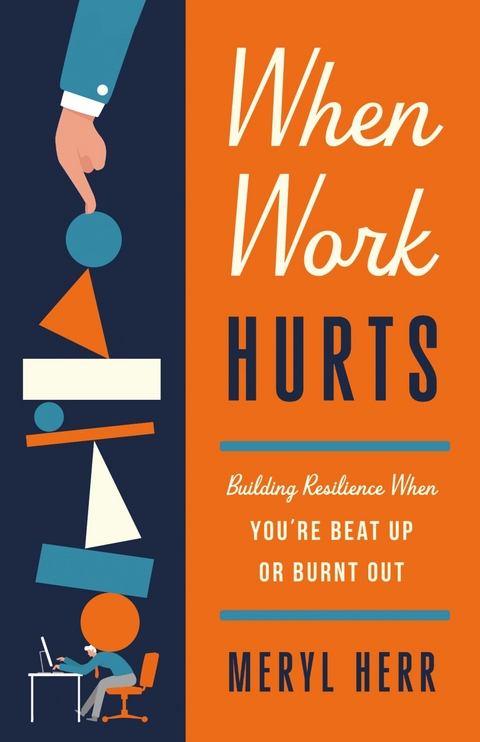
When Work Hurts (eBook)
208 Seiten
IVP (Verlag)
978-1-5140-1025-9 (ISBN)
Meryl Herr (PhD, Trinity Evangelical Divinity School) is the owner of The GoodWorks Group LLC, a consulting firm specializing in educational program planning and evaluation. She previously served as director of research and resources at Fuller Seminary's Max De Pree Center for Leadership, where she conducted research and created resources to help Christian marketplace leaders integrate their faith with their work. Meryl lives with her family near Athens, Georgia.
Meryl Herr (PhD, Trinity Evangelical Divinity School) is the owner of The GoodWorks Group LLC, a consulting firm specializing in educational program planning and evaluation. She previously served as director of research and resources at Fuller Seminary's Max De Pree Center for Leadership, where she conducted research and created resources to help Christian marketplace leaders integrate their faith with their work. Meryl lives with her family near Athens, Georgia.
When the Walls
Fall Down
After ten years in educational and nonprofit leadership in her community of Athens, Georgia, Lora had a vision for what could help children flourish—schools that were student-centered and creative. The events of 2020 helped her refine that vision. As racial tensions rose in the United States and she began receiving invitations to speak on race-related issues, Lora started to reflect on her educational journey as a Black child who attended a predominately White private school. She lamented not having Black cultural spaces to explore that part of her identity while growing up. That’s what Athens needed—a school that would focus on the thriving of the community’s Black youth. The idea came like a torrent, she told me. The call to start Joy Village School was unmistakable.
Joy Village School welcomed twenty-five students in the fall of 2022. Drawing on the West African tradition of Harambe, students began their days with chants, cheers, and affirmations before attending to their core subjects of math, language arts, and Black history. After a focused reading time, they participated in enrichment activities such as drumming, chess, coding, cooking, basketball, and step. Everything seemed to be flourishing, except Lora was crumbling on the inside.
Running a school required leasing a building and paying staff—two huge expenses. Lora took out personal loans to help cover the costs, and she began to focus thirty to forty hours per week on fundraising on top of her teaching and administrative responsibilities. She took any opportunity she had to talk to people about the school and ask for a donation. She made pleas via social media, telling the world, “We’re having such a joyful experience here.” But what Lora felt was the antithesis of joy. She told me,
I set out to create this school and do work that was meaningful to me, but the job I ended up doing was 20 percent of the meaningful, lifegiving work. I spent 80 percent of my time fundraising and writing grants—thirty grants that year, and I was out at community events all the time meeting people and trying to raise money.
She admitted, “I was maintaining a façade of togetherness when on the inside I was drowning a lot of the time.”
Lora was exhausted. She was working seventy to eighty hours per week. At one point she contracted Covid-19 and shingles, but she didn’t take time off. She had to keep the school afloat. Still, she put a happy face on even though she and her school were crumbling. Lora was drowning in debt and eventually had to declare personal bankruptcy. When the school finally closed at the end of its first year, it felt like a mercy while at the same time sending Lora spiraling deep into a midlife crisis. Lora’s dream died, and with the closing of Joy Village School came a flood of grief.
The pain we experience in our work can vary in severity and scope. Researchers believe the brain processes socio-emotional pain the same way it processes pain from a physical injury.1 Like the pain we feel in our body, the emotional pain we experience from work can be chronic or acute. It can be tolerable or debilitating. It can dissipate or accumulate. Regardless, it hurts and cries out for our attention.
WHEN WORK DISAPPOINTS
Disappointment at work is an everyday experience for most of us. It happens when work fails to live up to our hopes or expectations. We don’t finish everything on our to-do list. Only one person attends the online event we planned. Customers prefer our competitor’s product to ours. Our boss tells us that our report needs another round of revisions. We overcook the chicken—again.
It’s all frustrating. But for the most part, we can deal with that level of disappointment. We reexamine our priorities and brush up our time management strategies. We receive the one attendee with hospitality and gratitude and think about how we might better promote the next event. We do some market analysis to reassess our customers’ needs. We dig in and fix the report. We finally buy a new oven.
But sometimes the disappointments are more profound. I think of a 2019 Indeed commercial that depicts a group of professionals standing in a conference room.2 At the front of the room, we see Claire, gleaming in expectation as her boss prepares to announce the name of the company’s newest vice president. As soon as the “m” sound rolls off her boss’s tongue, Claire’s face begins to fall. The promotion went to her colleague Michael. We get the sense that she had been passed over before. She’s crushed.
In 2022, news outlets began talking about the “Great Resignation” because people in the United States were quitting their jobs in record numbers.3 They quit their jobs during the Great Resignation because work had become a Great Disappointment. The Pew Research Center found that people who quit their jobs during that period tended to do so because of low pay, no opportunities for advancement, and feeling disrespected at work.4 Patrick quit a job for all three of those reasons.
He was working as an adjunct professor for a small college. From the outset, the pay was terrible. Patrick had dreamed of becoming a professor for years and thought he could tolerate the low pay for a season in exchange for an opportunity to get his foot in the door. At one point, he did the math and figured he could have been making about the same amount working retail. That was rather infuriating since the teaching job required a doctorate; still, he was willing to accept it for a while.
But soon, the possibilities for advancement went from slim to nil. He felt like some people in the university didn’t respect him. Others made him feel like he had nothing to contribute to the school beyond the few tasks they had asked him to do. Patrick’s disappointment became so profound that it festered into resentment and bitterness. Like a poison, it started seeping into his relationships and his work. Even his students began to pick up on his cynicism. He knew he should quit but needed the money and wanted to hold out hope that it would get better. But it didn’t. Things got worse. And he left. To Patrick, it felt like a bad breakup, like waking up to the realization of unrequited love. And it hurt.
WHEN WORK DISILLUSIONS US
Disappointment leads to pain; but the disillusionment we experience at work can also hurt us. Disillusionment comes when work challenges some of our deeply held assumptions.
My husband and I got married in 2005 while we were both in seminary, but we knew that we couldn’t afford for both of us to be in school at the same time. So we agreed that one would work full-time while the other finished their degree, and then we would switch. That’s how I came to teach middle school math. Two months after we got married, I landed the job at a local Christian school.
I was so excited about the job because I loved teaching math, and I was eager to help my students understand how math fit into God’s big story. I decorated my classroom, designed some fun learning activities, and developed relationships with the other teachers. I knew the job would be difficult—four different math classes and three electives to prep and almost no support from our special education staff. But no one prepared for me for the biggest challenge I would face: the parents.
I would get an earful from parents when their students had to sit the bench at a basketball game because they weren’t passing pre-algebra. It didn’t matter that I offered to help their students before school, after school, and during study hall. It didn’t matter that I had extra credit work available for all students. To these parents, the fact that their kids weren’t passing was my fault and mine alone.
Another parent was so hostile toward me that the principal would no longer let her communicate with me on the phone or in person without an administrator present. It turned out that this mom had a rather tumultuous home life and opted to take it out on me. I decided I would take her verbal abuse again in a heartbeat if it kept her from unleashing her anger on her son, who was my student.
And then there were the parents of eighth graders who pressured me to recommend their children for the best math classes at their new high schools, even when I knew the student had little chance of success. If I declined, I was “ruining their lives.” That math placement would affect their ability to get into Harvard. I secretly wished I could tell one mom, “Ma’am, right now your daughter appears to be more interested in boys and basketball than equations and inequalities. Maybe let’s work together to help her learn to solve for x so that she passes my class and doesn’t have to repeat pre-algebra as a freshman.”
Over time, the parents’ persistent enmity wore me down. I had no idea that people who paid money to send their children to a Christian school could be so mean. The way they treated me jilted me out of my naiveté. Note to my twenty-five-year-old self: not everyone in a Christian school community will act Christlike.
Disillusionment at work is no respecter of persons. Catherine was a young mom who had taken a new job to support herself and her kids. She was quite good at her job, and her boss noticed. He gave her more responsibility. And then he gave her something she didn’t want—sexual harassment. He hit on her. In an instant, any illusions Catherine had about her boss’s professionalism shattered. She quit immediately. But the hurt persisted. She had...
| Erscheint lt. Verlag | 11.3.2025 |
|---|---|
| Verlagsort | Lisle |
| Sprache | englisch |
| Themenwelt | Sachbuch/Ratgeber ► Beruf / Finanzen / Recht / Wirtschaft ► Bewerbung / Karriere |
| Religion / Theologie ► Christentum ► Moraltheologie / Sozialethik | |
| Schlagworte | Bad • bad bosses • Biblical • biblical view of work • Boss • Burned • Burnout • burnout recovery • calling • Career • Christian • Corporate • Empowerment • Exhaustion • Faith • Faith and Work • faithfulness • Grief • harassment • Healing • integrating faith and work • Job • Loss • Mental Health • ministry • preventing • Productivity • Recovery • Resilience • Toxic • toxic boss • toxic workplace • Trauma • Vocation • Work • work life balance • workplace culture • Workplace Harassment • work trauma |
| ISBN-10 | 1-5140-1025-9 / 1514010259 |
| ISBN-13 | 978-1-5140-1025-9 / 9781514010259 |
| Informationen gemäß Produktsicherheitsverordnung (GPSR) | |
| Haben Sie eine Frage zum Produkt? |
 EPUB (Wasserzeichen)
DRM: Digitales Wasserzeichen
Dieses eBook enthält ein digitales Wasserzeichen und ist damit für Sie personalisiert. Bei einer missbräuchlichen Weitergabe des eBooks an Dritte ist eine Rückverfolgung an die Quelle möglich.
Dateiformat: EPUB (Electronic Publication)
EPUB ist ein offener Standard für eBooks und eignet sich besonders zur Darstellung von Belletristik und Sachbüchern. Der Fließtext wird dynamisch an die Display- und Schriftgröße angepasst. Auch für mobile Lesegeräte ist EPUB daher gut geeignet.
Systemvoraussetzungen:
PC/Mac: Mit einem PC oder Mac können Sie dieses eBook lesen. Sie benötigen dafür die kostenlose Software Adobe Digital Editions.
eReader: Dieses eBook kann mit (fast) allen eBook-Readern gelesen werden. Mit dem amazon-Kindle ist es aber nicht kompatibel.
Smartphone/Tablet: Egal ob Apple oder Android, dieses eBook können Sie lesen. Sie benötigen dafür eine kostenlose App.
Geräteliste und zusätzliche Hinweise
Buying eBooks from abroad
For tax law reasons we can sell eBooks just within Germany and Switzerland. Regrettably we cannot fulfill eBook-orders from other countries.
aus dem Bereich


