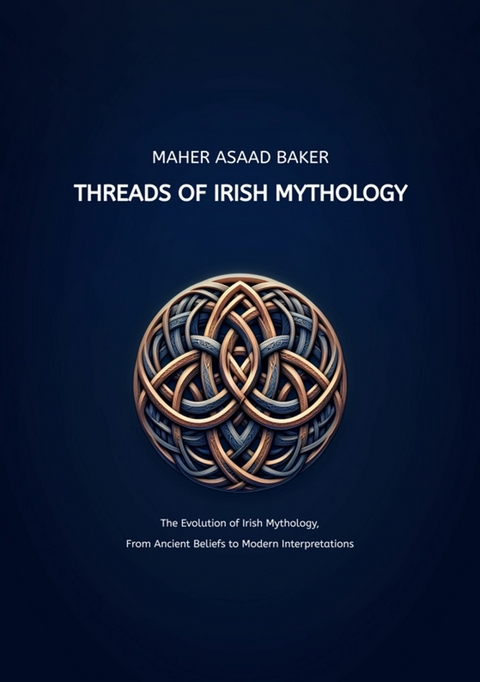
Threads of Irish Mythology (eBook)
89 Seiten
tredition (Verlag)
9783384184979 (ISBN)
Maher Asaad Baker (In Arabic: ???? ???? ???) is a Syrian Musician, Author, Journalist, VFX & Graphic artist, and Director, he was born in Damascus in 1977. Since his teens, he has been building up his career, starting by developing applications and websites while exploring various types of media-creating paths. He started his career in 1997 with a dream of being one of the most well-known artists in the world. Reading was always a part of his life as he was always surrounded by his father's books, but his writing ability didn't develop until a later age as his most time was occupied with other things such as developing, writing songs and music, or in media projects production, he is most known for his book "How I wrote a million Wikipedia articles" and a novel entitled "Becoming the man".
Maher Asaad Baker (In Arabic: ماهر أسعد بكر) is a Syrian Musician, Author, Journalist, VFX & Graphic artist, and Director, he was born in Damascus in 1977. Since his teens, he has been building up his career, starting by developing applications and websites while exploring various types of media-creating paths. He started his career in 1997 with a dream of being one of the most well-known artists in the world. Reading was always a part of his life as he was always surrounded by his father's books, but his writing ability didn't develop until a later age as his most time was occupied with other things such as developing, writing songs and music, or in media projects production, he is most known for his book "How I wrote a million Wikipedia articles" and a novel entitled "Becoming the man".
Introduction
The mythology and folklore of Ireland have endured for centuries, permeating the cultural identity of the Gaelic people with a vivid lexicon of gods, heroes, monsters, and magic. To delve into these ancestral narratives is to glimpse an archaic worldview and value system that profoundly shaped how the Irish collectively understood their relationship to supernatural forces and one another. Though its origins reach back to Ireland's pre-Christian era, the mysticism of its myths still finds expression in everything from Ireland's unique customs to its global diaspora today.
Given the oral tradition in which these myths were first transmitted, their full richness cannot be distilled in a concise summary. However, to gain a sense of the variegated textures woven throughout Ireland's mythology requires first acknowledging its cosmological framework and some of its most iconic figures. With an appreciation for how it’s symbolic resonances informed ancestral understandings of human nature and destiny, one can glimpse why these timeless tales of Ireland's mythic past remain a vibrant expression of its cultural soul.
At the highest level of Irish cosmology are three fundamental realms: the Otherworld, the spirit world, and the human world. The Otherworld designates an ethereal dimension adjacent to but separate from mortal reality, a place where time flows more slowly and beings possess heightened abilities. Ruled over by deities and supernatural entities, the Otherworld housed mystical islands, palaces, and landscapes parallel to those of Ireland yet slightly out of phase.
It was to the Otherworld that heroic figures like Cú Chulainn or Finn McCool would occasionally travel, trading their earthly identities for wonder-filled sojourns among otherworldly beings untouched by old age or disease. Though separate, the Irish myths portray the Otherworld as deeply intertwined with humanity's affairs; its inhabitants could bless or curse mortal endeavors, while certain sacred places like standing stones acted as portals between realms. Overall, the Otherworld came to symbolize the mystical contours of existence beyond sensory perception.
Below the Otherworld lay the spirit world, home to fairies, leprechauns, pookas, and other elemental spirits integral to Irish folklore. Presiding over particular landscapes, haunting family bloodlines, or patronizing rural households, the myriad spirits of Ireland populated the nooks and crannies of mortal experience. While some brought fortune or kept guardianship over natural places, others brought misfortune or demanded tribute in exchange for services. Stories of spirit-human encounters served as cautionary tales for preserving harmonious relationships with the land's uncanny inhabitants.
As for the human world, pre-Christian Ireland consisted of five provinces divided among rival kingdoms, their competing rulers vying for supremacy in an arena shaped by intricate laws of kinship, hospitality, and vengeance. Ruled by an intricate caste system with warrior aristocrats on top and bondsmen on bottom, society was organized tribally under the same patron deities as their clan. When not engaged in intra-Gaelic skirmishes, the heroes and heroines of Irish myth partook in fantastic adventures that reflected societal ethics, often with the backdrop of domestic squabbles or cunning tricksters.
Presiding over creation in Irish myth was the triad of father gods often called the Tuatha Dé Danann, meaning the Tribes of the goddess Danu. Chief among them was the Dagda, a figure of immense authority and magical skill who owned a cauldron that could feed armies and a club that could kill with one blow or resurrect with another. Associated with fertility, strength, and bountiful harvests, the Dagda's benevolent yet unpredictable nature captured the untamed vitality of the Irish landscape.
Complementing the Dagda was the god of storms, craftsmanship, and battle, known as Goibniu. Skilled in metalworking and smithing, Goibniu crafted legendary weapons and aided warriors in combat through magical means. Meanwhile, Lug, a solar deity connected to knowledge, athletics, and arts, ensured order prevailed during conflicts. Under them were gods and goddesses governing various natural phenomena and human endeavors, from the horses of Manannán Mac Lir to the healing waters of Boann.
As spiritually formative entities, the Tuatha Dé Danann became role models for proper masculine and feminine conduct, as well as patrons of crafts and talents. Their palaces, described as verdant islands shrouded in perpetual mists and feasts, came to symbolize an Edenic era in Ireland before the coming of Christianity, a mythic past resonant with tribal notions of divine kinship and guardianship over the land. The gods' eventual defeat at the hands of invading Milesians depicted their transformation into Fairy folk who nevertheless retained influence in mortal affairs.
While the gods constituted Ireland's highest divine order, it was her legendary heroes that most embodied Irish valor, cunning, and link to the Otherworld. Perhaps most famous were the Ulster Cycle tales centering around Cú Chulainn, the Hound of Ulster and his companions who defended the northern Ulaid kingdom through super-human feats of bravery and magical armaments. Whether battling invaders or monsters, Cú Chulainn's exploits resonated with masculine ideals of protecting one's kin and faithful service to the king.
Similarly renowned were the Fenian Cycle stories featuring Fionn mac Cumhaill and the elite band of warriors called the Fianna. Associated with woods and wilderness areas, the Fianna pursued mighty quests, outwitted satirists and jugglers, and partook in Otherworldly adventures led by Fionn, a great seer and hunter. Their carefree lives as noble huntsmen living off the land embodied an adventurous, masculine ideal at the edge of civil society.
Beyond these major heroic cycles, many lesser-known figures recurred in local folktales, blending fanciful events with historical personalities. Figures like Mongán Mac Fiachna inhabited a twilight realm between myth and legend, often accompanied by supernatural hounds or possessing prophetic gifts. Likewise, Ireland's post-Christian narratives came under Arthurian influences, with ancient Irish kings refashioned as proto-Arthurian characters guarding against waves of pre-Milesian invaders in fantastic battles against Crom Cruach and his followers.
No survey of Ireland's folk beliefs would be complete without acknowledging its cornucopia of spirits, goblins, and fairies. Central to rural traditions was the notion of the daoine sídhe, or fairy folk believed to live in earth-mounds and passage tombs. Appearing as tiny men and women or as spectral clouds, the daoine sídhe were capricious tricksters who blessed pastoral areas with abundant milk or curses with blight until offered propitiations of milk or bread. Their fairy mounds were not to be trod upon at least one rouse their ire.
Somewhat malevolent was the pooka, taking forms as a black horse or goat to mislead late-night travelers, while leprechauns were solitary mischievous sprites guarding hidden treasures. Often confused with leprechauns were the clurichaun, resident drunkards of the fairy realm who could be heard at night engaging in phantom revelry. Likewise, banshees foretold death with plaintive wails, territorial spirits called pookas protected natural sites, and sprites called leachtaraí prepared places for human slumber with phantasmal bedding.
In more ominous corners of folk belief were the gruagachs, primitive goblins made of twisted branches and leaves who snatched unwary children into the woods. Similar were the fearsome Bó Méidhir, a giant cow said to haunt the Scottish Borders and suck dry kidnapped humans from its teats. Meanwhile, selkies were shapeshifting seals whose discarded skins could be stolen by men to force them into marriage. With such myths, the Irish landscape came alive with an entire ecology of unearthly inhabitants to be respected and propitiated.
Over fifteen centuries since their genesis, the myths and folklore of Ireland have endured various forms of cultural transmission across generations. While some motifs have been diminished or Christianized through syncretism, the evocative narratives at the heart of Ireland's ancient spiritual background remain etched in the land's Gaelic identity. They color everything from place names still redolent with arcane symbolism to how Irish people view their relationship with nature today.
Likewise, the archetypal heroes and deities depicting masculine and feminine ideals found new life as iconic emblems of Irish nationalism during the independence struggles of the 19th century. Even globally, Irish-descended communities adopted mythological figures as a means of cultural reconnection to their genealogical origins, reviving dormant myths through neo-pagan reconstructionism, arts, and festivals worldwide. Their pertinence endures wherever people yearn to tap into the animistic mysteries that first charged Ireland's misty landscapes with souls, deities, and otherworldly intelligence.
With care to appreciate Ireland's myths not as facts but as spiritually nourishing symbols, one glimpses how their multiform richness enchanted ancestral imaginations into crafting a vivid lexicon that mediated between the visible and invisible, binding communities through shared lineages and moral allegories. Though the pre-Christian gods may no longer be worshipped, their heritage infuses Ireland's folkways with magic resonant with older animistic...
| Erscheint lt. Verlag | 1.4.2024 |
|---|---|
| Verlagsort | Ahrensburg |
| Sprache | englisch |
| Themenwelt | Sachbuch/Ratgeber ► Gesundheit / Leben / Psychologie ► Esoterik / Spiritualität |
| Geschichte ► Allgemeine Geschichte ► Altertum / Antike | |
| Geisteswissenschaften ► Geschichte ► Regional- / Ländergeschichte | |
| Schlagworte | celtic folklore • cultural influence • Ireland • Irish mythology • modern culture • Mythological Traditions |
| ISBN-13 | 9783384184979 / 9783384184979 |
| Informationen gemäß Produktsicherheitsverordnung (GPSR) | |
| Haben Sie eine Frage zum Produkt? |
 EPUB (Wasserzeichen)
DRM: Digitales Wasserzeichen
Dieses eBook enthält ein digitales Wasserzeichen und ist damit für Sie personalisiert. Bei einer missbräuchlichen Weitergabe des eBooks an Dritte ist eine Rückverfolgung an die Quelle möglich.
Dateiformat: EPUB (Electronic Publication)
EPUB ist ein offener Standard für eBooks und eignet sich besonders zur Darstellung von Belletristik und Sachbüchern. Der Fließtext wird dynamisch an die Display- und Schriftgröße angepasst. Auch für mobile Lesegeräte ist EPUB daher gut geeignet.
Systemvoraussetzungen:
PC/Mac: Mit einem PC oder Mac können Sie dieses eBook lesen. Sie benötigen dafür die kostenlose Software Adobe Digital Editions.
eReader: Dieses eBook kann mit (fast) allen eBook-Readern gelesen werden. Mit dem amazon-Kindle ist es aber nicht kompatibel.
Smartphone/Tablet: Egal ob Apple oder Android, dieses eBook können Sie lesen. Sie benötigen dafür eine kostenlose App.
Geräteliste und zusätzliche Hinweise
Buying eBooks from abroad
For tax law reasons we can sell eBooks just within Germany and Switzerland. Regrettably we cannot fulfill eBook-orders from other countries.
aus dem Bereich