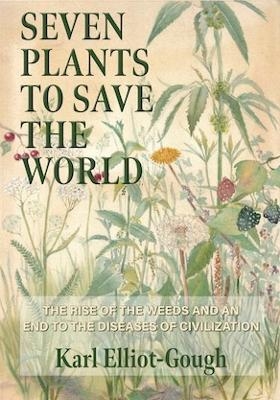
Seven Plants to Save the World
Aeon Books Ltd (Verlag)
978-1-80152-162-8 (ISBN)
Born from nearly a decade of working solely and closely with these seven plants, Karl Elliot-Gough’s groundbreaking book presents a new paradigm for understanding our relationship with plants, encouraging all who work with herbs and nature to embark on a journey of sustainability, prosperity and health.
With a blend of traditional and scientific research, Elliot-Gough uses these seven key plants – nettle, dandelion, yarrow, plantain, cannabis, hawthorn and blackberry – in a pioneering analysis of the ways in which the bounty of nature can transform not only the health of the individual, but also act as a guide in developing a more sustainable, respectful and abundant world.
Seven Plants to Save the World is a bold testimony to the limitless opportunities that the plants can offer humanity, outlining the surprising possibility of systemic change through which the world can become harmonious and sustainable with everyone thriving, as opposed to hardly surviving.
The book begins with seven monographs of the individual plants which explore their folklore and traditional usage, the scientific evidence, a range of industrial applications, along with information on foraging, harvesting, recipes and more. The second half of the book presents an innovative compendium of solutions, in which plants are instrumental in sustaining and developing global systems for the benefit of the planet and humanity. These systems include healthcare, economics, industry, agriculture and culture. Elliot-Gough unpicks how plants can guide us in developing a more sustainable future within these systems, benefiting the planet as a whole.
Seven Plants to Save the World provides readers with a path to feel emboldened and optimistic in a world which often seeks to suppress systemic change, as well as offering real and practical guidance in implementing such change in our own lives and communities, for the good of the planet and every living thing.
Karl Elliot-Gough studied archaeology and anthropology at UCL and is a former musician, producer and record label owner providing aural pleasure from non-genre specific quality electronic music. Twelve years of research and writing for his first book The Seven Deadly Whites: The Rise of the Diseases of Civilization (Earth Books, 2016). Karl lives in the Sussex countryside with his wife and 4 children and enjoys West German ceramics, a theremin, things megalithic and anthropologic, cycling fast, foraging slow and can sometimes be found taking walks and talks at festivals.
CONTENTS
INTRODUCTION
Human Plants
The diseases of civilization
Oikonomia
Disconnection
NETTLE
Humble pie
It’s a family affair
Nettle history, ethnobotany and folklore
“It’s got more chi, man!”
A whole heap of benefits
Side effects
Tea terrorists and vultures
Equipoise (ek-wuh-poiz)
“Who’s the daddy?”
A bit more ChAT
Phenomenal phenols
The first epidemiological study
Nettles for textiles
What’s wrong with cotton?
The nettle industrial revolution
Get foraging
Recipes
Nettle neglect
DANDELION
The best things in life are free
Etymologicum
What’s in a name?
Chronological cappers
When folklore was the law
Dawn of the lawn
The Big C
Duelling with the diuretics
Warning!
Nutrients
Phreaky phytonutrients
The inconvenient truth
More than an opinion
Taraxagum
Dandelions are proper cool
Foraging/harvesting
Culinary dandelions
Final word
YARROW
Armageddon
Them Greeks, they knew a thing or two
History and names
Ethnobotanical
Traditional
“It’s all about the phytonutrients, darling!”
Axis of Evil leading the way (again)
Here’s more countries’ opinions
OTC cash registers on fire
Aedes albopictus
Radiation
Divination
“Need ya aura cleansing or chakras aligned, Mister?”
Anything else?
It can’t all be good, can it?
Foraging, growing and culinary curios
Summation
PLANTAIN
Canine crisis
The People will not revolt. They will not look up from their screens long enough to notice …
Species specific
Names
First Nation peoples loved them
History
Traditional uses
Firm scientific credentials
Forbidden knowledge
Psyllium (silly om)
Farmers need to become the guardians of the soil
CANNABIS
Human Plant numero uno?
Mary Jane, what’s in the name?
“Psst … you wanna buy sum smoke?”
Hamp or hemp
Cannabis history, BC
AD
Into the twentieth and twenty-first centuries
Building a better world – Hempcrete
Fabric
Paper production
The decorticator
Plastic, bio-plastic and oil
Hempire
The seed – health
CBD
Some science
Side effects
Smacked out or stoned?
Wrapping it up
HAWTHORN
Barbs of wisdom
Hawthorn (Crataegus sp.)
Botanical
Folk and ethnographic
Bubbling up from the depths of time
Jesus Christ and the soul of London
Vibrations, green men, fairies and pixilated superstitions
Traditional uses
Heart disease
Global science
Fishy science with an industrial whiff
Eating
Pleaching and a smeuse
Enclosure
It’s not ‘just’ the land that got stolen/reappropriated
BLACKBERRY
Botanically and plantality
Challenging etymology
So little folklore, so much Devil’s piss
History, ethnobotanic and traditional uses
Any problems?
The biggest threat to the future of all Gaia’s organisms
Last scientific studies to digest
Can’t get away from those polyphenols
The B17 story
Foraging and Shinrin-Yoku
Blackberry cultivation
Yum!
SOLUTIONAL SUMMATION
SYSTEMIC REFORMATION
Health system
An end to the diseases of civilization
Medicine
Economic system
What is money?
Crypto or Green currency?
Show us the money
A Green-backed economy
Industrial system
Building
Fabrics
Transport
Petroleum
Agricultural system
The great agricultural myth
PermaLife 1:0
A nation is only as healthy as the soil it stands upon
Permaculture
10 acres with planning consent
How to get the land … the peasants are revolting
Forest charter, allotments and PCCs
Land prices and subsidies
Pharmas to farmers
Cultural system
Obscenity law
The Co-operator
Wetiko and follow the money
Socialism?
Take a bow, the Seven Plants
APPENDIX
Nutritional profiles
Pesticide sprayed since 1950
Pollution
GDPs vs corporation revenues
Humans
Historical pandemics
BIBLIOGRAPHY
INDEX
| Erscheinungsdatum | 22.08.2024 |
|---|---|
| Verlagsort | London |
| Sprache | englisch |
| Maße | 178 x 254 mm |
| Themenwelt | Sachbuch/Ratgeber ► Gesundheit / Leben / Psychologie ► Alternative Heilverfahren |
| Medizin / Pharmazie ► Naturheilkunde ► Phytotherapie | |
| ISBN-10 | 1-80152-162-X / 180152162X |
| ISBN-13 | 978-1-80152-162-8 / 9781801521628 |
| Zustand | Neuware |
| Informationen gemäß Produktsicherheitsverordnung (GPSR) | |
| Haben Sie eine Frage zum Produkt? |
aus dem Bereich