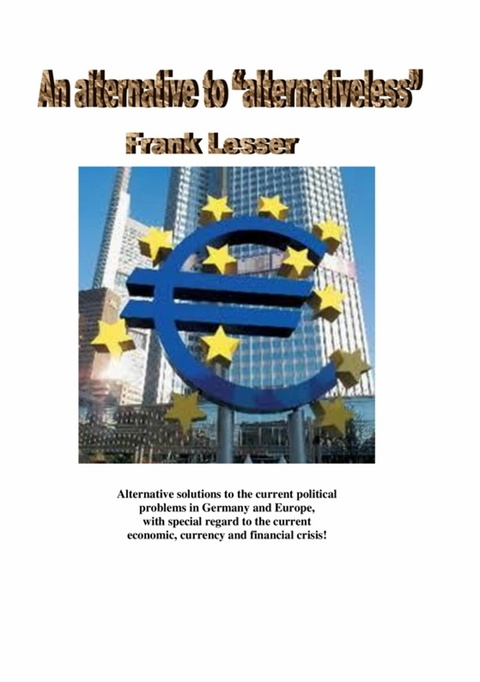
An alternative to 'alternativeless' (eBook)
304 Seiten
tredition (Verlag)
978-3-384-17065-1 (ISBN)
Cuando emprendo nuevos "proyectos", mi cerebro tiene la capacidad de llenarse literalmente de todo tipo de hechos, filtrarlos inmediatamente y clasificar todos los insignificantes e ignorarlos en gran medida. Los hechos importantes los enlazo de la forma más lógica e impecable posible, como un jugador de ajedrez. Aquí es donde reside mi verdadera fuerza, tanto por el gran número de unidades de este tipo como por el escaso número de errores. Una vez que el "proyecto" está completo a mi satisfacción, entonces "nace el niño" y olvido deliberadamente todos los hechos y detalles, mi cerebro se borra y formatea como la memoria de un ordenador para dejar sitio al siguiente proyecto y a las siguientes unidades lógicas. Pero, por supuesto, las palabras clave son suficientes para volver a recordar lo olvidado si es necesario, aunque esto lleva su tiempo. Así que mi punto fuerte no reside en una memoria fotográfica a largo plazo de todas las cosas que he abordado en mi vida, sino en almacenar con paciencia infinita en mi memoria a corto plazo todos los datos relevantes para el problema que me interesa en ese momento, en afinar y refinar constantemente las ideas y las conclusiones. Por eso no soy el tipo de persona que responde a una pregunta complicada a la velocidad del rayo. Me tomo mi tiempo para escudriñar y pensar las cosas, y mis respuestas son correspondientemente profundas. En consecuencia, quien ponga en duda o ataque mis opiniones y soluciones a los problemas, que he encontrado con tanto esfuerzo, lo tiene difícil. No porque sea terco, sino porque todas mis opiniones y convicciones tienen fundamentos muy arraigados.
Cuando emprendo nuevos "proyectos", mi cerebro tiene la capacidad de llenarse literalmente de todo tipo de hechos, filtrarlos inmediatamente y clasificar todos los insignificantes e ignorarlos en gran medida. Los hechos importantes los enlazo de la forma más lógica e impecable posible, como un jugador de ajedrez. Aquí es donde reside mi verdadera fuerza, tanto por el gran número de unidades de este tipo como por el escaso número de errores. Una vez que el "proyecto" está completo a mi satisfacción, entonces "nace el niño" y olvido deliberadamente todos los hechos y detalles, mi cerebro se borra y formatea como la memoria de un ordenador para dejar sitio al siguiente proyecto y a las siguientes unidades lógicas. Pero, por supuesto, las palabras clave son suficientes para volver a recordar lo olvidado si es necesario, aunque esto lleva su tiempo. Así que mi punto fuerte no reside en una memoria fotográfica a largo plazo de todas las cosas que he abordado en mi vida, sino en almacenar con paciencia infinita en mi memoria a corto plazo todos los datos relevantes para el problema que me interesa en ese momento, en afinar y refinar constantemente las ideas y las conclusiones. Por eso no soy el tipo de persona que responde a una pregunta complicada a la velocidad del rayo. Me tomo mi tiempo para escudriñar y pensar las cosas, y mis respuestas son correspondientemente profundas. En consecuencia, quien ponga en duda o ataque mis opiniones y soluciones a los problemas, que he encontrado con tanto esfuerzo, lo tiene difícil. No porque sea terco, sino porque todas mis opiniones y convicciones tienen fundamentos muy arraigados.
Some of the currently leading theories of modern economics
Before I come to my alternative trains of thought, I would like to briefly present some of the current theories established in the Western world to solve the great financial and economic crisis, in order to illustrate the difference. In the German-speaking world, for example, these modern theories are to be found among the representatives of the so-called 'Austrian school of economics' , apart from the modern socialist and communist theories, which are absolutely useless.
Many of these modern economists are concerned with a transformation of the liberal economic policy embodied in the free, liberal market economy, which is why they call themselves "libertarians" for distinction. The theses of these modern, libertarian economists can also be read on the Internet, and I quote:
• The first mortal sin of real existing liberalism is the insufficient intellectual appropriation of liberal basic principles.
• The second mortal sin of real existing liberalism consists in shrinking back from communicating the results of liberal thinking unambiguously and representing them offensively.
• The "libertarian" message contains above all a ban and outlawing of the initial use and threat of violence as well as the protection of life, freedom and property in the sense of elementary rights of defence.
• The libertarian message is: Let your fellow men live undisturbed and in peace, and leave each of them to seek their own happiness and choose their own means, as long as they are non-violent. Whoever seriously adopts this slogan is already moving in libertarian ways.
• A currency initiative of interest to these modern economists was launched in Switzerland. Under the title "Project Gold Franc", the Swiss Thomas Jakob is attempting to use a constitutional initiative to provide the already existing Swiss franc with a gold-backed alternative.
• Especially against the background of the eroding euro and the hardly less endangered US dollar, the initiative could trigger discussions not only in Switzerland about the possibilities of gold-backed currencies.
• The current monetary order is based on uncovered paper money, which at irregular intervals causes severe economic crises and inflation. Libertarian economists have long warned of the recent crash. In their view, the current financial and economic crisis is by no means the result of the free market economy. In fact, the causes lie in the abuse of the state's paper money monopoly.
• According to modern economics, the causes of the crisis are
There is no alternative to the free market. Every form of intervention by the state, banks and companies associated with the state leads to disruptions of the extremely effective market. These disturbances are answered by those who cause them, usually the state, by new interventions, since it is mistakenly believed that the laws of the market can be manipulated. Each new intervention makes the situation worse. In desperation, the state finally resorts to the last resort: it nationalises production and thus leads it even more quickly to ruin. The current global economic crisis began years before this catastrophe.
Through their central banks, the states, above all the USA, could pump unlimited amounts of money, which is actually "counterfeit money", into the market. This meant that trillions of trillions of dollars were misinvested. One boom chased the next. Necessary market adjustments were repeatedly postponed by "counterfeit money loans".
From 2002 to 2007, a huge real estate bubble emerged as banks used cheap paper money from central banks to throw real estate loans at customers without checking their creditworthiness. The madness of the money producers encouraged the recklessness of the mortgage holders, who extended their mad consumption with new loans to apparent increases in the value of their real estate. This "mortgage game", which was not new in either America or Europe, was accompanied by the gambling games of the banks on both continents - the Chinese and Indians were virtually unaffected. Whereas futures, puts, calls and other derivatives were previously used to hedge commodity futures and trading risks, these now degenerated into pure roulette games. Instead of profits of 10 - 20 %, the stakes increased a thousand times and the fact that the losses could be just as high was pushed aside. There are currently contracts worldwide in unimaginable multiples of trillions. The bursting of these contracts would exceed the financial strength of even the largest states, such as the USA.
• Not only smaller states are acutely threatened, but also the No. 1 economic power, the USA, which is currently in an economic nosedive. It is the global expansion of fiat money and the huge derivative bubbles that make this crisis even more devastating than that of 1929. It will last a long time, make states disappear - the US and the EU will dissolve like the Soviet Union, and destroy values on all inhabited continents on an unprecedented scale.
• The hope is that new, solid currencies will emerge on a private basis.
• A digital gold currency, such as the gold dinar of the Emirates and Malaysia, the Mexican silver peso and similar currencies, has good medium-term prospects.
• Savers who bet on gold and silver and do not speculate with them are given the best chance of getting through these times well. End of quotes.
My comment on that:
These modern economists have undoubtedly pointed out a huge amount of flaws in the current economic and financial system, including the huge amount of things going wrong with central banks, but they have not realized what the real flaw in the so-called money creation of central banks is, namely not the uninhibited printing of money ("counterfeit money"), but the lending of this money in the form of key interest rate loans, see my remarks below in the chapters "The simple explanation of the main cause of the current crisis and a serious proposal for a solution" and "The false money creation policy of the central banks".
And private and gold currencies will not solve the crisis at all, at best they will fight for a time delay with the ideas of modern economists, see my explanations in the chapter "Solution concept: …" below.
As you can read in the following chapters of this book, I too assume that in Germany the problems of national debt, unemployment, low wages and the reduction of social benefits must be tackled with a parallel currency (or, in the case of EMU, with country-specific parallel currencies), but not with a "gold-backed" currency, but with a currency backed by goods and services, which is also "constructed" by a trick in such a way that the problems can be solved in record time. These immensely important details in the "laying of the foundation stone" of new currencies are also the difference to the parallel currencies recently proposed by Professor Dr. Dirk Meyer and other experts. As long as the main evil at the central banks (i.e. in Europe the ECB) has not been eliminated, these parallel currencies will be of little use, and as long as the parallel currencies are only "poor or people's currencies", the problem of national debt, mass unemployment, mass impoverishment and the ever widening gap between rich and poor will not be solved permanently. In my concept, the country-specific parallel currencies are constructed in such a way that very strong new currencies are created, which do not need to be devalued, but which will take their place from day one on the international currency markets in the free play of forces. And, as already mentioned, in order to solve the problems in the long term, I am calling for completely new algorithms in the primary money creation of the central banks in parallel.
Modern economics succumbs to the error of confusing the symptoms with the actual causes. I do, however, pay great personal tribute to these modern economists; for the step alone towards massive criticism of the liberal market economy, which is not only taught at all western universities but has also successfully asserted itself in international comparison, requires not only intelligence and specialist knowledge but also the courage to swim against the current.
But I don't want to hide the fact that all these people, from my alternative point of view, didn't "dig" deep enough, they somehow got stuck in their completely correct criticism of things. These modern economists have, so to speak, taken the reins in public appearances in the media in recent years, which naturally leads to the fact that only the same theories that do not go beyond certain limits are disseminated in public discussions.
As I have already said, in my view all these deserving scientists have done an outstanding job, but only in the merciless exposure of symptoms and at best secondary causes; the primary causes, the basic evils, have remained hidden from them. Their view of the connections is undeniably completely correct, they have uncovered systemic weaknesses that are the cause of further weaknesses, but in my view the causes named are again only the symptoms of even deeper causes.
Of course I have tried to get in contact with these people several times in the last years, I can prove it with the emails stored in my computer. However, it always failed...
| Erscheint lt. Verlag | 25.3.2024 |
|---|---|
| Verlagsort | Ahrensburg |
| Sprache | englisch |
| Themenwelt | Sachbuch/Ratgeber ► Beruf / Finanzen / Recht / Wirtschaft ► Bewerbung / Karriere |
| Sachbuch/Ratgeber ► Beruf / Finanzen / Recht / Wirtschaft ► Geld / Bank / Börse | |
| Wirtschaft ► Betriebswirtschaft / Management | |
| Schlagworte | ECB policy • euro crisis • Financial Policy • Hydrogen combustion engine • money creation • Parallel currencies • Photovoltaics in North Africa • Sovereign debt |
| ISBN-10 | 3-384-17065-2 / 3384170652 |
| ISBN-13 | 978-3-384-17065-1 / 9783384170651 |
| Informationen gemäß Produktsicherheitsverordnung (GPSR) | |
| Haben Sie eine Frage zum Produkt? |
 EPUB (Wasserzeichen)
DRM: Digitales Wasserzeichen
Dieses eBook enthält ein digitales Wasserzeichen und ist damit für Sie personalisiert. Bei einer missbräuchlichen Weitergabe des eBooks an Dritte ist eine Rückverfolgung an die Quelle möglich.
Dateiformat: EPUB (Electronic Publication)
EPUB ist ein offener Standard für eBooks und eignet sich besonders zur Darstellung von Belletristik und Sachbüchern. Der Fließtext wird dynamisch an die Display- und Schriftgröße angepasst. Auch für mobile Lesegeräte ist EPUB daher gut geeignet.
Systemvoraussetzungen:
PC/Mac: Mit einem PC oder Mac können Sie dieses eBook lesen. Sie benötigen dafür die kostenlose Software Adobe Digital Editions.
eReader: Dieses eBook kann mit (fast) allen eBook-Readern gelesen werden. Mit dem amazon-Kindle ist es aber nicht kompatibel.
Smartphone/Tablet: Egal ob Apple oder Android, dieses eBook können Sie lesen. Sie benötigen dafür eine kostenlose App.
Geräteliste und zusätzliche Hinweise
Buying eBooks from abroad
For tax law reasons we can sell eBooks just within Germany and Switzerland. Regrettably we cannot fulfill eBook-orders from other countries.
aus dem Bereich