


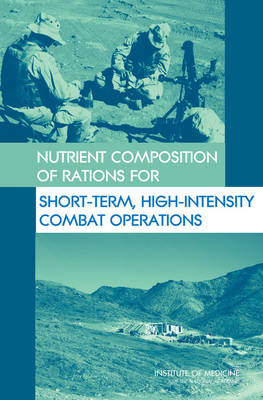
Nutrient Composition of Rations for Short-Term, High-Intensity Combat Operations
Seiten
2006
National Academies Press (Verlag)
978-0-309-09641-6 (ISBN)
National Academies Press (Verlag)
978-0-309-09641-6 (ISBN)
Recognizing the importance of good nutrition for physical and mental status, the Department of Defense asked the Institute of Medicine to guide the design of the nutritional composition of a ration for soldiers on short-term, high-stress missions. This book considers military performance, health concerns, food intake, and food technology issues.
Recognizing the importance of good nutrition for physical and mental status, the
Department of Defense asked the Institute of Medicine to guide the design of the
nutritional composition of a ration for soldiers on short-term, high-stress missions.
Nutrient Composition of Rations for Short-Term, High-Intensity Combat Operations considers
military performance, health concerns, food intake, energy expenditure, physical
exercise, and food technology issues. The success of military operations depends
to a large extent on the physical and mental status of the individuals involved.
Appropriate nutrition during assault missions is a continuous challenge mainly due
to diminished appetites of individuals under stress. Many less controllable and
unpredictable factors, such as individual preferences and climate, come into play to
reduce appetite. In fact, soldiers usually consume about half of the calories needed,
leaving them in a state called "negative energy balance." The consequences of
being in negative energy balance while under these circumstances range from
weight loss to fatigue to mental impairments. An individual's physiological and
nutritional status can markedly affect one's ability to maximize performance during
missions and may compromise effectiveness. With the number of these missions
increasing, the optimization of rations has become a high priority.
Table of Contents
Front Matter
Executive Summary
1 Introduction
2 Answers to the Military Questions
3 General Consideration and Summary of the Ration Design
Appendix A: Workshop Agenda
Appendix B: Workshop Papers
Appendix C: Biographical Sketches of Workshop Speakers
Appendix D: Biographical Sketches of Committee Members and Staff
Appendix E: Aconyms and Abbreviations
Appendix F: Glossary
Recognizing the importance of good nutrition for physical and mental status, the
Department of Defense asked the Institute of Medicine to guide the design of the
nutritional composition of a ration for soldiers on short-term, high-stress missions.
Nutrient Composition of Rations for Short-Term, High-Intensity Combat Operations considers
military performance, health concerns, food intake, energy expenditure, physical
exercise, and food technology issues. The success of military operations depends
to a large extent on the physical and mental status of the individuals involved.
Appropriate nutrition during assault missions is a continuous challenge mainly due
to diminished appetites of individuals under stress. Many less controllable and
unpredictable factors, such as individual preferences and climate, come into play to
reduce appetite. In fact, soldiers usually consume about half of the calories needed,
leaving them in a state called "negative energy balance." The consequences of
being in negative energy balance while under these circumstances range from
weight loss to fatigue to mental impairments. An individual's physiological and
nutritional status can markedly affect one's ability to maximize performance during
missions and may compromise effectiveness. With the number of these missions
increasing, the optimization of rations has become a high priority.
Table of Contents
Front Matter
Executive Summary
1 Introduction
2 Answers to the Military Questions
3 General Consideration and Summary of the Ration Design
Appendix A: Workshop Agenda
Appendix B: Workshop Papers
Appendix C: Biographical Sketches of Workshop Speakers
Appendix D: Biographical Sketches of Committee Members and Staff
Appendix E: Aconyms and Abbreviations
Appendix F: Glossary
Committee on Optimization of Nutrient Composition of Military Rations for Short-term, High-stress Situations, Committee on Military Nutrition Research
1 Front Matter; 2 Executive Summary; 3 1 Introduction; 4 2 Answers to the Military Questions; 5 3 General Consideration and Summary of the Ration Design; 6 Appendix A: Workshop Agenda; 7 Appendix B: Workshop Papers; 8 Appendix C: Biographical Sketches of Workshop Speakers; 9 Appendix D: Biographical Sketches of Committee Members and Staff; 10 Appendix E: Aconyms and Abbreviations; 11 Appendix F: Glossary
| Erscheint lt. Verlag | 9.1.2006 |
|---|---|
| Verlagsort | Washington |
| Sprache | englisch |
| Maße | 152 x 229 mm |
| Themenwelt | Natur / Technik ► Fahrzeuge / Flugzeuge / Schiffe ► Militärfahrzeuge / -flugzeuge / -schiffe |
| Sozialwissenschaften ► Politik / Verwaltung | |
| Technik ► Lebensmitteltechnologie | |
| ISBN-10 | 0-309-09641-3 / 0309096413 |
| ISBN-13 | 978-0-309-09641-6 / 9780309096416 |
| Zustand | Neuware |
| Informationen gemäß Produktsicherheitsverordnung (GPSR) | |
| Haben Sie eine Frage zum Produkt? |
Mehr entdecken
aus dem Bereich

aus dem Bereich
von der frühen Neuzeit bis ins Computerzeitalter
Buch | Hardcover (2025)
De Gruyter (Verlag)
CHF 83,90


