


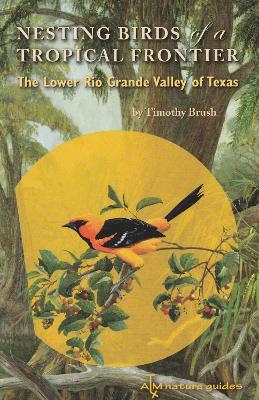
Nesting Birds of a Tropical Frontier
The Lower Rio Grande Valley of Texas
Seiten
2005
Texas A & M University Press (Verlag)
978-1-58544-490-8 (ISBN)
Texas A & M University Press (Verlag)
978-1-58544-490-8 (ISBN)
Drawing on years of personal observation and study, the author writes a work of natural history about the little-known breeding bird communities of the Valley and the diversity of nesting strategies and behaviors that can be seen. Art and color photographs by several of Texas' top nature photographers show off some of the Valley's famous birds.
Halfway between Dallas and Mexico City, along the last few hundred miles of the Rio Grande, lies a subtropical outpost where people come from all over the world to see birds. Located between the temperate north and the tropic south, with desert to the west and ocean to the east, the Lower Rio Grande Valley of Texas provides habitat for a variety of birds seen nowhere else in the United States. If you want to see a Hooked-billed Kite, Muscovy Duck, or Altamira Oriole, this is the place. Drawing on years of personal observation and study, Timothy Brush has written a classic work of natural history about the little-known breeding bird communities of the Valley and the diversity of nesting strategies and behaviors that can be seen. Brush estimates that there are more than 150 current breeding species in the Lower Rio Grande Valley. ""In Nesting Birds of a Tropical Frontier"", he describes the habits, distribution, changes in occurrence, and general outlook of these as well as former breeders, concentrating on Valley specialties and other birds of particular interest in the Valley. The species are all dependent upon appropriate habitat, from riparian forest to mesquite savannah, and Brush describes the history of these habitats and the special features that keep the birds coming. He also discusses conservation and the need for both large-scale land acquisitions by public and private groups and small-scale restoration through urban parks and individual landscaping. Art by Gerald Sneed and color photographs by several of Texas' top nature photographers show off some of the Valley's famous birds. Historical maps of vegetation and geology help us gain a better perspective on the changes that have taken place along the Rio Grande and on the breeding bird communities of the U.S. - Mexico frontier.
Halfway between Dallas and Mexico City, along the last few hundred miles of the Rio Grande, lies a subtropical outpost where people come from all over the world to see birds. Located between the temperate north and the tropic south, with desert to the west and ocean to the east, the Lower Rio Grande Valley of Texas provides habitat for a variety of birds seen nowhere else in the United States. If you want to see a Hooked-billed Kite, Muscovy Duck, or Altamira Oriole, this is the place. Drawing on years of personal observation and study, Timothy Brush has written a classic work of natural history about the little-known breeding bird communities of the Valley and the diversity of nesting strategies and behaviors that can be seen. Brush estimates that there are more than 150 current breeding species in the Lower Rio Grande Valley. ""In Nesting Birds of a Tropical Frontier"", he describes the habits, distribution, changes in occurrence, and general outlook of these as well as former breeders, concentrating on Valley specialties and other birds of particular interest in the Valley. The species are all dependent upon appropriate habitat, from riparian forest to mesquite savannah, and Brush describes the history of these habitats and the special features that keep the birds coming. He also discusses conservation and the need for both large-scale land acquisitions by public and private groups and small-scale restoration through urban parks and individual landscaping. Art by Gerald Sneed and color photographs by several of Texas' top nature photographers show off some of the Valley's famous birds. Historical maps of vegetation and geology help us gain a better perspective on the changes that have taken place along the Rio Grande and on the breeding bird communities of the U.S. - Mexico frontier.
TIMOTHY BRUSH is an associate professor of biology at the University of Texas - Pan American in Edinburg. He has been observing, studying, and writing about the birds of the Lower Rio Grande Valley for over a decade.
| Erscheint lt. Verlag | 30.11.2005 |
|---|---|
| Zusatzinfo | 31 colour photos & 10 paintings, 6 maps, bibliography, index |
| Verlagsort | College Station |
| Sprache | englisch |
| Maße | 156 x 236 mm |
| Gewicht | 497 g |
| Themenwelt | Sachbuch/Ratgeber ► Natur / Technik ► Naturführer |
| ISBN-10 | 1-58544-490-1 / 1585444901 |
| ISBN-13 | 978-1-58544-490-8 / 9781585444908 |
| Zustand | Neuware |
| Informationen gemäß Produktsicherheitsverordnung (GPSR) | |
| Haben Sie eine Frage zum Produkt? |
Mehr entdecken
aus dem Bereich


aus dem Bereich
Buch | Hardcover (2019)
Quelle & Meyer (Verlag)
CHF 55,90
Die Tagfalter und Widderchen Deutschlands
Buch | Softcover (2025)
Verlag Eugen Ulmer
CHF 33,90


