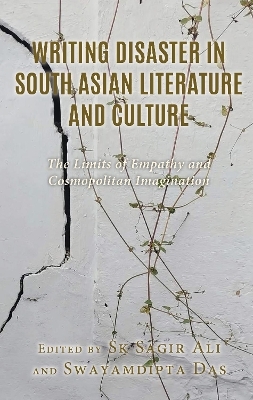
Writing Disaster in South Asian Literature and Culture
Lexington Books (Verlag)
978-1-6669-5147-9 (ISBN)
Writing Disaster in South Asian Literature and Culture: The Limits of Empathy and Cosmopolitan Imagination looks at the myriad ways in which disaster events (both man-made and natural) are perceived and represented in South Asian literature and culture. This book explores the affective mechanisms of empathy and imaginary identification which are conditioned and reiterated by biopolitical statist regimes of power to preempt and coopt any radical agential or cognitive intervention which might be evinced by the event of the disaster. The contributors also examine South Asian disasters vis-a-vis the registers of ecological crises, migration events, civil and liberation wars, and pandemics to understand the multifarious ways in which such ‘disasters’ are used as tropes to peddle certain structures of interpellation in the collective consciousness.
Sk Sagir Ali is assistant professor of English literature at Midnapore College in West Bengal, India. Swayamdipta Das is lecturer in the Department of English at Narasinha Dutt College in West Bengal, India.
Introduction: Sk. Sagir Ali and Swayamdipta Das
Part I: Ecological Disasters and the Statist Contours of Conditional Empathy
Chapter One: Ecological Crises to Socio-Political Disaster: Revisiting the Politics of Empathy Around Marichjhapi Massacre and the Dalit Question, Madhumita Biswas
Chapter Two: Ecological Disaster And The River of Stories—Resuscitating Empathy Through Graphic Narratives, Pritha Banerjee
Chapter Three: Simulations of the Future: Climate Change and Disaster in Contemporary Indian Science Fiction in English, Swati Moitra
Chapter Four: Magic Realism and Trauma: A Study of Comingling of Spaces in Amitav Ghosh’s Gun Island, Nilanjan Chakraborty
Part II: Migration, Displacement, and the Cosmopolitan Gaze: The Monolingualism of the Disaster Imagination
Chapter Five: Can Disaster be Known in the Light of the Language? Unity and Possibility of the Future in Shaktipada Rajguru’s Dandak Theke Marichjhapi, Joydip Datta and Samrat Sengupta
Chapter Six: Fear of Refugee and Disaster: Monstrosity, Risky Body, and Moral Panic in Exit West, Sk. Sagir Ali
Chapter Seven: Systemic Strategies of Identity Constructions and Deliberate Exclusions: Understanding the Socio, Economic and Political Circumstances of Rohingya Muslims in Myanmar, Rajeesh CS
Part III: Disasters and Other Heterotopias: Disaster Poetics and the Re-writing of the Postcolonial Nation-State
Chapter Eight: Re-imagining Disaster Capitalism through Fecopoetics and the Literature of Waste: Fyatarus and the beyond of the Empathy Machine in the Short Stories of Nabarun Bhattacharya, Swayamdipta Das
Chapter Nine: War, Religion, and Terror: Syed Shamsul Haq’s Two Novellas Blue Venom and Forbidden Incense, Mohammad Shafiqul Islam
Chapter Ten: Global Catastrophe, Local Residues: Re-Thinking The ‘Global-Local’ Dynamic In Imagining Catastrophes Through Bishnu Dey’s ‘Cassandra’ Poems’, Subhayu Bhattacharjee
Chapter Eleven: The Vanishing Dead: Memory, Necropolitics and the Modern State, Debamitra Kar
Part IV: Pandemics, Public Health Disasters, and Biopolitical Regimes of Control
Chapter Twelve: Marked by Disposable Deaths: Mourning and Community in Times of Pandemic, Shinjini Basu
Chapter Thirteen: Gendered Empathy and its Impact on Efficient Pandemic Management, Sudeshna Mukherjee
About the Contributors
| Erscheinungsdatum | 23.03.2024 |
|---|---|
| Co-Autor | Sk Sagir Ali, Pritha Banerjee, Shinjini Basu |
| Sprache | englisch |
| Maße | 158 x 236 mm |
| Gewicht | 513 g |
| Themenwelt | Sachbuch/Ratgeber ► Natur / Technik ► Natur / Ökologie |
| Geisteswissenschaften ► Geschichte | |
| Geisteswissenschaften ► Sprach- / Literaturwissenschaft ► Anglistik / Amerikanistik | |
| Geisteswissenschaften ► Sprach- / Literaturwissenschaft ► Literaturwissenschaft | |
| ISBN-10 | 1-6669-5147-1 / 1666951471 |
| ISBN-13 | 978-1-6669-5147-9 / 9781666951479 |
| Zustand | Neuware |
| Informationen gemäß Produktsicherheitsverordnung (GPSR) | |
| Haben Sie eine Frage zum Produkt? |
aus dem Bereich