


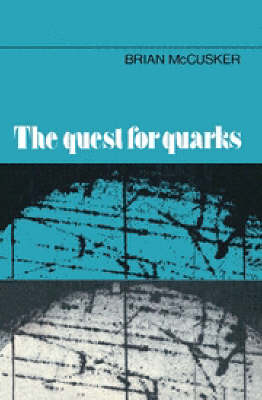
The Quest for Quarks
Seiten
1983
Cambridge University Press (Verlag)
978-0-521-24850-1 (ISBN)
Cambridge University Press (Verlag)
978-0-521-24850-1 (ISBN)
This short introduction to elementary particles poses the questions: are quarks the fundamental building blocks of matter; what are they like; how many different kinds exist; and can they exist in a free state? It discusses the ultimate structure of matter: atoms, the nucleus, protons, neutrons and pions, and quarks.
This short account of elementary particles written for the layman poses the questions: are quarks the fundamental building blocks of matter; what are they like; how many different kinds exist; and can they exist in the free state? What is the ultimate structure of matter? Is it made of atoms, small, simple, indivisible particles, or not? John Dalton's 'chemical atoms' turned out to be composite, composed of an electron cloud and a very small, very dense nucleus. This nucleus, in turn, was found to be composite, made up of protons and neutrons bound together by pions. All three of these (and many like particles) have now been found to be made of quarks. At first there were only three of these and they were thought to be long sought after fundamental building blocks. But now we know of at least 18 quarks, 18 anti-quarks and eight 'gluons' that hold the quarks together. The whole atomic idea is in doubt and the alternate possibility of a Universe that is one, whole and indivisible opens up. This fascinating book will be an inspiration to anyone wishing a first exposure to this intriguing and mystical area of modern physics.
This short account of elementary particles written for the layman poses the questions: are quarks the fundamental building blocks of matter; what are they like; how many different kinds exist; and can they exist in the free state? What is the ultimate structure of matter? Is it made of atoms, small, simple, indivisible particles, or not? John Dalton's 'chemical atoms' turned out to be composite, composed of an electron cloud and a very small, very dense nucleus. This nucleus, in turn, was found to be composite, made up of protons and neutrons bound together by pions. All three of these (and many like particles) have now been found to be made of quarks. At first there were only three of these and they were thought to be long sought after fundamental building blocks. But now we know of at least 18 quarks, 18 anti-quarks and eight 'gluons' that hold the quarks together. The whole atomic idea is in doubt and the alternate possibility of a Universe that is one, whole and indivisible opens up. This fascinating book will be an inspiration to anyone wishing a first exposure to this intriguing and mystical area of modern physics.
Acknowledgements; 1. The structure of matter; 2. The strange particles; 3. Quarks; 4. The great accelerator hunt; 5. The quest for the free quark; 6. Matter and the Universe; Index.
| Erscheint lt. Verlag | 3.11.1983 |
|---|---|
| Verlagsort | Cambridge |
| Sprache | englisch |
| Maße | 152 x 228 mm |
| Gewicht | 360 g |
| Themenwelt | Sachbuch/Ratgeber ► Natur / Technik |
| ISBN-10 | 0-521-24850-7 / 0521248507 |
| ISBN-13 | 978-0-521-24850-1 / 9780521248501 |
| Zustand | Neuware |
| Informationen gemäß Produktsicherheitsverordnung (GPSR) | |
| Haben Sie eine Frage zum Produkt? |
Mehr entdecken
aus dem Bereich
aus dem Bereich
wenn Mensch und Maschine eins werden
Buch | Hardcover (2024)
Piper (Verlag)
CHF 33,55


