Field Notes on Listening (eBook)
156 Seiten
Wolsak and Wynn (Verlag)
978-1-989496-85-5 (ISBN)
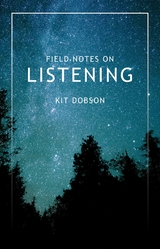
When Kit Dobson's daughter looked at the field of stars on the screen at the beginning of a new Star Wars movie in the theatre and remarked to her father, 'Yeah, right. There's not that many stars,' Dobson suddenly realized his daughter had never truly seen the night sky. From then on Dobson began to think seriously about how little we, as humans, interact with the natural world and how that has changed our place within it. Field Notes on Listening is a response to our lack of connection to the land we call home, the difficult history of how many of us came to be here and what we could discover if we listened deeply to the world around us. Written in brief, elegant sections, Field Notes on Listening starts at Dobson's kitchen table, a family heirloom, and wends through time and space, looking at his family's lost farm, the slow violence of climate change, loss of habitat, the tensions of living in late-stage capitalism and through careful listening strives to find a way through it all, returning, in the end, to home and the same table.
II
We find speaking of the Anthropocene, even speaking in the Anthropocene, difficult. It is, perhaps, best imagined as an epoch of loss – of species, places and people – for which we are seeking a language of grief and, even harder to find, a language of hope.
– Robert Macfarlane, Underland: A Deep Time Journey
But the only people who hear the saints and philosophers are those who keep on listening.
– Robert Bringhurst and Jan Zwicky, Learning to Die: Wisdom in the Age of Climate Crisis
The second date written on the bottom of the dining-room table is 1988, when the table was rebuilt. This date is written in my father’s handwriting. In that year, while we were living in Vancouver, he disassembled and reconstructed the table. He also made two leaves as inserts to expand it. These leaves were – and are – a near match to the original wood, though they have always left a very slight gap when they are put in. The dowel ends slot just a little bit unevenly into holes long-since drilled into the tabletop. I spent many an afternoon oiling the wood surface, especially once my parents gave the table to us for our growing household. They shipped it from Calgary all the way to Halifax, where we were living after my studies. It occupied pride of place alongside the wooden pressback chairs that my parents first acquired in Ontario in the 1970s. And then, only a few months later, we found ourselves moving back to Calgary and, as a result, shipped the table right back to the city from which it had come.
One summertime, not long ago, I was driving my rusting, aging Mazda west on Calgary’s 17th Avenue. Seventeenth Avenue has felt down on its luck of late, even before the pandemic. To me, though, it remains a central and in many ways well-heeled strip of the city. It houses a number of trendy restaurants, bars, nightclubs and shops. Some are still open, while other empty storefronts wait for the times to improve. On this particular summer day, it was full of life. It was a sunny afternoon and people came out of the woodwork to stroll the streets, people-watch and catch the warm sunshine. This was during the last oil boom. I ended up driving behind a Lamborghini. I don’t recall its colour, nor its specific model, but I could peer into the wee rear window and see a youngish man behind the wheel. I have never seen anyone who wasn’t a dude driving a Lamborghini. For the sake of what follows, let’s say that the Lamborghini was blue. We drove along. The man was driving slowly, showing off his symbol of wealth and status. People looked at his shiny car. Then they looked past my clunky yet effective ride. We pulled up to a light. Just before the light changed to green, a car turned into our flow of traffic. It was another Lamborghini. Let’s say that this one was yellow, but otherwise the same in all significant respects. It was driven by another youngish man. Presumably he had also been enriched by the boom. Presumably he was also unencumbered by many responsibilities. Calgary was like this during the boom years, and it was particularly evident in the summertime. Expensive cars came out to enjoy the warmth, not unlike mosquitoes, wasps and other biting and stinging insects. We were now in a procession: yellow Lamborghini, blue Lamborghini and me in my Mazda. People looked at the Lambos. I nodded to an onlooker. I received a look of mild disdain in return. The Lamborghinis seemed uncomfortable, however. They started to weave a little bit in the lane, posturing, showing off. Then, as we went through an intersection, the blue Lamborghini peeled off, turning the corner with a loud engine roar. He did so in order to get out, I supposed, from under the shadow of the usurper: the newly arrived, yellow Lamborghini that had supplanted him at the head of the column. Fair enough. We drove on. The traffic was calm. The day was grand. A minute or two later, we passed another block. A car turned onto the road behind me. It was the same Lamborghini, the blue one. It must have driven around the next block in an attempt to get back into the lead, only to end up third in our revised parade: yellow Lamborghini, rusting Mazda, blue Lamborghini. We drove along in our glory. This time I waved to an onlooker. I got an enthusiastic, single-fingered wave in response. The Lamborghini motors hummed. My Mazda chugged. We left the main strip of 17th Avenue and I turned south. The story ends there. Calgary is no longer like this, but it was once. Many Calgarians are praying for the day when the Lamborghinis return in their former numbers. They are sifting the runes and reading the prophecies, hoping for a sign. Others among us are looking to the future, knowing that something else will be coming.
On another day, not long before the world turned, we were in Edmonton. The day was loud, crisp and sunny. Greta Thunberg stood on the steps of the legislature, sixteen years old, wearing a down jacket. “Can you see her?” I asked my kids. “I can see her eyebrows,” one of them answered. It was only a few months before the pandemic. I didn’t expect Thunberg to be carrying the same sign that I had seen in the pictures, but she was. It was on plywood, black text on white paint: skolstrejk för klimatet. After local organizers spoke – Indigenous people, people of colour, youth – Thunberg’s turn came. Ten thousand people cheered. I had been rallying and protesting and marching in solidarity since the 1990s, starting with a rally against Alberta’s then premier Ralph Klein’s cuts to education, yet this was the largest demonstration that I had ever seen in this province. Thunberg’s message was distinct. It rang out across the filled square, overtop of the few angry white men in the crowd. These men were outnumbered, it seemed, by a thousand to one. Later, they would be given airtime in the media in the name of including “both sides of the story.” Listen, Thunberg said, and thank you. She acknowledged the territory, the Indigenous land keepers, and she was unmincing in her speech. Listen to science, she repeated. Listen to the youth. We cheered and spoke back to a relentless provincial government. I reflected on the scene, finding that I was giving up on my generation and investing my hopes in the young. My generation is proving itself to be inadequate to the challenge. Standing there, we focused on Thunberg’s speech, not on the climate change denier behind us. My children held my hands, which is increasingly rare as they age. And then it was over. The crowd began to move. We found ourselves next to a police cordon of bikes. It had been set up in order to provide an exit from the podium. A human chain of young people formed around Thunberg. Then, all of a sudden, we were next to her. Her eyes scanned us, serious. She smiled and then thanked the reporter who had sidled up beside her. She was short, we observed, much shorter than any of us. What does it take to create a movement? How can one motivate a global audience? I lamented the cowardice of my age. I recognized a tiny shard of myself in the angry, aging white men. They felt that their way of life was under siege. In some ways, it is, because we cannot continue to live in the ways that we have done. I feel that tension too, if I am honest. It is not a feeling that I enjoy. I can see how I have been trying to build a safe life for my children. How I have hardened to my own contradictions in order to try to make their lives possible. Yet Thunberg was right on that day: the world is changing, it must change and it will change. The task is to learn to listen. If I do well, I might help to create a future that is not dominated by people who look like I do. Whatever might happen in the future, though, for the moment, Thunberg’s message sufficed. And then she was gone. We cleared out of the grounds.
A few months later, just before I was forced to come home from Spain, I visited the village of Ledesma. I had been reflecting for a long time on what it might mean to live in an era defined by human impacts on the environment – an idea summed up by those who use the term Anthropocene to characterize this epoch. By then we were all watching the news reports of a new and ill-understood virus that was starting to spread rapidly. Ledesma is a small, now partly depopulated village not far from Salamanca. It is famous for raising bulls for the bullfights. The Romans knew it as Bletisa. A friend drove the two of us through Salamanca and across the countryside, past empty early March fields and groves of oaks, charting along the Río Tormes. Before long, the riverbed opened into a shallow gorge that was strewn with rocks. Small boulders dotted the landscape. The town was perched on top of a hill, where it straddled the river, with two bridges – the new, serviceable one and the older one. We crossed the river and entered the town centre. After seeking directions, we found the taberna where we had lunchtime reservations. We were late, the tavern keeper told us. She cheerfully ushered us in nonetheless through the low door. The restaurant was packed. It was a marked contrast to the almost deserted town outside. I stood out because I was a foot or so taller than most of the locals. All of the locals were aged. Youth seemed to be nowhere in sight. Every time that I turned in the tavern, the owners reached up to put their hands to my head to make sure that I didn’t injure myself. It was welcome guidance, as the doorways were very low indeed. Even the ceiling was not much greater than my six feet. We sat in one corner of the small, full room. We ate a delicious meal. I had garlic soup (mostly meat), followed by a plate of excellently cooked pork. There were no side dishes or vegetables, just...
| Erscheint lt. Verlag | 14.6.2022 |
|---|---|
| Sprache | englisch |
| Themenwelt | Literatur ► Anthologien |
| Literatur ► Biografien / Erfahrungsberichte | |
| Literatur ► Essays / Feuilleton | |
| Literatur ► Romane / Erzählungen | |
| Sachbuch/Ratgeber ► Natur / Technik ► Natur / Ökologie | |
| Geisteswissenschaften ► Sprach- / Literaturwissenschaft ► Literaturwissenschaft | |
| Naturwissenschaften ► Biologie ► Ökologie / Naturschutz | |
| Schlagworte | Canada • Canadian • Canadiana • Literary • Memoir • Nature • personal essays |
| ISBN-10 | 1-989496-85-7 / 1989496857 |
| ISBN-13 | 978-1-989496-85-5 / 9781989496855 |
| Informationen gemäß Produktsicherheitsverordnung (GPSR) | |
| Haben Sie eine Frage zum Produkt? |
 EPUB (Ohne DRM)
Digital Rights Management: ohne DRM
Dieses eBook enthält kein DRM oder Kopierschutz. Eine Weitergabe an Dritte ist jedoch rechtlich nicht zulässig, weil Sie beim Kauf nur die Rechte an der persönlichen Nutzung erwerben.
Dateiformat: EPUB (Electronic Publication)
EPUB ist ein offener Standard für eBooks und eignet sich besonders zur Darstellung von Belletristik und Sachbüchern. Der Fließtext wird dynamisch an die Display- und Schriftgröße angepasst. Auch für mobile Lesegeräte ist EPUB daher gut geeignet.
Systemvoraussetzungen:
PC/Mac: Mit einem PC oder Mac können Sie dieses eBook lesen. Sie benötigen dafür die kostenlose Software Adobe Digital Editions.
eReader: Dieses eBook kann mit (fast) allen eBook-Readern gelesen werden. Mit dem amazon-Kindle ist es aber nicht kompatibel.
Smartphone/Tablet: Egal ob Apple oder Android, dieses eBook können Sie lesen. Sie benötigen dafür eine kostenlose App.
Geräteliste und zusätzliche Hinweise
Buying eBooks from abroad
For tax law reasons we can sell eBooks just within Germany and Switzerland. Regrettably we cannot fulfill eBook-orders from other countries.
aus dem Bereich