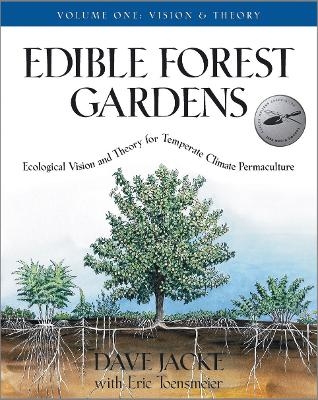
Edible Forest Gardens, Volume 1
Chelsea Green Publishing Co (Verlag)
9781931498791 (ISBN)
Edible Forest Gardens is a groundbreaking two-volume work that spells out and explores the key concepts of forest ecology and applies them to the needs of natural gardeners in temperate climates. Volume I lays out the vision of the forest garden and explains the basic ecological principles that make it work. In Volume II, Dave Jacke and Eric Toensmeier move on to practical considerations: concrete ways to design, establish, and maintain your own forest garden. Along the way they present case studies and examples, as well as tables, illustrations, and a uniquely valuable "plant matrix" that lists hundreds of the best edible and useful species.
Taken together, the two volumes of Edible Forest Gardens offer an advanced course in ecological gardening--one that will forever change the way you look at plants and your environment.
Dave Jacke has been a student of ecology and design since the 1970s, and has run his own ecological design firm—Dynamics Ecological Design Associates—since 1984. Dave is an engaging and passionate teacher of ecological design and permaculture, and a meticulous designer. He has consulted on, designed, built, and planted landscapes, homes, farms, and communities in the many parts of the United States, as well as overseas, but mainly in the Northeast. A cofounder of Land Trust at Gap Mountain in Jaffrey, NH, he homesteaded there for a number of years. He holds a B.A. in Environmental Studies from Simon's Rock College (1980) and a M.A. in Landscape Design from the Conway School of Landscape Design (1984). You can learn more about his work at edibleforestgardens.com. He lives in Keene, New Hampshire. Eric Toensmeier is the award-winning author of Paradise Lot and Perennial Vegetables, and the co-author of Edible Forest Gardens. Eric is an appointed lecturer at Yale University, a Senior Fellow with Project Drawdown, and an international trainer. He presents in English and Spanish throughout the United States, Canada, Mexico, Guatemala, and the Caribbean. Eric has studied useful perennial plants and their roles in agroforestry systems for over two decades, and cultivates about 300 species in his urban garden. His writing can be viewed online at perennialsolutions.org.
List of Tables and Figures
Preface
Introduction: An Invitation to Adventure
What Is an Edible Forest Garden?
Gardening LIKE the Forest vs. Gardening IN the Forest
Where Can You Grow a Forest Garden?
The Garden of Eden: It Sounds Great, But Is It Practical?
An Invitation to Adventure
1: The Forest and the Trees
The Primal Forest: A Remembrance
Gardening the Forest
Forest Remnants
Feature Article 1: Natives and Exotics: Definitions and Questions
Suburban Ecology
Gardening in the Industrial Image
Lessons Learned
Box 1-1: Shifting the Burden to the Intervenor
2: Visions of Paradise
Study of the Household: Ecology Defined
Tales of Mimicry
Advantages of Forest Mimicry
The Limitations of Forest Mimics
Spanning the Gamut: Images of Forest Gardens
Goals of Forest Gardening
Revision--the Garden of Eden?
Box 2-1: The Principle of Functional Interconnection
Case Study 1: Charlie's Garden
Part Two: Ecology: Form and Function in the Forest Garden
3: The Five Elements of Forest Architecture
Vegetation Layers
Feature Article 2: With All These Layers, What Do I Grow in the Shade?
Soil Horizons
Density
Patterning
Diversity
Summary
Case Study 2: Robert's Garden
4: Social Structure: Niches, Relationships and Communities
Species, Species Niches, and Species Relationships
Multi-Species Interactions: Frameworks of Social Structure
Feature Article 3: Natives and Exotics, Opportunists and Invasives
Social Structure Design: Strategies and Anchors
Chapter Summary
5: Making A Living In The Dark: Structures of the Underground Economy
The Anatomy of Self-Renewing Fertility
Feature Article 4: Parent Materials: The Soil's Nutritional Constitution
Plant Roots: Engines of the Underground Economy
The Soil Food Web
Summary: Dabbling In The Underground Economy
6: Succession: Four Perspectives on Vegetation Dynamics
Classical Linear Succession and Climax
Progressive Succession to Shifting Mosaic Steady State
Patch Dynamics: Out of Line and Out of Balance
A "Unified Oldfield Theory": Successional Causes
Feature Article 5: "Invasive" Plants and the Unified Oldfield Theory
Succession Design: Using the Four Models
Summary: The Simultaneity of the Four Models
Case Study 3: E.F. Schumacher Forest Garden
Conclusion: Elements, Dynamics, and Desired Conditions
Appendices
Appendix 1: Forest Gardening's "Top 100" Species
Appendix 2: Plant Hardiness Zone Maps
Appendix 3: Publications and Organizations
Bibliography
Glossary
General Index
| Erscheint lt. Verlag | 9.7.2013 |
|---|---|
| Zusatzinfo | Index; Bibliography; Charts; Illustrations, color |
| Verlagsort | White River Junction |
| Sprache | englisch |
| Maße | 235 x 261 mm |
| Gewicht | 1066 g |
| Themenwelt | Sachbuch/Ratgeber ► Natur / Technik ► Garten |
| Naturwissenschaften ► Biologie ► Ökologie / Naturschutz | |
| ISBN-13 | 9781931498791 / 9781931498791 |
| Zustand | Neuware |
| Informationen gemäß Produktsicherheitsverordnung (GPSR) | |
| Haben Sie eine Frage zum Produkt? |
aus dem Bereich