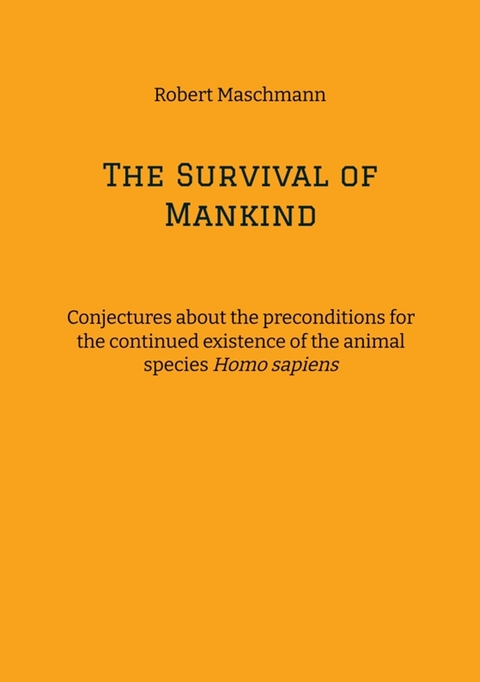
The Survival of Mankind (eBook)
128 Seiten
tredition (Verlag)
978-3-384-06070-9 (ISBN)
Robert Ludwig Maschmann ist Diplom-Soziologe und wurde am 16.02.1962 in Mallersdorf im Landkreis Straubing/Bogen geboren. Aufgewachsen ist er in Geiselhöring, ebenfalls im Landkreis Straubing/Bogen. Sein Abitur legte er im Jahre 1981 am Ludwigsgymnasium in Straubing ab. Danach studierte er von 1982 bis 1988 Soziologie und Philosophie an der Universität Regensburg. Robert Maschmann lebt in in Regensburg und arbeitet dort als Dozent, Schriftsteller und Autor philosophischer Fachbücher. Seine philosophischen Interessen gelten vor allen Dingen Arthur Schopenhauer, Friedrich Nietzsche und E.M. Cioran. Ebenso hat er sich intensiv mit fernöstlicher Philosophie beschäftigt, insbesondere mit dem Zen-Buddhismus. Seine literarischen Interessen gelten hauptsächlich Samuel Beckett und Franz Kafka.
Robert Ludwig Maschmann ist Diplom-Soziologe und wurde am 16.02.1962 in Mallersdorf im Landkreis Straubing/Bogen geboren. Aufgewachsen ist er in Geiselhöring, ebenfalls im Landkreis Straubing/Bogen. Sein Abitur legte er im Jahre 1981 am Ludwigsgymnasium in Straubing ab. Danach studierte er von 1982 bis 1988 Soziologie und Philosophie an der Universität Regensburg. Robert Maschmann lebt in in Regensburg und arbeitet dort als Dozent, Schriftsteller und Autor philosophischer Fachbücher. Seine philosophischen Interessen gelten vor allen Dingen Arthur Schopenhauer, Friedrich Nietzsche und E.M. Cioran. Ebenso hat er sich intensiv mit fernöstlicher Philosophie beschäftigt, insbesondere mit dem Zen-Buddhismus. Seine literarischen Interessen gelten hauptsächlich Samuel Beckett und Franz Kafka.
2 Mankind
I am sure that if you were to ask random people in a pedestrian zone in any city in the world what is meant by "Mankind", most people would answer that "Mankind" means the totality of all people who live on Earth or who exist on Earth. But, as I will show in a moment, this would not be a meaningful and useful definition of the term “Mankind”. The simple reason for this is that this definition of the term "Mankind" is, on the one hand, too imprecise to be able to use it meaningfully, since this definition of Mankind does not specify a concrete point in time at which these people live on Earth and, on the other hand, is again too narrowly defined, because Mankind then consists, even if one specifies a certain point in time, not only of the people who live on Earth at this certain point in time, but also of the people who lived on Earth before this certain point in time and who will have lived on Earth after this point in time.
The statement that Mankind means all human beings who live or exist on Earth would only define the term "Mankind" correctly in its generality if all human beings who live on Earth had always been immortal inner-worldly and if they had never at any time begotten human beings. If the number of human beings on Earth were constant, because these human beings had always been immortal inner-worldly and at the same time had never begotten "new" human beings, then the human beings living today would be identical with the human beings living yesterday and also identical with the human beings living tomorrow, and then and only then would Mankind always be identical with the totality of human beings living on Earth.
The statement: "Mankind is the totality of all people living on Earth" would therefore only be correct in this generality if people had always been immortal inner-worldly and had never fathered children, because the quantity or totality of all living people is not constant and changes permanently, since people are constantly being born, but people are also constantly dying. At the moment, an average of about 4.3 people are born and about 1.8 people die every second worldwide. In this sense, Mankind is growing by about 2.5 people per second. Or by about 80 million people per year. The fact that the exact number of people born and died per year, per day or even per second cannot of course be determined exactly is not relevant for the definition of the term "Mankind". What is relevant for this definition is only that the number of living people is not constant and that this number changes permanently due to the birth and death of people. And this is indisputably so.
If one were to make the statement that Mankind is the totality of all people living on Earth, then, since the totality of people living on Earth is constantly changing, one must always specify a certain period of time within the framework of which the totality of people living on Earth or who exist is to be determined.
If, for example, a speaker were then to preface her statement: "Mankind is the totality of all people who live on Earth." and say that Mankind consists of the totality of all people who live on Earth today, then she would also have to specify this "today" once again by stating the exact time, which date is actually meant by "today".
Thus, if by "today" (assumed) the speaker meant the day 01.01.2023 from 00:00 o’clock to 24:00 o’clock, one could then determine Mankind on the day 01.01.2023 and call the thus determined totality of people who were alive on the day 01.01.2023 "Mankind on the day 01.01.2023". If one had wanted to include the totality of all people who made up Mankind on the day 01.01.2023, then one would have had to wait until the day 01.01.2023 was over and history, since until the end of the day 01.01.2023 the number of living people would have changed constantly through death and above all through the birth of people.
Therefore, it would only make sense to say that Mankind on the day 01.01.2023 consists of the totality of all people who lived and existed on Earth during this day 01.01.2023, since it is only in retrospect that one can survey the entire period of this day 01.01.2023 and thus also the number of people who lived and existed on this day, since, to repeat, the number of people who live and exist is constantly changing due to the fact that people are born, but also people die. The totality of all people who would form Mankind on the day 01.01.2023 would then be the people who were alive and lived on Earth at the beginning of this day 01.01.2023 plus the approximately 216,000 people who during this day 01.01.2023 joined Mankind as "new" people, so to speak, through their birth. The people who were alive at the end of the day 01.01.2023 are then those people who form the totality of all people who are alive at the beginning of the day 02.01.2023. These are the people who were alive at the beginning of the day 01.01.2023 minus the approximately 155,520 people who died during the day 01.01.2023 and plus the approximately 371,520 people who were born on the day 01.01.2023. How do I arrive at these 216,000, 155,520 and 371,520 people? Quite simple.
The day 01.01.2023 has a total of 24 hours. These 24 hours have 1440 minutes, and these 1440 minutes have 86,400 seconds. If we take the average mortality rate of currently about 1.8 people per second, then about 155,520 people will have died on the day 01.01.2023. If we take the average birth rate of currently about 4.3 people per second, then on this day 01.01.2023 about 371,520 people will have been born. This means that on this day 01.01.2023 Mankind will have grown by about 216,000 people.
In order to clarify these relationships once again, I will construct a small model of Mankind at this point, in which I will determine that the total population of people on the day 01.01.2023 at 00:00 o’clock consists of the people P1 to P1000. Of these people P1 to P1000, the people P1 to P10 are assumed to die in the period of the day 01.01.2023. At the same time, however, the people P1001 to P1022 are born in this period of the day 01.01.2023. On the day 01.01.2023 at 24:00 o’clock sharp, the total population of people then consisted of people P11 to P1022. The number of people alive during this period has thus increased by 12 people during this period of the day 01.01.2023 from 00:00 o’clock to 24:00 o’clock as 10 people died and 22 people were born. It can be clearly seen that the composition of people living and existing in a given period is constantly changing due to the birth and death of people. Furthermore, the number of people also increases steadily over the course of this period, as more people are born than die.
The Mankind on the day 01.01.2023 at 00:00 o'clock consisted at this time of the people P1 to P1000 and on the day 01.01.2023 at 24:00 o'clock at this time of the people P11 to P1022. These people P11 to P1022 now form the total population of people on the day 02.01.2023 at 00:00 o'clock. Of these people P11 to P1022, people P11 to P20 are assumed to die in the period of the day 02.01.2023. At the same time, however, people P1023 to P1044 are assumed to be born in this period of the day 02.01.2023. On the day 02.01.2023 at 24:00 o'clock, the total population of people then consists of the people P21 to P1044, who in turn form the total population of people on the day 03.01.2023 at 00:00 o'clock. And so on.
If one considers the entire period of the day 01.01.2023 from 00:00 o’clock to 24:00 o’clock, then the totality of all people who were alive and existed in this period consists of the people P1 to P1022. These people P1 to P1022 then form the Mankind on the day 01.01.2023. The Mankind on the day 02.01.2023 would then have consisted of the people P11 to P1044, as these were the people who were alive and existed during the entire period of the day 02.01.2023. As can be seen, the term "Mankind" in this small model of Mankind denotes something different in relation to the day 01.01.2023 than in relation to the day 02.01.2023. This would of course also be the case if one were to determine the actual number of people who were alive and existed on the day 01.01.2023 and on the day 02.01.2023.
If, however, one was to determine only Mankind on the day 01.01.2023, as in the above example, then one would exclude from the determination of Mankind all those people who were still alive on the day 31.12.2022, but who were no longer alive at the beginning of the day 01.01.2023, but who would undisputedly have to be added to Mankind, since they existed as human beings.
The first problem that arises from the specification of a certain period of time for the determination of a totality of people who are then to be Mankind is that all those people would be excluded from the determination of Mankind who lived or were alive on Earth before and after this period of time but would have to be counted as part of Mankind because they existed as human beings.
However, a second problem also arises from the specification of a certain period of time for the determination of a totality and a set of people who are then supposed to be Mankind in this period of time. For if a speaker were always to specify an exact period of time to which this statement refers with the statement: "Mankind is the totality of all people living on Earth", then of course, as the above example has also shown, there would not be "the one Mankind", but as many Mankinds as totals of people could be determined who were alive in different periods of time. In principle and purely theoretically, this would then be an infinite number of...
| Erscheint lt. Verlag | 20.11.2023 |
|---|---|
| Verlagsort | Ahrensburg |
| Sprache | englisch |
| Themenwelt | Sachbuch/Ratgeber ► Gesundheit / Leben / Psychologie ► Partnerschaft / Sexualität |
| Geisteswissenschaften ► Philosophie | |
| Schlagworte | Das mögliche Ende der Menschheit • Das Schicksal der Menschheit • Das Schicksal der Tierart Homo sapiens • das Überleben der Menschheit • Das Überleben der Tierart Homo Sapiens |
| ISBN-10 | 3-384-06070-9 / 3384060709 |
| ISBN-13 | 978-3-384-06070-9 / 9783384060709 |
| Informationen gemäß Produktsicherheitsverordnung (GPSR) | |
| Haben Sie eine Frage zum Produkt? |
 EPUB (Wasserzeichen)
DRM: Digitales Wasserzeichen
Dieses eBook enthält ein digitales Wasserzeichen und ist damit für Sie personalisiert. Bei einer missbräuchlichen Weitergabe des eBooks an Dritte ist eine Rückverfolgung an die Quelle möglich.
Dateiformat: EPUB (Electronic Publication)
EPUB ist ein offener Standard für eBooks und eignet sich besonders zur Darstellung von Belletristik und Sachbüchern. Der Fließtext wird dynamisch an die Display- und Schriftgröße angepasst. Auch für mobile Lesegeräte ist EPUB daher gut geeignet.
Systemvoraussetzungen:
PC/Mac: Mit einem PC oder Mac können Sie dieses eBook lesen. Sie benötigen dafür die kostenlose Software Adobe Digital Editions.
eReader: Dieses eBook kann mit (fast) allen eBook-Readern gelesen werden. Mit dem amazon-Kindle ist es aber nicht kompatibel.
Smartphone/Tablet: Egal ob Apple oder Android, dieses eBook können Sie lesen. Sie benötigen dafür eine kostenlose App.
Geräteliste und zusätzliche Hinweise
Buying eBooks from abroad
For tax law reasons we can sell eBooks just within Germany and Switzerland. Regrettably we cannot fulfill eBook-orders from other countries.
aus dem Bereich