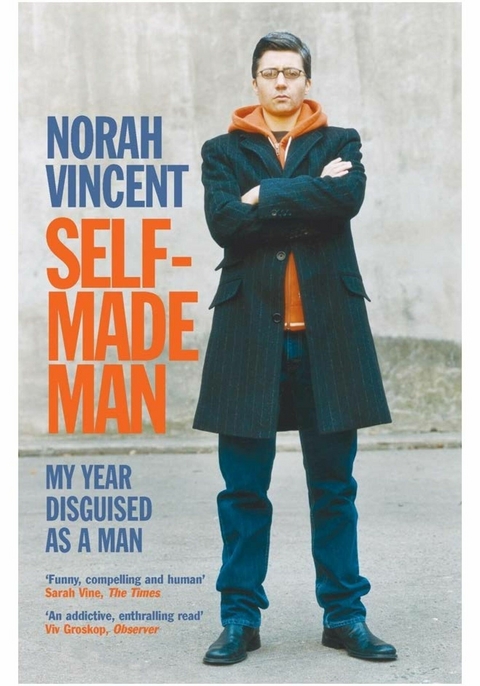
Self-Made Man (eBook)
304 Seiten
Atlantic Books (Verlag)
9781805462446 (ISBN)
NORAH VINCENT is a freelance journalist working in New York City. Self-Made Man is her first book.
Norah Vincent became an instant media sensation with the publication of Self-Made Man, her take on just how hard it is to be a man, even in a man's world. Vincent spent a year and a half disguised as her male alter ego, Ned, exploring what men are like when women aren't around. As Ned, she joined a bowling team, took a high-octane sales job, went on dates with women (and men), visited strip clubs, and even managed to infiltrate a monastery and a men's therapy group. At once thought-provoking and pure fun to read, Self-Made Man is a sympathetic and thrilling tour de force of immersion journalism.
Norah Vincent (1968-2022) was the New York Times bestselling author of the nonfiction books Self-Made Man and Voluntary Madness, as well as two works of fiction: Thy Neighbor and Adeline. Formerly an op-ed columnist for the Los Angeles Times, she was a long-time resident of New York City.
1 | Getting Started |
Seven years ago, I had my first tutorial in becoming a man.
The idea for this book came to me then, when I went out for the first time in drag. I was living in the East Village at the time, undergoing a significantly delayed adolescence, drinking and drugging a little too much, and indulging in all the sidewalk freak show opportunities that New York City has to offer.
Back then I was hanging around a lot with a drag king whom I had met through friends. She used to like to dress up and have me take pictures of her in costume. One night she dared me to dress up with her and go out on the town. I’d always wanted to try passing as a man in public, just to see if I could do it, so I agreed enthusiastically.
She had developed her own technique for creating a beard whereby you cut half-inch chunks of hair from unobtrusive parts of your own head, snipped them into smaller pieces and then more or less glopped them onto your face with spirit gum. Using a small, round freestanding mirror on her desk, she showed me how to do it in the dim, greenish light of her cramped studio apartment. It wasn’t at all precise and it wouldn’t have passed muster in daylight, but it was sufficient for the stage, and it would work well enough for our purposes in dark bars at night. I made myself a goatee and mustache, and a pair of exaggerated sideburns. I put on a baseball cap, loose-fitting jeans and a flannel shirt. In the full-length mirror I looked like a frat boy—sort of.
She did her thing—which was more willowy and faint, more like a young hippie guy who couldn’t really grow much of a beard—and we went out like that for a few hours.
We passed, as far as I could tell, but I was too afraid to really interact with anyone, except to give one guy brief directions on the street. He thanked me as “dude” and walked on.
Mostly, though, we just walked through the Village scanning people’s faces to see if anyone took a second or third look. But no one did. And that, oddly enough, was the thing that struck me the most about that evening. It was the only thing of real note that happened. But it was significant.
I had lived in that neighborhood for years, walking its streets, where men lurk outside of bodegas, on stoops and in doorways much of the day. As a woman, you couldn’t walk down those streets invisibly. You were an object of desire or at least semiprurient interest to the men who waited there, even if you weren’t pretty—that, or you were just another pussy to be put in its place. Either way, their eyes followed you all the way up and down the street, never wavering, asserting their dominance as a matter of course. If you were female and you lived there, you got used to being stared down because it happened every day and there wasn’t anything you could do about it.
But that night in drag, we walked by those same stoops and doorways and bodegas. We walked by those same groups of men. Only this time they didn’t stare. On the contrary, when they met my eyes they looked away immediately and concertedly and never looked back. It was astounding, the difference, the respect they showed me by not looking at me, by purposely not staring.
That was it. That was what had annoyed me so much about meeting their gaze as a woman, not the desire, if that was ever there, but the disrespect, the entitlement. It was rude, and it was meant to be rude, and seeing those guys looking away deferentially when they thought I was male, I could validate in retrospect the true hostility of their former stares.
But that wasn’t quite all there was to it. There was something more than respect being communicated in their averted gaze, something subtler, less direct. It was more like a disinclination to show disrespect. For them, to look away was to decline a challenge, to adhere to a code of behavior that kept the peace among human males in certain spheres just as surely as it kept the peace and the pecking order among male animals. To look another male in the eye and hold his gaze is to invite conflict, either that or a homosexual encounter. To look away is to accept the status quo, to leave each man to his tiny sphere of influence, the small buffer of pride and poise that surrounds and keeps him.
I surmised all of this the night it happened, but in the weeks and months that followed I asked most of the men I knew whether I was right, and they agreed, adding usually that it wasn’t something they thought about anymore, if they ever had. It was just something you learned or absorbed as a boy, and by the time you were a man, you did it without thinking.
After the incident had blown over, I started thinking that if after being in drag for only a few hours I had learned such an important secret about the way males and females communicate with each other, and about the unspoken codes of male experience, then couldn’t I potentially observe much more about the social differences between the sexes if I passed as a man for a much longer period of time? It seemed true, but I wasn’t intrepid enough yet to do something that extreme. Besides, it seemed impossible, both psychologically and practically, to pull it off. So I filed the information away in my mind for a few more years and got on with other things.
Then, in the winter of 2003, while watching a reality television show on the A&E network, the idea came back to me. In the show, two male and two female contestants set out to transform themselves into the opposite sex—not with hormones or surgeries, but purely by costume and design. The women cut their hair. The men had theirs extended. Both took voice and movement lessons to learn how to speak and behave more like the sex they were trying to become. All chose new wardrobes and names for their alter egos. Though the point of the exercise was to see who could pass in the real world most effectively, the bulk of the program focused on the transformations themselves. Neither of the men really passed, and only one of the women stayed the course. She did manage to pass fairly well, though only for a short time and in carefully controlled circumstances.
As in most reality television shows, especially the American ones, nobody involved was particularly introspective about the effect their experiences had had on them or the people around them. It was clear that the producers didn’t have much interest in the deeper sociological implications of passing as the opposite sex. It was all just another version of an extreme makeover. Once the stunt was accomplished—or not—the show was over.
But for me, watching the show brought my former experience in drag to the forefront of my mind again and made me realize that passing in costume in the daylight could be possible with the right help. I knew that writing a book about passing in the world as a man would give me the chance to survey some of the unexplored territory that the show had left out, and that I had barely broached in my brief foray in drag years before.
I was determined to give the idea a try.
But first things first. Before I could build this man I was to become, I had to think of an identity for him. I needed a name. The name had to be something familiar, something I might respond to when called. Failing to answer to my name would surely give me away as an impostor. For convenience I wanted something that started with the letter N. That narrowed the options considerably, and most of them were unappealing. There was no way, for example, that I was going to be known as Norman or Norm. Nick, when paired with Norah, seemed a little too clever by half, and Neil or Nate just didn’t suit me.
That’s when I hit upon the name Ned, a nickname from childhood that had long since fallen out of use, but one that was, as it happened, intimately tied to the project at hand.
I got the name Ned when I was about seven. I got it partly because Norah is a hard name to nick, but mostly because nothing but a boy’s name really made sense when you saw what my parents were faced with in their only daughter. Practically from birth, I was the kind of hard-core tomboy that makes you think there must be a gay gene.
How else to explain my instinctive loathing for dresses, dolls and frills of any kind when other girls delighted in such things? How else to explain the weird attachments and fetishes that came so young and against all social programming? Why, for example, did I insist on dressing like a ranch hand when I was barely out of diapers? Why did I choose to play the saxophone when every other girl chose the flute or the clarinet? Why did I covet my father’s tube of VO5, and shave my brothers’ GI Joes with his razors? Why was the only female doll I ever owned or liked an armor-clad Joan of Arc?
Impossible to say, really. Gender identity, it seems, is in the genes as surely as sex and sexuality are, but we don’t know why the programming deviates. Maybe a crossed wire somewhere, or the hormonal equivalent. It seems as likely an explanation as any for how it is that even before she’s old enough to know the meaning of desire or cultural signifiers, being born gay tends to make a girl crave helmets and hiking boots. Whatever the case, I was the happily twisted result of some gland or helix gone awry, a fate that found me playing Tarzan high in the apple tree on summer afternoons, and dressing in full-blown drag for Halloween by the time I was seven.
My mother has since said that she should have suspected something then, when I borrowed one of my father’s blazers and a porkpie hat, drew a beard and mustache on my...
| Erscheint lt. Verlag | 16.11.2023 |
|---|---|
| Verlagsort | London |
| Sprache | englisch |
| Themenwelt | Literatur ► Biografien / Erfahrungsberichte |
| Literatur ► Romane / Erzählungen | |
| Sachbuch/Ratgeber ► Geschichte / Politik | |
| Sozialwissenschaften ► Soziologie ► Gender Studies | |
| Schlagworte | androgyny • Cross-Dresser • Cross-dressing • drag king • Gender • gender fluid • gender fluidity • gender fraud • Gender Relations • gender wars • LGBTQIA • non-binary • Nonbinary • Queer • Sexism • Sexuality • Trans • Transgender • transvestisism • Transvestite • undercover |
| ISBN-13 | 9781805462446 / 9781805462446 |
| Informationen gemäß Produktsicherheitsverordnung (GPSR) | |
| Haben Sie eine Frage zum Produkt? |
 EPUB (Wasserzeichen)
DRM: Digitales Wasserzeichen
Dieses eBook enthält ein digitales Wasserzeichen und ist damit für Sie personalisiert. Bei einer missbräuchlichen Weitergabe des eBooks an Dritte ist eine Rückverfolgung an die Quelle möglich.
Dateiformat: EPUB (Electronic Publication)
EPUB ist ein offener Standard für eBooks und eignet sich besonders zur Darstellung von Belletristik und Sachbüchern. Der Fließtext wird dynamisch an die Display- und Schriftgröße angepasst. Auch für mobile Lesegeräte ist EPUB daher gut geeignet.
Systemvoraussetzungen:
PC/Mac: Mit einem PC oder Mac können Sie dieses eBook lesen. Sie benötigen dafür die kostenlose Software Adobe Digital Editions.
eReader: Dieses eBook kann mit (fast) allen eBook-Readern gelesen werden. Mit dem amazon-Kindle ist es aber nicht kompatibel.
Smartphone/Tablet: Egal ob Apple oder Android, dieses eBook können Sie lesen. Sie benötigen dafür eine kostenlose App.
Geräteliste und zusätzliche Hinweise
Buying eBooks from abroad
For tax law reasons we can sell eBooks just within Germany and Switzerland. Regrettably we cannot fulfill eBook-orders from other countries.
aus dem Bereich