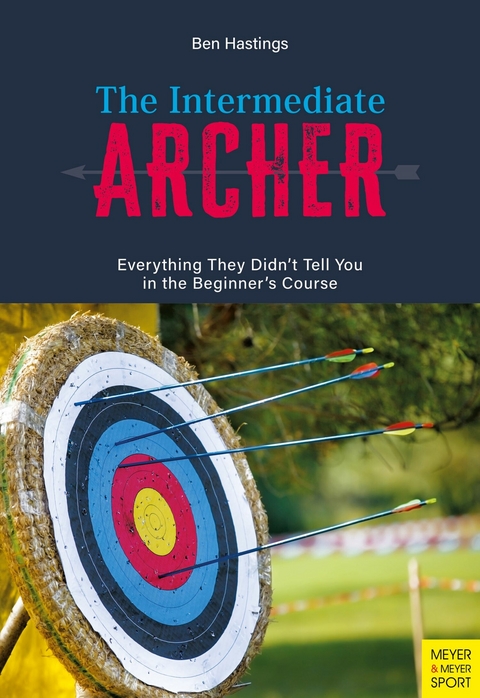
Intermediate Archer (eBook)
144 Seiten
Meyer & Meyer Sport (Verlag)
978-1-78255-529-2 (ISBN)
Ben Hastings' interest in archery was piqued at a young age when he was allowed to string and unstring his elder brother's longbow. From there, he entered the target sports, pistol and rifle shooting, but in the aftermath of shootings in the late 20th century, these sports became problematic. His interest in archery was soon revived by a have-a-go session while on holiday. Ben now regularly shoots freestyle, barebow, longbow, and flatbow target archery. Ben is an Archery GB Level 2-licensed coach and Competition Judge and has been coaching for several years. He is also a member and senior coach of one of the oldest archery clubs in England. Ben coaches pupils of a school in Surrey and also started an after-school archery club at another local secondary school. He coaches beginner's courses and provides further coaching to all ages and abilities. His students range from beginner to Grand Master Bowman standard and have competed at almost all levels. He currently resides on the Surrey/Hampshire borders in the southwest of England.
The Intermediate Archer fills the resource gap, helping those archers who have taken their first steps by completing a beginner's course and are wondering where to go next. It is the answer to all of the intermediate archer's questions, such as how do they improve their technique, what sort of equipment should they buy, and what type of archery is right for them? Author Ben Hastings provides the information every intermediate archer needs. He covers archery types, bow types, other equipment and equipment maintenance, the anatomy of the bow, technique, competition, the mental side of archery, and more all in this one concise yet complete guide. With this book, the intermediate archer can feel confident as they further improve and enhance their skills.
Ben Hastings' interest in archery was piqued at a young age when he was allowed to string and unstring his elder brother's longbow. From there, he entered the target sports, pistol and rifle shooting, but in the aftermath of shootings in the late 20th century, these sports became problematic. His interest in archery was soon revived by a have-a-go session while on holiday. Ben now regularly shoots freestyle, barebow, longbow, and flatbow target archery. Ben is an Archery GB Level 2–licensed coach and Competition Judge and has been coaching for several years. He is also a member and senior coach of one of the oldest archery clubs in England. Ben coaches pupils of a school in Surrey and also started an after-school archery club at another local secondary school. He coaches beginner's courses and provides further coaching to all ages and abilities. His students range from beginner to Grand Master Bowman standard and have competed at almost all levels. He currently resides on the Surrey/Hampshire borders in the southwest of England.
INTRODUCTION
WHO THIS BOOK IS FOR
This book is intended to fill a gap in resources available to archers who have completed a beginner’s course and are wondering where they go next. What variety of archery is for them? How can they improve their technique? What sort of equipment should they buy? How much should they spend on it? What bits of equipment are essential right now and which can wait until a few months or a year down the track?
This book is subtitled “Everything They Didn’t Tell You in the Beginner’s Course,” not because I have any reasonable doubt about the quality of courses offered by the vast majority of clubs, but because time on a beginner’s course is necessarily limited and the main need for the club is to concentrate first on ensuring you— and everyone around you—are safe and behave safely, and then to concentrate on ensuring the course is enjoyable and fun (this being the key to turning courses into membership fees). You will almost certainly find many things in this book that they did, in fact, teach you on the course. These bear repetition. Some people, in their excitement on the day, may not have heard them or have forgotten them, or just need the extra emphasis. Please don’t be insulted by that repetition.
Quite a few archery clubs offer excellent lessons for beginners, whether on a course that takes an hour or so on a Saturday morning for several weeks, or a course that fits into one or two days. Coaching beyond that point is more of a problem since it requires dedication not only from the archer themselves but also from suitably qualified coaches, most of whom give their time for free. Many archery clubs have unqualified archers teaching beginners. This is not necessarily a bad thing—I have met unqualified archers who provide extremely good coaching to a beginner and qualified coaches who shouldn’t be allowed anywhere near the field in the first place. All that most beginner’s courses teach you is how to shoot safely without endangering yourself, others around you, or the surroundings.
I do not, therefore, intend this book to replace coaching from a qualified club coach. To provide advice on form, technique, and good (and bad) habits requires patient observation, thoughtful analysis, good psychology, and trust in both directions. You can video yourself and watch back what you do—from one angle only. A coach will look at what you are doing from all around—with suitable camera equipment even from above and almost right in front of you. But this book can help you get started. I hope that it will prove a useful companion right up to the point where you are entering competitions and beginning to think about classification status such as Master or Grand Master Bowman.
WHAT IT CONTAINS
What’s in this book? Answers to many of the questions that any archer will ask as soon as their beginner’s course is over and they have the certificate in their hand allowing them to shoot unsupervised. And that is all that most beginner’s courses will do for you. There is little time to provide good coaching on technique, on how to improve results, or even etiquette on the shooting line (although this last item really should have been included).
In here you can find some details on archery equipment suitable for an intermediate archer. For the purposes of this book, my definition of an intermediate archer is being stretched slightly here, to include someone who has only just completed their beginner’s course rather than someone who already owns a useful bow with arrows matched to their draw length and the bow’s draw weight, and can make necessary adjustments to the equipment themselves.
Almost all references and illustrations in the book are for a right-handed archer (or, more accurately, an archer shooting right-handed). I have nothing whatsoever against “lefties”, and I apologise for this apparent bias, but being totally inclusive and thus having to explain each time which way things go could easily cause confusion. Where there might be a difference I make an effort to explain this.
Archery uses quite a mixture of units. Most of this is a matter of history. You will find many weights measured in pounds or kilograms, distances in yards or metres, target sizes (generally) in centimetres, bow lengths usually in inches, stabiliser weights might be in ounces or grams, bow equipment threads could be metric or imperial. This can get confusing, and sometimes care needs to be taken to avoid financial loss in ordering the wrong item or damaging equipment by trying to force the wrong size bolt into a hole.
There are several different disciplines within archery. If you don’t like being cold, wet, and muddy, then indoor target archery is probably the area for you. Combining a walk (or run) in the woods carrying everything you might need during the day with shooting at distances you have to gauge for yourself at either formal paper targets or models of animals, then 3D or field archery might tickle your fancy. The majority of this book, however, is going to concentrate mostly on target archery, whether indoor or outdoor, on a regulated range.
That still leaves quite a few variations on the theme. Olympic recurve (or freestyle)—a recurve bow with damping, stabilisation, a sight, and a draw-length indicator (clicker)—is probably the most common form of club archery. Barebow—similar to freestyle but without any aids to sighting, stabilisation, or damping—is slowly becoming more popular. It provides additional challenges in technique which I will touch on later. Compound bows offer technological assistance in holding a powerful and very accurate bow at full draw through the assistance of cams and cables. Once again, more information will be found in the relevant chapter. One of the other bow forms you will often see on an outdoor range is a traditional bow such as a flatbow or longbow. Longbows in particular tend to have much heavier draw weights and so are not really suitable for a raw beginner, but after technique and upper body fitness have improved, longbows can offer a lot to someone who likes the feeling of participating in and re-enacting the heyday of archery from mediaeval through to Tudor times.
WHY JOIN A CLUB?
There is no compulsion whatsoever to join an archery club. If you prefer solitude, shoot in your back garden or elsewhere on private property without others to distract you; you don’t need to spend money on either club fees or national association subscriptions. You would, however, be well advised to have some form of insurance against third-party accidents. You also need to ensure that others can’t stray into the path of your arrows and that, should a misfire or equipment failure send an arrow in an unusual direction, suitable barriers such as good stop netting will protect your legal and financial status. Please don’t be tempted to shoot on public land without either permission or extensive precautions against accident and injury.
All that said, I heartily recommend joining a club. Apart from the obvious social benefits, a club is where you’re most likely to find someone to coach you for free or where, if you need a metal detector to look for that arrow which went astray or the loan of one of the rarer and more expensive tools such as an arrow jack, one will be available to borrow. Other archers will almost always be happy to give you the benefit of their experience, to show you their equipment, and allow you to try out their bows or other equipment. A club will have insurance, maintain the range, hold a (usually small) stock of target faces and pins, and keep its members notified of events, upcoming competitions whether internal, regional, or national, and encourage improvement and development of technique and results. Other club members will help with maintenance of your equipment, such as loaning you a fletching jig, teaching you how to refletch or repoint arrows, or tuning your set-up. They will also often have second-hand equipment they want to get rid of—often at discount prices; my own club organises a sort of archery jumble sale regularly! For those archers who want to advance their classification, clubs will organise suitable events and maintain records of scores and resultant classifications. I can sum up what membership of a club provides in one word—support.
WHEN TO BUY
Not now, if you can help it. Don’t rush it. Archery can be an expensive hobby and while a particular bit of kit may suit you right now, you don’t want to spend loads of money on it only to find you outgrow it in either physical size, strength, ability, or technique in only a few months. Some clubs will lend or hire equipment. There are organisations out there which will hire equipment, often quite cheaply. One such in the UK is Stylist Bows near Rugby in Warwickshire, another is Urban Archers (see the Links section at the end of the book).
For younger juniors, aged up to about 13 or 14, I would not normally recommend renting a bow since very few rental bows are suitable for the youngest archers. Buy an inexpensive takedown bow instead. Alternatively, some clubs have bows available to borrow.
For older archers, if the rental option is not available, I don’t recommend spending huge sums on the “best” equipment. Do some research on the internet, as people often outgrow bows and sell onwards. Get advice on items from someone experienced in your club (see above!). Above all, bear in mind that as your technique and your upper body fitness improve you will need different equipment. At time of writing, a basic wooden takedown bow can be bought for...
| Erscheint lt. Verlag | 1.6.2023 |
|---|---|
| Verlagsort | Aachen |
| Sprache | englisch |
| Themenwelt | Sachbuch/Ratgeber ► Sport |
| Schlagworte | 3D archery • Archery • Arrow • Beginner • Bow • clout archery • Field archery • horse archery • Intermediate • Popinjay archery • recurve bow • target archery |
| ISBN-10 | 1-78255-529-3 / 1782555293 |
| ISBN-13 | 978-1-78255-529-2 / 9781782555292 |
| Informationen gemäß Produktsicherheitsverordnung (GPSR) | |
| Haben Sie eine Frage zum Produkt? |
 EPUB (Adobe DRM)
Kopierschutz: Adobe-DRM
Adobe-DRM ist ein Kopierschutz, der das eBook vor Mißbrauch schützen soll. Dabei wird das eBook bereits beim Download auf Ihre persönliche Adobe-ID autorisiert. Lesen können Sie das eBook dann nur auf den Geräten, welche ebenfalls auf Ihre Adobe-ID registriert sind.
Details zum Adobe-DRM
Dateiformat: EPUB (Electronic Publication)
EPUB ist ein offener Standard für eBooks und eignet sich besonders zur Darstellung von Belletristik und Sachbüchern. Der Fließtext wird dynamisch an die Display- und Schriftgröße angepasst. Auch für mobile Lesegeräte ist EPUB daher gut geeignet.
Systemvoraussetzungen:
PC/Mac: Mit einem PC oder Mac können Sie dieses eBook lesen. Sie benötigen eine
eReader: Dieses eBook kann mit (fast) allen eBook-Readern gelesen werden. Mit dem amazon-Kindle ist es aber nicht kompatibel.
Smartphone/Tablet: Egal ob Apple oder Android, dieses eBook können Sie lesen. Sie benötigen eine
Geräteliste und zusätzliche Hinweise
Buying eBooks from abroad
For tax law reasons we can sell eBooks just within Germany and Switzerland. Regrettably we cannot fulfill eBook-orders from other countries.
aus dem Bereich