


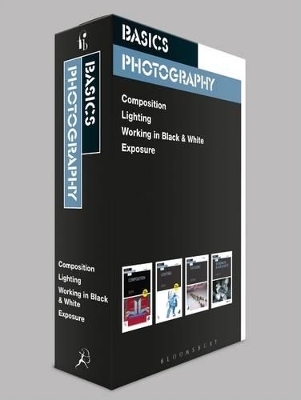
Basics Photography Box Set
Bloomsbury Academic
978-1-4725-7813-6 (ISBN)
- Titel ist leider vergriffen;
keine Neuauflage - Artikel merken
With easy-to-read text, clear diagrams for quick reference, inspiring case studies and practical exercises, the Basics Photography Box Set offers a complete guide to creating stunning photographic images.
The set includes over 800 full-colour images, including stunning imagery from master photographers such as Fay Godwin, Dorothea Lange, Bernd and Hilla Becher, Sebastião Salgado and Hiroshi Sugimoto.
Together, the books cover topics such as: the formal elements of composition (including scale, point, line, shape, form, texture, pattern and colour); perspective and lenses; light theory; colour theory; natural light, available light and studio light; depth of field; close-up techniques; filters and flash; f-numbers and shutter speeds; and lighting and exposure for black-and-white photography.
David Präkel has enjoyed a successful and diverse career in journalism, photography and education. He has taught photography at all levels in the UK and America, at the prestigious Kodak Imaging Training Centre and in his own training workshops in Northumberland.
Composition (9782940411771)
Introduction. Chapter 1: Basics: The case for competition; The rules; Viewpoint; Perspective; Scale; Case study - Simplify, simplify, simplify; Exercise - Lenses and perspective. Chapter 2: Formal elements: Point; Line; Shape; Form; Texture; Pattern; Tone; Colour; Case study - Aesthetics and the formal elements; Exercise - Exploring a single object. Chapter 3: Organizing space: Frames; Balance; Appearance of space; Case study - Making space; Exercise - Depth of field. Chapter 4: Organizing time: Time passing; Moments; The decisive moment; Sequences; Case study - Moving camera; Exercise - Re-photography. Chapter 5: Originality: Finding your own view; Contrasts and humour; Imbalance; Cropping; Colour; Digital imaging; Case study - Reinvent an old process; Exercise - Using 'found' images. Chapter 6: Application: Landscape; Still life; Portrait; Documentary; Figure; Action/sports; Fine art; Advertising. Conclusion.
Lighting (9782940411955)
Chapter 1: What is light? : Basic theory; Colour theory; Exposure ; Case study: The lightmeter; Polarized light ; Case study: The colour temperature meter ; Imaging at the ends of the spectrum; Exercise: Using a colour checker. Chapter 2: Natural light: Daylight; Evening light; Night; Case study: The seasons; Effect of location; Exercise: Time of day. Chapter 3: Available light: Flames; Incandescent lamps; Fluorescent light; Street lighting; Case study: Camera supports; Neon light; Gig photography; Exercise: Street still life. Chapter 4: Photographic light: Continuous light; Flash; Case study: Studio flash; Exercise: The single source. Chapter 5: Controlling light: Studios; Shaping light; Building light; Exercise: Lighting ratios; Rembrandt lighting; Butterfly lighting; Commercial lighting; Case study: Light tent; Backgrounds. Chapter 6: Using light: Quality of light; Revealing shape; Revealing form; Revealing texture; Revealing tone and colour; Experimenting with light; Exercise: The single object.
Working in Black and White (9782940373857)
How to get the most out of this book. Introduction. Basic theory: Blach and white and greyscale; History; Photograms; Colour to black and white; Filtration; Contrast. The art of black and white: Learning to 'see' in black and white; Previsualisation and composition; The great themes; Older cameras/lenses for a unique look. Lighting: Quality; Direction; Subject contrast; Lighting contrast; Subject brightness range; Metering; High-key and low-key imagery; Infrared. Capturing black and white: Film and developer; The 'look' of film; Staining developers; Exposure index; Chromogenic film; Film grain; Digital noise; The Zone System; Tone compression and expansion; Instant black-and-white film. Realising the image: Printing to match the contrast of the film; Fixed-grade and variable-contrast papers; Scanning film; Local exposure control; Paper choice; Contact printing; Digital negatives; Liquid emulsion; Colour to black and white; Greyscale conversions; Products for a 'film' look; Black-only printing; The future. Reintroducing colour: Toning; Digital toning; Duotones, tritones and quadtones; Oils, pastels and pencils on prints; Digital hand rendering. Conclusion. Contacts. Glossary. Acknowledgements.
Exposure (9782940411054)
How to get the most out of this book. Introduction. Chapter 1: Basic theory: Light itself; What is good exposure?; Histograms; Contrast; Stops; Reciprocity; Exposure Value (EV); Subject Brightness Range (SBR); Over- and underexposure; Clipping; Key; Speed and sensitivity; Exposure Index (EI); Filters. Chapter 2: Shutter speed and time: Motion and time; Neutral Density (ND) filters to extend time; Types of shutter; Creative use of shutter speeds. Chapter 3: Aperture and depth of field: f-numbers and stops; Depth of field; Creative use. Chapter 4: Meters and metering: Types of exposure meter; Reflected versus incident light meters; Exposure Value (EV) compensation; Other light meters; So why not do it in Photoshop?. Chapter 5: Dynamic range: Graduated Neutral Density (Grad ND) filters; RAW files; High Dynamic Range (HDR); The Zone System; Pushing and pulling film; Local exposure control. Chapter 6: Special cases: Technical versus subjective exposure; Back and rim light; White balance; Winter weather; Flash; Close-up; Infrared; Open shutter; Multiple exposures; Extreme lighting. Conclusion. Contacts. Glossary. Acknowledgements and image credits.
| Erscheint lt. Verlag | 16.10.2014 |
|---|---|
| Reihe/Serie | Basics Photography |
| Zusatzinfo | 600 colour illus |
| Verlagsort | London |
| Sprache | englisch |
| Gewicht | 2445 g |
| Themenwelt | Kunst / Musik / Theater ► Fotokunst |
| Sachbuch/Ratgeber ► Freizeit / Hobby ► Fotografieren / Filmen | |
| ISBN-10 | 1-4725-7813-9 / 1472578139 |
| ISBN-13 | 978-1-4725-7813-6 / 9781472578136 |
| Zustand | Neuware |
| Informationen gemäß Produktsicherheitsverordnung (GPSR) | |
| Haben Sie eine Frage zum Produkt? |


