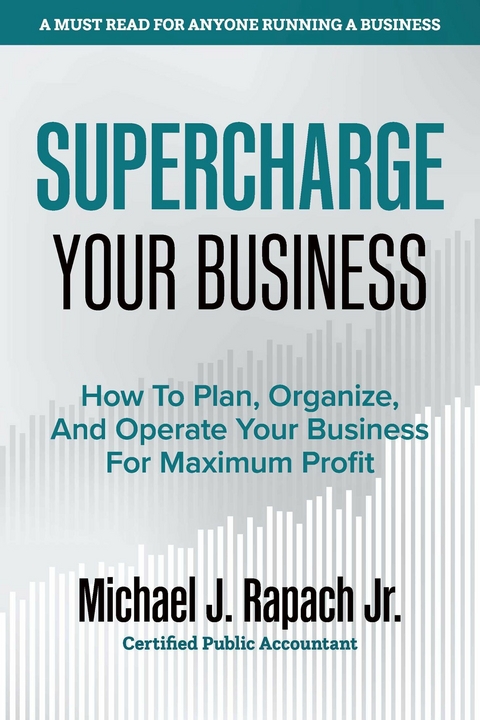
Supercharge Your Business (eBook)
300 Seiten
Bookbaby (Verlag)
978-1-6678-8403-5 (ISBN)
Author Michael J. Rapach Jr. is a practicing Certified Public Accountant with over 40 years of experience operating and advising small businesses.
"e;Supercharge Your Business"e; will teach business owners how to increase profits and run operations with maximum efficiency. Author Michael J. Rapach Jr. will guide readers through setting up a financial framework using the COMMAND System, identifying sources of profit loss, and buying or selling their business in the future.
Introduction
“A fool and his money are soon parted.”
—Anonymous
Most businesses do not make enough money. The purpose of this book is to help business owners address this problem and make more money from their business. If there is one guiding principle of this book, it is this: long-term financial success in business does not happen by accident. A sound, proven business strategy is required, and this methodology needs to be diligently and consistently applied.
he term “business” for purposes in this book includes all businesses ranging from small sole proprietorships to multi-million-dollar businesses. While the objective of financial success, i.e., “making money,” might appear to be obvious, statistics have consistently shown that it is highly likely that most businesses will fail given enough time and, in most cases, failure could have either been avoided, prolonged, or perhaps the business should never have been started in the first place.
Why Do Most Businesses Fail?
The real question one must ask is, why do most businesses have such a dismal track record? Is it due to a lack of overall management talent, under capitalization, intense competition, lack of a marketing plan, or lack of sufficient demand for the product or service being provided? Usually, it is a combination of all of these factors, and there is no clear answer.
Can Failure Be Avoided?
Most businesses ultimately seem to enter into a period of gradual deterioration that finally builds up to a point where failure is imminent. Could this failure have been avoided? Yes, in many cases failure could have been avoided if certain steps had been taken to identify the problems that were arising and thus allow for the taking of timely steps to correct the problems before they reached a critical stage. This process of analyzing the current state of affairs on a regular basis and planning corrective actions to be taken immediately is very important and serves as the basis of the financial management system included in this book.
Most businesses fail because of poor financial management and poor business decisions, and poor financial management is the direct result of not having an adequate information system in place to help manage the finances of the business. What you need, therefore, is an early warning system to keep you out of trouble and on track.
Proof of Numerous Failures
One need not look very far to see first-hand proof of the high rate of business failures. On any given day, you can drive down the street and spot numerous vacant stores and offices available for rent or see businesses holding “Going out of business” sales. Did you ever stop and realize that most of these vacant stores and offices now available for rent were formerly occupied by businesses that did not make it? It’s a sobering thought when you think about the former owners of these businesses—now with broken dreams, bruised egos, and quite likely scars from the permanent financial damage that has been inflicted upon them.
The Solution
This book will provide a comprehensive financial management system that may be used by businesses of any size. This strategy will help business owners in making financial decisions based on sound financial information and not on hopes and dreams alone. In addition, it must be made clear at the outset that numbers are the language of business and one must learn to speak this language fluently if he or she is to be successful.
Businesses will always have problems, and a detailed study of the numbers will tell you where the problems are and how concerned you need to be. Many people become intimidated with the mere mention of numbers and financial statements, and these people put themselves at a great risk of failure by refusing to utilize financial statements as tools to help run their business. Large businesses became large and successful by applying certain sound business principles, and it is these same principles that must be utilized by smaller businesses to become successful, as well. These principles have been made very simple in this book and can easily be applied by small business owners. What will be required, however, will be ambition, perseverance, focus and discipline, and the ability to pivot and make rapid changes if necessary, traits that are usually required to be successful in any endeavor.
Reading the Instructions
There is an old saying that says when all else fails, try reading the instructions. Unfortunately, when a business gets into trouble, there usually is no place to turn to for help and no instructions to read. In fact, when the business owner is confronted with the early signs of problems, he quite often goes into a state of denial where he really does not want to know the true financial facts for fear of confirming what he already senses is the case. This state of denial continues until the business problem ultimately reaches a critical point and a payroll or other important financial obligation like a loan or a payroll tax payment is missed, and the business fails, usually after many sleepless nights and after a lengthy period of feeling helpless.
Business Owner’s Manual
This book will supply an owner’s manual for handling the finances of a business. The matters contained in this manual are not overly complicated, and the math involved will be confined to simple addition and subtraction, certainly simple enough to be understood by the average person. What the book will supply is a financial framework, a strategy that will constantly confirm that you are headed in the right direction.
The system is an information gathering process that will guide you in conducting your financial affairs on a daily, monthly, and annual basis. The paradox of the system is in its simplicity—the system is so simple that it is hard, not hard to understand but sometimes hard to consistently apply. These procedures are not applied on a regular and consistent basis by most businesses because the managers of the business are either not aware of the procedures and their components or are simply not disciplined enough to apply the procedures because they are not convinced of their importance. This lack of structure probably explains why there are so few truly successful businesses.
Changing Your Mental Approach
Applying the system outlined in this book will require you to change your mental approach to running your business. Quite simply, you must run your business by the numbers. You must know how you are doing at all times and not wait until the end of your fiscal year to see how you did. In my private accounting and consulting practice, I am constantly amazed by the number of people who ask me as their CPA how they are doing rather than them telling me how they are doing. Unfortunately, these are the same people who do not keep running balances in their checkbooks, do not reconcile their bank statements at the end of the month, do not study their aged accounts receivable report daily, do not have a marketing plan, and do not know how their direct labor costs compare to their competitors.
It’s amazing how many people there are running businesses that do not even open up the company’s bank statements at the end of the month. Also, the next time you are standing in line at the bank, observe how many people ask the teller to give them their bank balance, a clear indication that they haven’t a clue as to the correct checkbook balance of their business or personal account.
You Must Take Charge
Let me make one thing perfectly clear: you should not rely on your outside accountant to tell you how your business is doing. Most outside accountants for businesses are not paid enough to supply the business with timely financial information in a manner really necessary to run their business adequately. Accountants generally work in the past. They obtain your financial records after the end of your fiscal year and summarize the data in the form of a financial statement and income tax return. Unfortunately, any advice they may offer on the basis of the observations resulting from their work is usually not very meaningful, as it is usually too late to take any timely corrective action. In addition, the scope of work of the outside accountant usually does not include really caring if you make a profit or not, but rather that the financial reports accurately report what actually took place and that the tax returns are filed accurately and on time. This distinction is extremely important to understand, because it may very well cause you to place too much reliance on the role of the outside accountant.
There is a place for the outside accountant in the financial management system and it very well may be a very important place, but it must be emphasized that merely using the services of an accountant is not a financial management system in itself. The recommended role of an outside accountant will be explained in greater detail in Chapters 7 and 8.
The COMMAND System to the Rescue
Running your own business is much harder than most people imagine. In addition, failure of the business can cause severe financial consequences for the rest of the owner’s life. With such a high failure rate and so much at stake, it is essential that...
| Erscheint lt. Verlag | 18.3.2023 |
|---|---|
| Sprache | englisch |
| Themenwelt | Sachbuch/Ratgeber |
| Wirtschaft ► Betriebswirtschaft / Management ► Unternehmensführung / Management | |
| ISBN-10 | 1-6678-8403-4 / 1667884034 |
| ISBN-13 | 978-1-6678-8403-5 / 9781667884035 |
| Informationen gemäß Produktsicherheitsverordnung (GPSR) | |
| Haben Sie eine Frage zum Produkt? |
 EPUB (Ohne DRM)
Größe: 1,5 MB
Digital Rights Management: ohne DRM
Dieses eBook enthält kein DRM oder Kopierschutz. Eine Weitergabe an Dritte ist jedoch rechtlich nicht zulässig, weil Sie beim Kauf nur die Rechte an der persönlichen Nutzung erwerben.
Dateiformat: EPUB (Electronic Publication)
EPUB ist ein offener Standard für eBooks und eignet sich besonders zur Darstellung von Belletristik und Sachbüchern. Der Fließtext wird dynamisch an die Display- und Schriftgröße angepasst. Auch für mobile Lesegeräte ist EPUB daher gut geeignet.
Systemvoraussetzungen:
PC/Mac: Mit einem PC oder Mac können Sie dieses eBook lesen. Sie benötigen dafür die kostenlose Software Adobe Digital Editions.
eReader: Dieses eBook kann mit (fast) allen eBook-Readern gelesen werden. Mit dem amazon-Kindle ist es aber nicht kompatibel.
Smartphone/Tablet: Egal ob Apple oder Android, dieses eBook können Sie lesen. Sie benötigen dafür eine kostenlose App.
Geräteliste und zusätzliche Hinweise
Buying eBooks from abroad
For tax law reasons we can sell eBooks just within Germany and Switzerland. Regrettably we cannot fulfill eBook-orders from other countries.
aus dem Bereich