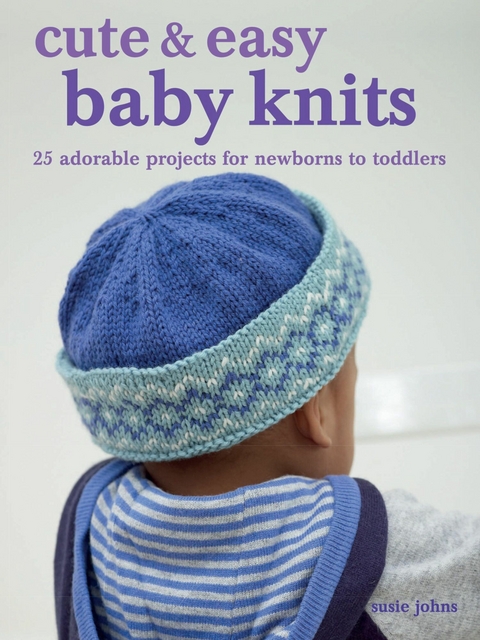
Cute & Easy Baby Knits (eBook)
217 Seiten
Ryland Peters & Small (Verlag)
978-1-80065-251-4 (ISBN)
Cute and Easy Baby Knits is a collection of 25 charming designs to keep little ones cosy and comfortable all year round. Learn how to make beautiful garments and accessories for babies and toddlers, from booties and hats for newborns to a textured tunic sweater and a pretty skirt. Susie Johns, an author of more than 30 books, shows you how to make 25 patterns that can be knitted by beginners as well as more experienced crafters. You'll find out how to create practical items that are certain to be a hit, such as a blanket with a ribbed border or a drawstring bag to store toys, as well as a teddy bear and bunting with bells that will jingle above a baby's bed. Illustrated with clear step-by-step artworks, the knitting know-how chapter guides you through all the techniques you will need, from simple knit and purl stitch to delicate delicate detailing effects and eye-catching features.
Learning to knit
The magic of knitting is the realization of just how simple it is to create a soft, supple fabric from a ball of yarn and some knitting needles. In this section you will find explanations and illustrations of the techniques used to make the knitted garments and accessories in this book.
Master the basics—casting on, forming knit and purl stitches, and binding (casting) off—and you are ready to get going on the simpler projects. Add to these basic skills by learning to shape pieces of knitting (by increasing and decreasing) and to work with texture and color (not as difficult as it may seem), then learn how to stitch pieces together and you can make any of the projects in this book.
Holding needles and yarn
If you are a knitting novice, you will need to discover which is the most comfortable way for you to hold your needles. This applies when using either a pair of knitting needles or a circular needle.
Like a knife
Pick up the needles, one in each hand, as if you were holding a knife and fork—that is to say, with your hands lightly over the top of each needle. As you knit, you will tuck the blunt end of the right-hand needle under your arm, let go with your hand and use your hand to manipulate the yarn, returning your hand to the needle to move the stitches along.
Like a pen
Now try changing the right hand so you are holding the needle as you would hold a pen, with your thumb and forefinger lightly gripping the needle close to its pointed tip and the shaft resting in the crook of your thumb. As you knit, you will not need to let go of the needle but simply slide your right hand forward to manipulate the yarn.
Holding the yarn
As you knit, you will be working stitches off the left needle and on to the right needle, and the yarn you are working with needs to be tensioned and manipulated to produce an even fabric. To hold and tension the yarn you can use either your right or left hand. Try both methods to discover which works best for you.
Yarn in right hand
With the ball of yarn on the right, catch the yarn around your little finger then lace it over the third finger, under the middle finger and over the first finger of your right hand.
Yarn in left hand
With the ball of yarn on your left, catch the yarn around your little finger then take it over the third and middle fingers. Most left-handed knitters will also find that, even if they reverse the direction of knitting (working stitches off the right needle onto the left needle), using the left hand to manipulate the yarn will be easier to manage.
Making a slip knot
Before you knit your first stitch, you will need to make a loop in the yarn. Follow these two simple steps.
With the ball of yarn to your right and the yarn end to the left, wrap a loop of yarn loosely around the first two fingers of your left hand, crossing over once. Holding a knitting needle in your right hand, insert the tip under the lower strand, as shown in the diagram, and pull it through to form a loop at the front.
Slip the yarn off your fingers, leaving the loop on the needle. Gently pull the yarn end on the left to tighten the knot and the length of yarn on the right, leading to the ball of yarn, to tighten the loop on the needle.
Casting on
This technique, sometimes called the thumb method, is usually considered to be the easiest and most versatile way of casting on.
1. Leave a long end, about ¾in (2cm) per stitch to be cast on, before making a slip knot; the slip knot counts as the first stitch. Holding the needle and the yarn leading to the ball in your right hand, use the free end of yarn to make a loop around your left thumb. As you do this, tension the yarn between the third and fourth fingers of your left hand. Insert the needle tip into the loop.
2. Bring the yarn leading to the ball up between your thumb and the needle then take it around the needle, as shown in the illustration.
3. Draw the yarn through to make a stitch on the needle, then release the loop from the left thumb and gently pull on the yarn end to tension (tighten) the stitch.
Knit and purl
Now you need to learn to do some knitting. Here are the basic principles of forming a knit stitch and a purl stitch, the two fundamental stitches in all forms of knitting.
Making a knit stitch
Begin by holding the needle with the cast-on stitches in your left hand and the other needle in your right hand. The yarn from the ball should be hanging at the back of the work. You will be working into each stitch on the left needle in turn to complete a knit row.
1. Insert the right needle from right to left (purlwise) into the front of the first stitch. Take the yarn over and around the tip of the right needle.
2. With the tip of the right needle, draw the yarn that is looped around that needle through the stitch on the left needle.
3. Drop the original stitch off the left needle to make a new knit stitch on the right needle.
Making a purl stitch
Hold the needles as you would when making a knit stitch, but with the yarn from the ball hanging at the front of the work. Work into each stitch on the left needle in turn to complete a purl row. The method given below assumes that you are holding the yarn in your right hand. If you hold it in your left hand, be sure to take it over the needle before pulling it through; wrapping it under the needle may seem an easier action to perform but it will result in your stitches facing the wrong way.
1. Insert the right needle from left to right (knitwise) into the front of the first stitch. Take the yarn to the left, then up and around the tip of the right needle.
2. Dip the tip of the right needle and draw the yarn that is looped around that needle through the stitch on the left needle.
3. Drop the original stitch off the left needle to make a new purl stitch on the right needle.
Binding (casting) off
Although there are various methods used to bind (cast) off stitches, this is the most common and the easiest to perfect. When you work every stitch as a knit stitch, it will produce an edge that looks like a chain. In some patterns, the instructions are given to “bind (cast) off in rib”, in which case you will need to knit the knit stitches and purl the purl stitches as you bind (cast) off, creating a softer, stretchier edge.
1. Work the first two stitches of the bind-off (cast-off) row then use the point of the left needle to lift the first stitch over the second stitch and off the right needle. Then work the next stitch so there are, once again, two stitches on the right needle and repeat the process, lifting one stitch over the other and off the needle. Continue until there is only one stitch remaining on the right needle.
2. Break the yarn, leaving a tail of yarn long enough for sewing any seams. Draw the end of the yarn through the remaining stitch, slip it off the needle and pull tightly to secure.
Shaping
By working increases and decreases, you can shape pieces of knitting to make a garment. Some of these techniques can also be used to create various stitch patterns.
Increasing
Each of the methods described here produces a different effect. For example, knitting into the front and back of a stitch creates a bar at the base of the new stitch; the lifted strand is almost invisible; while the yarnover creates a hole, which can be used for lacy patterns or to create a buttonhole.
Knit into the front and back
When you see the abbreviation “inc 1”, you will need to begin by knitting the stitch in the usual way. However, before dropping it from the left needle, take the right needle tip behind the left needle and knit into the stitch again, but this time into the back of it. Then drop the original stitch off the left needle, leaving the two new stitches on the right needle.
Make one stitch
The abbreviation for this is “M1”. Bring the left needle forward and, inserting the tip from front to back, lift up the horizontal strand that lies between the two needles. Take the right needle behind the left needle to knit into the back of the strand.
Yarnover
When you see the instruction “yo”, it means you either have to bring the yarn to the front of the work or take it to the back, depending on the stitch combination you are working on.
Between two knit stitches, bring the yarn between the needles to the front of the work, put the tip of the right needle into the next stitch on the left needle, then take the yarn over the right needle to the back, ready to knit the stitch (as shown in the illustration).
Between a knit and a purl stitch, bring the yarn to the front, over the needle, and back to the front again before putting the tip of the right needle into the next stitch to purl it.
Between two purl stitches, take the yarn over and right around the needle and to the front again before the tip of the right needle and into the next stitch to purl it.
Between a purl and a knit stitch, put the tip of the right needle into the next stitch on the left needle, take the yarn over the right needle and to the back to knit the stitch.
In each case, the action of taking the yarn over the needle will create an additional stitch on that needle.
Decreasing
It is important to employ the various methods described here in the correct place, as the decreases cause stitches to slant either to the right or the left;...
| Erscheint lt. Verlag | 13.6.2023 |
|---|---|
| Verlagsort | London |
| Sprache | englisch |
| Themenwelt | Sachbuch/Ratgeber ► Freizeit / Hobby ► Handarbeit / Textiles |
| Sachbuch/Ratgeber ► Freizeit / Hobby ► Heimwerken / Do it yourself | |
| Schlagworte | baby clothes • baby knits • baby toys • Blankets • craft • knits • Knitting • needlework |
| ISBN-10 | 1-80065-251-8 / 1800652518 |
| ISBN-13 | 978-1-80065-251-4 / 9781800652514 |
| Informationen gemäß Produktsicherheitsverordnung (GPSR) | |
| Haben Sie eine Frage zum Produkt? |
 EPUB (Adobe DRM)
Kopierschutz: Adobe-DRM
Adobe-DRM ist ein Kopierschutz, der das eBook vor Mißbrauch schützen soll. Dabei wird das eBook bereits beim Download auf Ihre persönliche Adobe-ID autorisiert. Lesen können Sie das eBook dann nur auf den Geräten, welche ebenfalls auf Ihre Adobe-ID registriert sind.
Details zum Adobe-DRM
Dateiformat: EPUB (Electronic Publication)
EPUB ist ein offener Standard für eBooks und eignet sich besonders zur Darstellung von Belletristik und Sachbüchern. Der Fließtext wird dynamisch an die Display- und Schriftgröße angepasst. Auch für mobile Lesegeräte ist EPUB daher gut geeignet.
Systemvoraussetzungen:
PC/Mac: Mit einem PC oder Mac können Sie dieses eBook lesen. Sie benötigen eine
eReader: Dieses eBook kann mit (fast) allen eBook-Readern gelesen werden. Mit dem amazon-Kindle ist es aber nicht kompatibel.
Smartphone/Tablet: Egal ob Apple oder Android, dieses eBook können Sie lesen. Sie benötigen eine
Geräteliste und zusätzliche Hinweise
Buying eBooks from abroad
For tax law reasons we can sell eBooks just within Germany and Switzerland. Regrettably we cannot fulfill eBook-orders from other countries.
aus dem Bereich