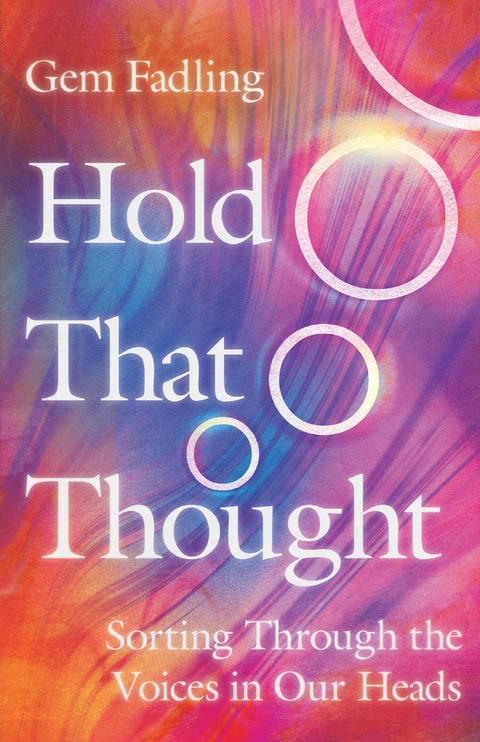
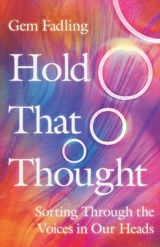
Hold That Thought (eBook)
InterVarsity Press (Verlag)
978-0-8308-4696-2 (ISBN)
Gem Fadling is a founding partner of Unhurried Living, Inc., a non-profit that resources and trains Christian leaders to rest deeper, live fuller, and lead better. A trained spiritual director, retreat speaker, and podcaster, Gem enjoys serving as a guide, with the intention of helping people encounter God in their very real lives. Gem lives in Mission Viejo, California, with her husband, Alan.
"e;You're not good enough."e;"e;You need to try harder."e;"e;Everything's fine!"e;These are the sorts of voices that we all have in our heads, and they often push us to act in ways that are both unhelpful and unsustainable. How do we quiet these narratives? More importantly, amid the chatter, how do we hear the voice of God?Gem Fadling helps us identify the competing voices and shows how they hinder our personal transformation. Drawing on years of spiritual direction and leadership at Unhurried Living, she shares her wisdom of how we make sense of inner voices and settle down enough to find our true voice. Using the discussion guide in the back of the book, groups can discuss the competing voices that they experience within their own souls and learn to notice, discern, and respond to the movement of God in their lives. When we find our true voice, we can let go of the striving and people-pleasing and rest in the presence of God and his plan for our lives.
Gem Fadling, CLC, is a founding partner of Unhurried Living, Inc., a non-profit that trains people to rest deeper, live fuller, and lead better. She is a certified life coach and a trained spiritual director who coaches women at the intersection of spiritual leadership and soul care. Gem is the host of the I Can Do That! Podcast and the coauthor of What Does Your Soul Love?: Eight Questions That Reveal God's Work in You.
IN THE MOVIE WONDER WOMAN, Diana has been raised and trained as a warrior. Steve, a young World War I pilot, crashes on her remote island, and she resolves to go with him to help with the raging war.1 After making their way past a few obstacles, they arrive at No Man’s Land. The two opposing sides have been at a stalemate for almost a year. No one has taken any ground. Steve and the men engage with the guys in the bunker, and a heated conversation between Steve and Diana ensues.
Steve assures Diana nothing can be done. He persists by saying it is impossible to cross No Man’s Land. Diana is perplexed and cannot believe what she is hearing. She is determined to act, so she turns her back as she unfurls her updo hair. In slow motion, she turns around, and we see her in her Wonder Woman crown and garb, as a new emboldened version of herself emerges.
As she climbs out of the bunker, our view flashes on her shield, arm bands, boots, and golden lasso. For the first time, she chooses to be herself, in all her fullness. She emerges into the burned landscape and gray sky of No Man’s Land. Bombs explode all around as she strides boldly into the space between the warring factions. In slow motion, a lone bullet is shot from the other side. As it makes its way to her, she waves her cuffed arm, and it ricochets away. The scene cuts to her face as we glimpse a tiny smirk and a determined twinkle in her eye. She gains more strength and courage to continue her journey across No Man’s Land. The music swells as bullet after bullet is deflected. Steve and his men gain the courage to follow her as they all emerge from the bunker. In the middle of the field, she is hit with a melee of machine gun bullets as the camera pans an overhead view. She takes all the hits with her shield. This gives Steve and his men an advantage, and they manage to overtake the men in the opposing bunker.
She simply needed to act on what was within her.
No Man’s Land is the location of Diana’s awakening. The truth is, she already had what she needed. She had trained as an Amazon warrior. Courage and fortitude simmered deep within. Her entire life journey led her to the center of that field.
She simply needed to act on what was within her.
She was alive to her voice, power, and choice, and she embraced and owned it. Along the way, all the moments of her life counted—the moments of training, of insight, of action, and, yes, of failure. The moment Diana steps out into No Man’s Land is a major turning point. But this did not happen all by itself out of nowhere. Everything counted leading up to that moment.
A NECESSARY CHOICE
I remember watching an interview with Patty Jenkins, the director of the Wonder Woman movie. She mentioned that she had to fight to get the No Man’s Land scene placed into the movie. Some thought it was unnecessary and slowed the movie down. But she knew instinctively that it was the inflection point of the movie and crucial to Diana’s story. Jenkins was right. It was absolutely necessary to witness Diana choosing to become who she already was.
How ironic that a woman had to use her voice to fight for a scene in which a woman steps into her own voice. And how telling that others were sure this part of the story was unnecessary. Isn’t it sometimes the same in our own lives? People all around suggesting what is and is not important for and to us.
Finding our voice and stepping into who we are is a beautiful part of our own personal story. This movement is critical—especially for the second half of life. Whatever we build in the first half gets to play out beautifully, lyrically, cinematically in the second half as we continue to shed the false self and step into who we are. No one’s life is perfect. We all still have struggles, fears, and self-doubt. However, we can enjoy a new sense of wisdom, grace, and focus. And these dynamics are beautiful to experience and witness.
Wonder Woman’s No Man’s Land graphically represents our own thought landscape. Unhelpful thoughts fire at us, seeking to derail or keep us stuck. But like Diana’s golden cuffs, we have the power to stop the unhelpful thought in its track by noticing, discerning, and responding. As we move past each “thought-bullet” our confidence grows, causing our freedom to increase and our voice to emerge.
MY VOICE BEFORE
During the first half of my life, I would describe myself as not having my voice. This means I couldn’t always identify what I wanted or what I needed. And even when I did, I didn’t speak up for myself. This wasn’t true 100 percent of the time, of course. I was still a functioning adult who could hold down a job, manage a household, and raise children. But there was this huge piece missing . . . what I’m calling here my God-given voice. As I began to wake up to this more and more, three dynamics of my non-voice rose to the surface.
I apologized for taking up space. Many years ago, I was teaching at a leadership retreat. We recorded our talks so we could put them online for the participants to refer to later, and I was the one who edited and uploaded the talks online. One time, as I was listening to a recording of myself, I realized I was talking way too fast. Some of that might have been nerves, but I do remember feeling as though I needed to hurry up so that (1) whoever was next could get up there and (2) I could get out of people’s way. My fast talking was a kind of apologizing for myself. I’m sorry I’m here, taking up this space. I’ll finish up real quick so the important things can happen. This was an undercurrent I began to notice in myself in these kinds of situations. I wasn’t believing in and standing in my own value, and I wasn’t speaking from a holy confidence in what God had placed inside of me.
There may be any number of undercurrents running under the surface of our lives. It is good to be aware of this dynamic so that we aren’t held back unnecessarily. An undercurrent can feel like a low hum of a thought that you usually don’t hear unless you take time to listen. Sometimes these thoughts can be brought to the surface as we unpack a difficult or frustrating situation with a friend or even a time of journaling. We can learn to listen more deeply to ourselves on our formational journey.
I rarely said “I.” When I talked about any version of my life history, I always said “we.” The “we” was Alan (my husband) and me. Part of the reason for this is that I met Alan when I was seventeen, began dating when I was nineteen, and got married when I was twenty-one. We grew up together in every sense and were tied at the hip in life and ministry from our earliest days. I was basically groomed for this because, in my mother’s mind, the most important part of being a woman was to be married and have children. So, this became an early goal for me. However, this forced ideal, paired with the dysfunction we both brought into our marriage from our families of origin, was a setup for classic enmeshment.
This was solidified by the conservative church culture at the time that encouraged the duties of the “pastor’s wife” and women in general. Intentional or not, trying to fit into a role as a Christian woman can lead to various versions of unhealth and even spiritual trauma. Many of us have some unlearning and major healing to engage in this regard. It is okay to have a healthy sense of self and not just be known in relation to someone else. I, as an individual, am one whom God dearly loves and it’s okay to believe, embrace, and live this.
My husband and I enjoyed partnership in ministry and most of my stories did include both of us. This is a great strength in our lives even to this day. But I didn’t have a clear sense of “just me.” I didn’t have a resounding “I.” This showed up clearly during my time in counseling. We had become enmeshed, and part of our work was to become independent. Our counselor worked diligently to move us from dependent to independent to interdependent. It turns out that interdependence is much more enjoyable. It allows both people to be who they are and to connect and contribute to the marriage in a healthier way.
After all the difficult inner healing work was done and I was graduating from and debriefing my process with my counselor, he let me in on a little secret. When we began, my self-esteem was so low and my use of the word “we” was so prevalent that he wasn’t sure he was going to find me. I’m embarrassed as I share this. I had no idea I was so un-present in my own life. With his help, the skillful guidance of the Holy Spirit, and my concerted engagement, I did, in fact, find me. And the beautiful energy of that continues to increase.
I couldn’t say, “I deserve.” I realize that the idea of deserving may get sticky here for some. Many of us have been taught that we don’t deserve anything. Why else would you need grace, mercy, or forgiveness? But my self-esteem took a hit in a way that didn’t lead to received grace. It led to an undervaluing and even a devaluing of myself. Grace is supposed to be a loving, inspiring, inviting part of the story, and it is—but somehow my self-worth got trampled down in the midst. My relationship to “I don’t deserve” was unhealthy, and I wasn’t in touch with my inherent value and worth as a child of God and as a human being. The focus of the word “deserve” wasn’t so much on the demand within it, but on my lack of healthy esteem for myself as a holy and...
| Erscheint lt. Verlag | 20.9.2022 |
|---|---|
| Verlagsort | Lisle |
| Sprache | englisch |
| Themenwelt | Sachbuch/Ratgeber ► Gesundheit / Leben / Psychologie ► Esoterik / Spiritualität |
| Religion / Theologie ► Christentum ► Kirchengeschichte | |
| Religion / Theologie ► Christentum ► Moraltheologie / Sozialethik | |
| Schlagworte | Anxiety • calling • Discernment • god's presence • God's voice • hearing God • inner voice • intrusive thoughts • Leadership • Listening Prayer • Sabbath Rest • Spiritual direction • Spiritual discipline • Spiritual Formation • spiritual growth • Vocation • Will of God • Women |
| ISBN-10 | 0-8308-4696-4 / 0830846964 |
| ISBN-13 | 978-0-8308-4696-2 / 9780830846962 |
| Informationen gemäß Produktsicherheitsverordnung (GPSR) | |
| Haben Sie eine Frage zum Produkt? |
 EPUB (Adobe DRM)
Kopierschutz: Adobe-DRM
Adobe-DRM ist ein Kopierschutz, der das eBook vor Mißbrauch schützen soll. Dabei wird das eBook bereits beim Download auf Ihre persönliche Adobe-ID autorisiert. Lesen können Sie das eBook dann nur auf den Geräten, welche ebenfalls auf Ihre Adobe-ID registriert sind.
Details zum Adobe-DRM
Dateiformat: EPUB (Electronic Publication)
EPUB ist ein offener Standard für eBooks und eignet sich besonders zur Darstellung von Belletristik und Sachbüchern. Der Fließtext wird dynamisch an die Display- und Schriftgröße angepasst. Auch für mobile Lesegeräte ist EPUB daher gut geeignet.
Systemvoraussetzungen:
PC/Mac: Mit einem PC oder Mac können Sie dieses eBook lesen. Sie benötigen eine
eReader: Dieses eBook kann mit (fast) allen eBook-Readern gelesen werden. Mit dem amazon-Kindle ist es aber nicht kompatibel.
Smartphone/Tablet: Egal ob Apple oder Android, dieses eBook können Sie lesen. Sie benötigen eine
Geräteliste und zusätzliche Hinweise
Buying eBooks from abroad
For tax law reasons we can sell eBooks just within Germany and Switzerland. Regrettably we cannot fulfill eBook-orders from other countries.
aus dem Bereich