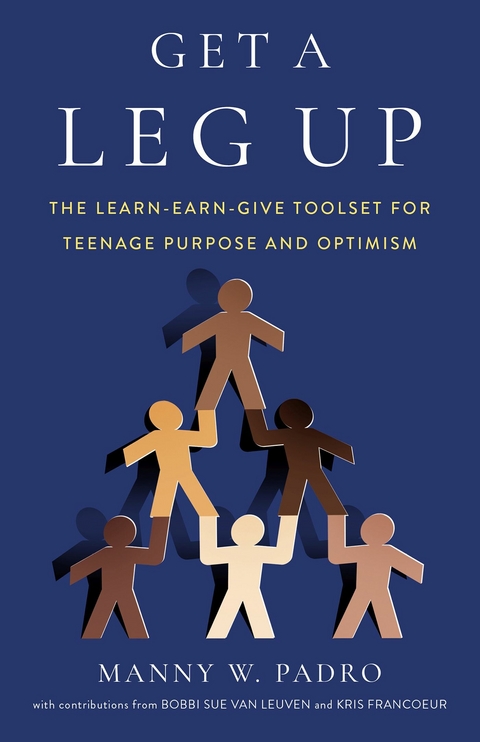
Get A Leg Up (eBook)
162 Seiten
Lioncrest Publishing (Verlag)
978-1-5445-2505-1 (ISBN)
Manny Padro moved from Puerto Rico to north Philadelphia when he was five, learning English as a second language and eventually following his entrepreneurial drive by delivering newspapers in his neighborhood. After graduating from Penn State, Manny worked as a park ranger for the National Park Service before transitioning to self-employment as a Certified Financial Planner. Manny lives in Salt Lake City, Utah, where he enjoys spending time with family as a husband, father, and grandfather.
You don't have to be a genius or a visionary or even a college graduate to be successful. You just need a framework and a dream. Michael DellEach of us has a purpose a reason for the decisions we make and the actions we take. Sometimes it only lives within us, unacknowledged and unidentified. Other times, our purpose is a force to be reckoned with. It drives us to set goals and accomplish them. It helps us build our own path. It enables us to recognize our success and celebrate it. Being successful down the road means identifying your purpose and values now. In Get a LEG Up, Manny Padro shares how he's achieved a life of happiness and fulfillment by learning to recognize his purpose and value system through behavior modification. Growing up in a low-income neighborhood, Manny relied on mentors to point him in a successful direction. Now, along with insight from dozens of other mentors, he's sharing what he's learned as a toolkit for young adults to gain a jump-start on a successful life. With exercises, anecdotes, and strategies for living each day with intention, this is the workbook you need to create healthy habits and commit to the future you want.
Introduction
Each day, millions of students enter and exit through the doors of high schools across the United States. As they do, they contemplate their own self-worth, their place in the world, and their prospects for life. Some feel positive about the future, but unfortunately, many feel an almost crushing despair without hope for a positive future for themselves.
This book is for those students and their educators.
I spent the first few years of my life on a plantain and coffee farm in the mountains of Puerto Rico. There was a wooden bridge by our house that crossed a canyon to get to the main road. My dad carried me when we needed to cross. We would drink milk from fresh coconuts, enjoy fresh sugar cane, and listen to the coquí frogs sing. In Puerto Rico we only spoke Spanish. My parents wanted us to have a different life and moved us to Philadelphia when I was five years old. We were too poor to rent an apartment so we lived in my aunt’s basement in North Philadelphia to avoid being homeless. We lived in a row home, surrounded by other row homes and buildings. My father took odd jobs in order for him to provide for our family. Life in North Philly was completely different from the life I lived during my early years on the family farm.
I started attending school. A few years later desegregation became part of my daily life. I was bused from the local elementary school to a school farther away from home. My experience with desegregation meant violence in and out of school. I wasn’t safe walking on the sidewalk next to my aunt’s house, walking to school, riding the bus to school, going to the bathroom, or even playing at recess. The teachers in our schools weren’t prepared or equipped to prevent or handle the violence that was erupting in our community, much less prepare us for the future. It wasn’t a place I wanted to be. They couldn’t break up fights without possibly being assaulted or having their tires slashed in the school parking lot. They did the best they could, especially since they were given no support, but in these circumstances my education was not great. Additionally I had to learn English since I only spoke and understood Spanish. My sisters and I learned quickly that we needed to talk white and act white. It helped us blend in better with some of my peers and deal with less racism, but we still had to deal with racism.
We were able to move out and into our own place after my dad had found a job and started bringing in wages. Eventually we moved out of North Philadelphia to Levittown. This move did not change the considerable chaos around us. There was less violence, but the education wasn’t much better. I trudged through school, not sure what I would do when I graduated from high school. You may wonder why I’m telling you about my background. It’s something I don’t speak about often, but I want you to know that the challenges you face, whether they are like mine or different, do not have to stop you from finding and developing your talents and finding your passion in life.
I am writing this book to share what I have learned over my lifetime that has helped me be successful in my business life and personal life. This knowledge from thirty years of actively learning is something I wish I would have had in my youth to help me achieve what I wanted to do with my life.
Much of how students view themselves comes from how they think adults view them. And those views can be limiting. Former President George W. Bush addressed this in his May 16, 2015, commencement address at Southern Methodist University. In his unique style, he encouraged the students: “To those of you graduating this afternoon with high honors, awards, and distinctions, I say well done. And as I like to tell the ‘C’ students, you too can be president.”
President Bush was pointing out that what we achieve in school isn’t the be-all and end-all of our potential, nor does it have to limit us.
The problem with hopes and prospects for life is that we often prescribe them for students. Many young people from poor, inner-city neighborhoods like mine was, are asked, “Why would you think of college or trade school?” Meanwhile, many from wealthier suburbs are prescribed four-year university educations, whether it’s their passion or not. Generally, their futures look entirely different. If the parents work blue-collar jobs, then the student likely will too. If the mother is a lawyer, then the daughter will probably go for a graduate degree.
Instead, what if there were a different way to approach kids’ futures? What if there is a different way to think about their aptitudes and possibilities in life? I believe there is—and in this book, we will explore exactly how to do this in a way that is completely personal and focused.
Time for Something Different
Henry Ford knew over a hundred years ago what the education system still needs to learn: “If you always do what you’ve always done, you’ll always get what you’ve always got.”
So I want you to try something different. If you’re a student, I want you to change the way you think about yourself. If you’re an educator, I want you to consider a change in your philosophy in order to change your trajectory and, therefore, students’ lives.
This book explores how to learn and teach differently so that students can achieve everything they can and should achieve in their lives.
If you are a student, this book will help you discover this for yourself.
While I feel this framework will benefit any student, I think it is imperative to share it with high school students who don’t see a bright future. These are the young people I knew personally when I lived in North Philadelphia. These are the youths who live with a sense of hopelessness that leads to giving up, dropping out, and a continuation of generational poverty and despair.
Why this age group? Because by the time students reach high school, they are forming a vision for their future and a sense of their prospects—along with enough maturity to know whether or not the odds are stacked against them.
Although I think this model can ultimately be used at any age, high school is ideal. Any older than the teen years, the more likely people are entrenched in their life circumstances and habits, so it’s harder to make major changes.
My background should have led me to a blue-collar future. That would have been fine, but that wasn’t my vision. I felt that college was the right route for me, although I wasn’t sure of what I wanted to study.
I chose college not because I thought that white-collar work is inherently better than blue-collar work. I believe both are viable and worthy. Instead, I think it’s all about determining your own values, purpose, aptitude, and goals. My grandson Braxton is in high school and exploring career options as a mechanic, blacksmith, or rancher. I want him to determine his own future based on his values, purpose, aptitude, and goals, which may be vastly different from mine, and I’m proud of him for doing so.
Today, I am a white-collar advisor from a blue-collar background. I am also a husband, father, grandfather, and a successful entrepreneur. Most importantly, I am a man who has clear values that I re-examine at least yearly to keep fresh and to hold myself to them.
I am a forward thinker, always looking ahead to see what I can achieve, but lately, I have looked backward and realized that I have been on the most incredible journey—partially because I had great teachers, mentors, and coaches. People were willing to reach out their hands and minds to help me learn and shape who I am today.
They taught me the three principles of success that form the basis of the framework I’m about to teach you:
- Learn
- Earn
- Give
If I had known this model when I was in high school or college, I would have been far more successful and happier much earlier in my life. Instead, it took me over thirty years to articulate this model.
And I want to share it with you. If you’re in high school, you’re in luck. Now is the time when this model of learning, earning, and giving can be most impactful, before you may be limited by poor educational models, opportunities, and prospects—before you head down the wrong path. This is your time to use a tried-and-true framework to develop better skills for the real world, to learn, and to find hope for the future. There are events in life that we can’t control, but I agree with the quote from Russell M. Nelson when he said, “The joy we feel has little to do with the circumstances of our lives and everything to do with the focus of our lives.”
Our current world is awash in turmoil. Each of us wants a better future and world for ourselves and those we love. By using this model, I firmly believe that we will slowly build a better world for everyone.
This book is not just an academic exercise for me. I live my life by the learn, earn, give model, and it has led to the happiness and success I now enjoy.
Each November, I look forward to the next calendar year, and I make my purpose-based plan for the year. I ask myself the following question: “What do I want to accomplish on a personal basis and on the business front?” My answer is always stated in a learn, earn, give format.
For example, last year my answer was to learn by going through the process of writing this book. My goal for earning was to meet or exceed my business plan objectives for that calendar year. My giving goal was much more personal, as it was...
| Erscheint lt. Verlag | 30.8.2022 |
|---|---|
| Sprache | englisch |
| Themenwelt | Sachbuch/Ratgeber ► Gesundheit / Leben / Psychologie ► Lebenshilfe / Lebensführung |
| ISBN-10 | 1-5445-2505-2 / 1544525052 |
| ISBN-13 | 978-1-5445-2505-1 / 9781544525051 |
| Informationen gemäß Produktsicherheitsverordnung (GPSR) | |
| Haben Sie eine Frage zum Produkt? |
 EPUB (Ohne DRM)
Größe: 1,3 MB
Digital Rights Management: ohne DRM
Dieses eBook enthält kein DRM oder Kopierschutz. Eine Weitergabe an Dritte ist jedoch rechtlich nicht zulässig, weil Sie beim Kauf nur die Rechte an der persönlichen Nutzung erwerben.
Dateiformat: EPUB (Electronic Publication)
EPUB ist ein offener Standard für eBooks und eignet sich besonders zur Darstellung von Belletristik und Sachbüchern. Der Fließtext wird dynamisch an die Display- und Schriftgröße angepasst. Auch für mobile Lesegeräte ist EPUB daher gut geeignet.
Systemvoraussetzungen:
PC/Mac: Mit einem PC oder Mac können Sie dieses eBook lesen. Sie benötigen dafür die kostenlose Software Adobe Digital Editions.
eReader: Dieses eBook kann mit (fast) allen eBook-Readern gelesen werden. Mit dem amazon-Kindle ist es aber nicht kompatibel.
Smartphone/Tablet: Egal ob Apple oder Android, dieses eBook können Sie lesen. Sie benötigen dafür eine kostenlose App.
Geräteliste und zusätzliche Hinweise
Buying eBooks from abroad
For tax law reasons we can sell eBooks just within Germany and Switzerland. Regrettably we cannot fulfill eBook-orders from other countries.
aus dem Bereich