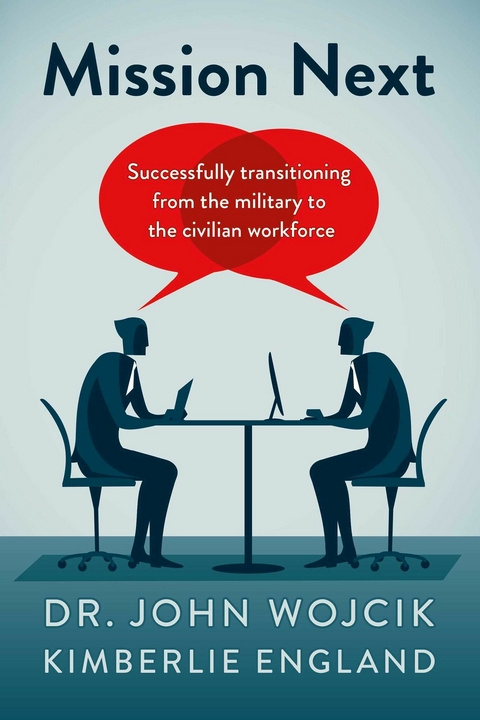
Mission Next (eBook)
192 Seiten
Bookbaby (Verlag)
9781667851310 (ISBN)
Transitioning service members should read Mission Next because it will increase their chances at achieving a smooth transition and finding a job that fits. It's a resource that covers every aspect of the transition from the military to the civilian workforce. Mission Next provides checklists and tips to make the journey easier. It also uses plain English to explain complicated concepts, such as civilian pay and benefits, so service members can make informed decisions about their civilian employment options. When we talked to veterans about their transition, they commented, "e;It's like I was the first person to ever leave."e; Joining the service is easy. Leaving is a whole lot harder. During their first year, service members spend months learning their first military occupational skill - and spend years refining and expanding those skills. Becoming an expert doesn't happen overnight; it takes time and hard work. This next transition requires a similar level of dedication and commitment. Close to 65% of active-duty veterans leave their first civilian jobs within 24 months. Our research showed that veterans leave because they struggle to conform to the culture of their organization and simply abandon their new civilian job. Mission Next will help transitioning service members avoid being part of that statistic. Mission Next will help transitioning service members rediscover who they are, write a resume that civilians can understand, find a job that fits, and learn how to operate in this new civilian work environment. How the Book EvolvedThe Mission Next consultants spent two years intensely researching why veterans leave their first jobs. We read the books, articles, and research so our clients don't have to. We even did a formal research study to gather first-hand accounts about why veterans leave. At the end of 2021, John defended his doctoral dissertation on the topic of why military officers leave their civilian jobs. The process was the culmination of almost six years of doctoral studies, document reviews, research, and formally presenting and defending the work. That led to our desire to publish a book to help transitioning veterans by providing a toolkit that can be referenced during each phase of the transition. Mission Next encourages service members to create a vision for their post-military life by providing thought-provoking exercises, such as revisiting personal values and drafting a vision statement. There are also chapters dedicated to Learning the Civilian Language, Answering Your Resume Questions, and Using Culture to Your Advantage.
1
UNDERSTANDING WHY
VETERANS LEAVE THEIR FIRST JOB
This book is not designed to tell you what you’re going to face when you transition without providing solutions. It’s also not going to come up with the answers for you. That’s because everyone’s path is different and some things in life are hard. Challenging. Demanding. What you’re about to experience—the military to civilian transition process—is not an easy thing to go through. You can, however, have a truly successful transition if you take the time to prepare and get yourself ready.
This book is also not simply one person’s perspective of what happened to them upon their retirement or ETS. The bookshelves are full of those accounts, often written by someone famous or high-ranking. They may even have a great headshot on the front cover. While reading about someone’s personal experiences may be helpful, this book is supported by academic theory and peer-reviewed research. Wait, don’t run away. This isn’t a book of philosophy and statistics. It’s a book that uses research and theory to help make transitioning as painless as possible. It’s going to get you where you want to be as you step into the civilian workforce.
This book is full of thought-provoking questions and exercises. If you want to make the most of this book—and have the best chance of a smooth transition—do the exercises. Every one of them. This might mean that you will have to work for weeks, or maybe even months, but it’ll be worth it.
Why Did You Join the Military?
Put yourself back to the point when you first thought, “I think I want to join the military.” It may have been only three or six years ago, or maybe more than twenty years have gone by since you made that decision. Regardless of how long ago it’s been, write down the first five reasons that come to mind when you reflect on your reasons for joining the military.
| Why I joined the military? |
| 1. |
| 2. |
| 3. |
| 4. |
| 5. |
It doesn’t matter if you write a few words, or a few sentences for each reason. Focus on what words come to your mind. You’ll use this information in Chapter 3 as you begin to identify your values and define your personal vision.
The Statistics on Leaving the Military
The best way to understand why veterans leave their first job is to examine the statistics. Over 200,000 service members leave active duty every year. To help personalize that number, consider how many people are working in your unit right now. Are there 10, 50, 300, or even 1,000? Now think about how many units like yours leave active duty every single day. It’s really a staggering amount of people that are faced with the challenges of transitioning into the civilian workforce. Keep in mind that for every service member that leaves, there are spouses, kids, step-kids, parents (and maybe a pet or two) who are transitioning too. All those moving parts are each going to behave in their own distinct way. You won’t be able to control all of it, but by preparing yourself as much as possible, you can limit the chaos that is likely to swirl around the decision to leave the military.
Some service members figure out how to smoothly transition with limited support, while others most certainly do not. As mentioned in the prologue, the Department of Defense and your branch of service worked hard to get you to enlist. They spent tens of thousands of dollars to get you to leave your comfortable, civilian world to wear a camouflage uniform to work every day. Your branch of service will try to help you transition, but keep in mind that the people working with you through this process will likely only be able to share their own personal experiences of what happened in their lives when they left active duty. That’s why it’s up to you to create your own personalized roadmap to transitioning. Your success in navigating this transition is almost entirely up to you.
We’ve established that each day, the equivalent of an entire crew of four fast attack submarines (around 550 per day) leaves active duty. Once those submariners leave service, 46% of them will still be looking for their first job after one year. The ones who do secure a civilian job will end up leaving those civilian organizations at incredibly high rates—rates that far exceed civilian turnover rates.
In the civilian world, around 19% of employees leave their jobs within the first year of being hired. Turnover rates for veterans are noticeably higher. Studies show that between 54% and 65% of veterans will leave their first civilian job by the end of their second year. Officers tend to stay in place a little longer than enlisted service members.
- Year One. 26.7% of officers reported leaving while 48% of enlisted service members reported leaving in that first year.
- Year Two. 26% of officers reported leaving while 20% of enlisted service members reported leaving in that second year.
It is difficult to ignore the staggering difference between how quickly former military members leave their first jobs compared to the civilian turnover rates. Civilian organizations repeatedly share how much they want to hire veterans. Government analysis and research studies back up this claim. Study after study confirms that businesses value veterans and want to hire them. The dissertation pointed to a long list of skills and values that civilian organizations desperately want including “sense of duty, commitment, dedication, selfless service, and leadership.” They want you and you want to work for those organizations. So, what’s the problem? It turns out that the answer is a little complicated, but with the right tools, you’ll be off to a good start.
The Gap between Military and Civilian Life
Look back at your notes from a couple pages earlier where you were asked to jot down the reasons you joined the armed services in the first place. That was how you felt before you signed up for duty and laced up your first pair of boots. After that, you spent the next [insert your number of years of service] years training, fighting, learning, and leading with people who were just like you. They lived in barracks and off-base housing just like you did. They PCS’d every couple years, which meant finding new schools, discovering the new local hangouts, and even making new friends. While you were on active duty, you constantly learned new skills and built-up your standing or credibility both as a service member and as a leader.
This is your “normal.” Every day, you got up, did PT or PRT with your team, put on the uniform, worked, and maybe hit the commissary on the way home. Everyone in your world was pretty much like you. Even your spouse and kids spoke the language and followed the behaviors without need for translation. You didn’t have to explain why you needed to get out of your car at 1700 to salute the flagpole before you zipped off base to your HOR. Everybody just got it. It’s not going to be like that where you’re going. We’re talking about your next mission: Mission Next.
Making a Plan—a Real Plan—for Change
Research shows that any time a human undergoes a significant transition, that transition requires the human to adapt to their new surroundings in such a way they can understand or at least coexist with the other humans in their new environment. In other words, change requires that you adapt. You’ve done this before though. Maybe you were in service when the DoD made “enhancements” to its Defense Travel System, which drove some service members crazy as they needed to figure out how to upload their travel vouchers and receipts and re-learn how to book a flight. Maybe you had to work through the Army’s new personnel management systems that merged human resource data, medical information, and performance evaluation systems with less than stellar results. Change can be painful, and adaptation can take a lot of work. During these transitions, people make mistakes and that’s okay. The key is to give the change the attention it deserves. Studies show that creating a deliberate plan to address the change helps humans do a better job in navigating their way through transitions.
Understanding Capital
Social scientists have studied how humans experience change for well over a hundred years. This means you don’t have to spend time studying change theory, and this book will help you understand what’s really going on as you navigate the social change.
When you were at basic training or in your officers commissioning course, you were indoctrinated into a new culture. You stopped being a civilian and became a service member. Change happened. There were times when you didn’t understand how your new society worked, or how you would learn all those new skills that were required. But you did. You pushed through all the...
| Erscheint lt. Verlag | 7.7.2022 |
|---|---|
| Sprache | englisch |
| Themenwelt | Sachbuch/Ratgeber ► Gesundheit / Leben / Psychologie ► Lebenshilfe / Lebensführung |
| ISBN-13 | 9781667851310 / 9781667851310 |
| Informationen gemäß Produktsicherheitsverordnung (GPSR) | |
| Haben Sie eine Frage zum Produkt? |
 EPUB (Adobe DRM)
Größe: 1,1 MB
Kopierschutz: Adobe-DRM
Adobe-DRM ist ein Kopierschutz, der das eBook vor Mißbrauch schützen soll. Dabei wird das eBook bereits beim Download auf Ihre persönliche Adobe-ID autorisiert. Lesen können Sie das eBook dann nur auf den Geräten, welche ebenfalls auf Ihre Adobe-ID registriert sind.
Details zum Adobe-DRM
Dateiformat: EPUB (Electronic Publication)
EPUB ist ein offener Standard für eBooks und eignet sich besonders zur Darstellung von Belletristik und Sachbüchern. Der Fließtext wird dynamisch an die Display- und Schriftgröße angepasst. Auch für mobile Lesegeräte ist EPUB daher gut geeignet.
Systemvoraussetzungen:
PC/Mac: Mit einem PC oder Mac können Sie dieses eBook lesen. Sie benötigen eine
eReader: Dieses eBook kann mit (fast) allen eBook-Readern gelesen werden. Mit dem amazon-Kindle ist es aber nicht kompatibel.
Smartphone/Tablet: Egal ob Apple oder Android, dieses eBook können Sie lesen. Sie benötigen eine
Geräteliste und zusätzliche Hinweise
Buying eBooks from abroad
For tax law reasons we can sell eBooks just within Germany and Switzerland. Regrettably we cannot fulfill eBook-orders from other countries.
aus dem Bereich