


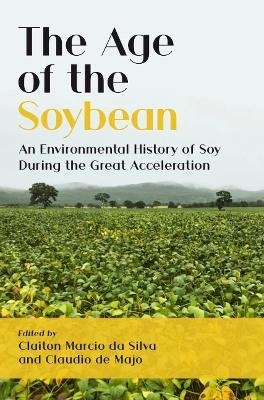
The Age of the Soybean
An Environmental History of Soy During the Great Acceleration
Seiten
2022
White Horse Press (Verlag)
978-1-912186-64-8 (ISBN)
White Horse Press (Verlag)
978-1-912186-64-8 (ISBN)
Soy is the embodiment of mechanised agriculture and is one of the main actors behind the socioeconomic, political and ecological transformations of industrial farming across the world. This book analyses this versatile legume's global expansion, helping to unveil the historical drivers behind the rise of the soybean in the global food chain.
The soybean is far more than just a versatile crop whose derivates serve the protein needs of a meatless diet. One of the world's most important commodities, soy represents the embodiment of mechanised industrial agriculture and is one of the main actors behind the socioeconomic, political and ecological transformations of industrial farming in several world regions. Despite the crop's potential as a cheap source of vegetal protein for human consumers, most industrial soybean production has fuelled the global meat industrial complex, as animal feed. Soybean is thus, paradoxically, still a relatively 'invisible' crop to the public at large, although its global yields continue to increase at stupendous rates, lining the pockets of agribusiness and to the detriment of traditional agriculture.
The transnational socio-ecological and economic entanglements characterising this versatile legume's global expansion have prompted scholarly attention as researchers around the world have begun to unveil the main historical drivers behind the rise of the soybean in the global food chain. This book aims to expand the analysis, offering the most significant effort so far at an environmental history of soybeans. Interrogating the socioeconomic and ecological transformations determined by (and determining) the rise of soy in international food chains during the Great Acceleration, the volume gathers contributions from an international cast of researchers, working in numerous geographical contexts, from Japan and China, to India, African nations, the Southern Cone of Latin America, Northern Europe and the United States. Soybean farming, breeding, processing and marketing have bound together the histories of these diverse regions and altered beyond recognition their ecological and socio-economic contexts.
The soybean is far more than just a versatile crop whose derivates serve the protein needs of a meatless diet. One of the world's most important commodities, soy represents the embodiment of mechanised industrial agriculture and is one of the main actors behind the socioeconomic, political and ecological transformations of industrial farming in several world regions. Despite the crop's potential as a cheap source of vegetal protein for human consumers, most industrial soybean production has fuelled the global meat industrial complex, as animal feed. Soybean is thus, paradoxically, still a relatively 'invisible' crop to the public at large, although its global yields continue to increase at stupendous rates, lining the pockets of agribusiness and to the detriment of traditional agriculture.
The transnational socio-ecological and economic entanglements characterising this versatile legume's global expansion have prompted scholarly attention as researchers around the world have begun to unveil the main historical drivers behind the rise of the soybean in the global food chain. This book aims to expand the analysis, offering the most significant effort so far at an environmental history of soybeans. Interrogating the socioeconomic and ecological transformations determined by (and determining) the rise of soy in international food chains during the Great Acceleration, the volume gathers contributions from an international cast of researchers, working in numerous geographical contexts, from Japan and China, to India, African nations, the Southern Cone of Latin America, Northern Europe and the United States. Soybean farming, breeding, processing and marketing have bound together the histories of these diverse regions and altered beyond recognition their ecological and socio-economic contexts.
Claiton Marcio da Silva is an Associate Professor at the Federal University of the Southern Frontier (UFFS), Santa Catarina, Brazil and a CNPq Productivity Researcher. Recently, he has been exploring the global environmental history of soybeans and their impacts on traditional populations in the Global South. Claudio de Majo is doctoral candidate at the Rachel Carson Center for Environment and Society (Ludwig-Maximilians University, Munich). His research interests include global environmental history, the environmental history of Europe and Latin America, and the relation between the commons and ecology. He is deputy editor of Global Environment: A Journal of Transdisciplinary History.
| Erscheinungsdatum | 03.11.2022 |
|---|---|
| Zusatzinfo | Various figures and illustrations |
| Verlagsort | Knapwell |
| Sprache | englisch |
| Maße | 152 x 229 mm |
| Themenwelt | Sachbuch/Ratgeber ► Natur / Technik ► Natur / Ökologie |
| Geisteswissenschaften ► Geschichte | |
| Weitere Fachgebiete ► Land- / Forstwirtschaft / Fischerei | |
| ISBN-10 | 1-912186-64-0 / 1912186640 |
| ISBN-13 | 978-1-912186-64-8 / 9781912186648 |
| Zustand | Neuware |
| Informationen gemäß Produktsicherheitsverordnung (GPSR) | |
| Haben Sie eine Frage zum Produkt? |
Mehr entdecken
aus dem Bereich


aus dem Bereich
die Geschichte einer außergewöhnlichen Begegnung
Buch | Hardcover (2025)
Klett-Cotta (Verlag)
CHF 34,90
eine Geschichte der letzten 500 Jahre
Buch | Hardcover (2025)
C.H.Beck (Verlag)
CHF 47,60


