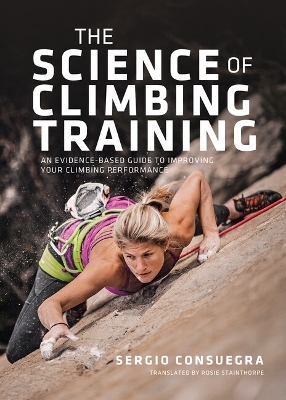
The Science of Climbing Training
Vertebrate Publishing Ltd (Verlag)
978-1-83981-182-1 (ISBN)
When it comes to training for climbing, there is an overwhelming amount of information out there. In The Science of Climbing Training, top Spanish climbing coach Sergio Consuegra has analysed our sporting needs from the perspective of exercise and sports science to provide an evidence-based approach to training for climbing. It is designed to help us improve climbing performance, whether we’re taking the next step in our training as we work towards a project, or if we’re a coach looking to optimise our athletes’ training. It doesn’t contain any 'magic' training methods, because there are none – although you might be shocked by the science behind some popular methods.
The first part explains what training is and how different training methods are governed by the physiological and biomechanical processes that occur in the body. The second part looks at how to improve specific needs (such as finger strength and forearm muscle endurance) and general needs (such as basic physical conditioning, pulling strength, pushing strength, strength training for injury prevention) for the different demands and types of climbing and bouldering. The third and final part suggests the best ways to fit it all together. It looks at adjusting training volume and intensity, and tapering to encourage supercompensation, all to help us achieve improved performance, whether it’s a breaking into a higher grade, ticking that long-standing project or climbing a dream route.
Sergio Consuegra Gómez discovered climbing and mountain sports when he started university, and he graduated with a degree in sports science from UPM university in Madrid (Universidad Politécnica de Madrid). He went on to teach the mountain sports and activities module at UPM for several years. With a keen interest in strength training and the design of training programmes, Sergio is constantly rethinking traditional ideas and championing scientific evidence as the basis of any training plan. It is this approach to training that led him to write this book: focusing on the science behind climbing performance and training, as opposed to methods based solely on personal experience, to provide an evidence-based approach to training for climbing. He’s an active climbing coach, and he lives in Jaca, Spain, where he can get out in the Pyrenees on a daily basis. Find out more at sergioconsuegra.com
IntroductionPART I: UNDERSTANDING TRAINING1. THE PROCESS OF TRAININGDefinitionIntensity and thresholdsHomeostasis, GAS and supercompensationThe principles of trainingWhat to train 2. UNDERSTANDING THE IMPORTANCE OF STRENGTHWhat is strength? Types of muscle contractionTypes of muscle fibre and recruitmentCauses of fatigueMuscle failure: Is it really necessary? Ways to develop strength: hypertrophy and neuralStrength training for injury prevention3. UNDERSTANDING AND OPTIMISING MOBILITYWhat is mobility? Flexibility, elasticity and stiffness Active vs passive flexibility and mobility reserveMyotatic reflex and autogenic inhibition or inverse myotatic reflexThreat perception as a limiting factor of ROMBrain maps, SIMs and DIMsOptions for optimising mobility4. BRIEF NOTES ON ANATOMYUpper body: pulling musclesCore: the connecting chainLower body: pushing musclesConnective tissue: tendons and ligaments5. MUSCLE CHAINS, FASCIA AND BIOTENSEGRITYFascia anatomy, deep fascia and superficial fasciaMain muscle chainsThe body as a biotensegrity structure6. BIOENERGETICS AND METABOLISMFocus: energy productionThe ATP-PCr systemAnaerobic glycolysisAerobic glycolysisFat oxidation or lipolysisThe energy continuum7. ANALYSIS OF THE MAIN PHYSIOLOGICAL FACTORS IN CLIMBING PERFORMANCEThe old paradigm of performance: intensity and energy systems according to number of movesNew findings about limiting factors in climbing performance: routes and boulderingPART II: OPTIMISATION OF TRAINING8. WHAT CAN I OPTIMISE IN MY TRAINING SESSIONS? Definition of training goalsGeneral warm-up. Joint mobilisation. Coordination-based cardio. Increasing ROM. Muscle activationCore activationSpecific wall-based exercisesTraversing. Introducing the session’s target techniqueWall-based core work. Resistance band exercises. Body tension Enhancing performance: post-activation potentiationClimbing-specific training needsMaximum strength trainingMaximum grip strength. Deadhangs. Evidence and protocols. Adaptation to different levels of trainingMaximum pulling strength. Pull-ups. Velocity-based training. Maximum intensity methods and calculating your RMMaximum isometric strength. Lock-offsRecovery time during and between sessionsPower and RFD trainingCampus board trainingRecovery time during and between sessionsIntegrated strength, power and RFD training: boulderingEndurance trainingPhysiological effects of different intensitiesIncreasing forearm blood flow. Continuous, long interval and intermittent methods. Blood flow restriction training (BFR)Improving recovery. High-intensity interval methods. Active wall-based recovery. Intermittent deadhangsPhysical conditioning for climbingStrength training to maximise performance. Methods and techniques for upper body, core and lower body exercisesStrength training for injury preventionCardiovascular endurance training for climbing. Base endurance, HIIT, body composition and SITMobility training for climbingPART III: PLANNING OF TRAINING9. TRAINING SESSION DESIGNSingle-focus sessions. Example sessionCriteria for planning a multi-focus session. Transfer and interference10. PERIODISATION MODELS: IN SEARCH OF OPTIMAL PEAK FORMBasic concepts: macrocycle, mesocycle and microcycleLinear periodization: traditional and reverse. General and specific preparation period. Competition and tapering period. Advantages and disadvantages. Example periodizationATR periodization: accumulation, transmutation and realisation mesocycles. Types and order of microcycles. Advantages and disadvantages. Example periodization11. DETRAININGAcknowledgementsAuthor bioBibliography
| Erscheinungsdatum | 06.03.2023 |
|---|---|
| Übersetzer | Rosie Stainthorpe |
| Zusatzinfo | Diagrams; Tables, color; Tables, black and white; Halftones, color |
| Sprache | englisch |
| Maße | 148 x 210 mm |
| Gewicht | 434 g |
| Themenwelt | Sachbuch/Ratgeber ► Sport |
| ISBN-10 | 1-83981-182-X / 183981182X |
| ISBN-13 | 978-1-83981-182-1 / 9781839811821 |
| Zustand | Neuware |
| Informationen gemäß Produktsicherheitsverordnung (GPSR) | |
| Haben Sie eine Frage zum Produkt? |
aus dem Bereich