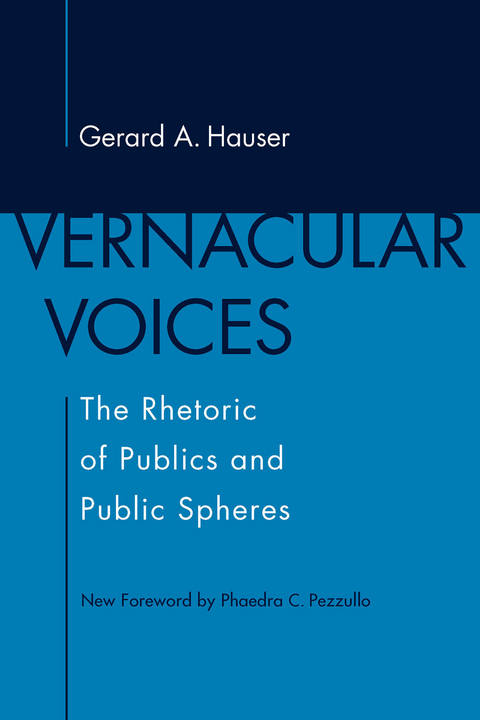
Vernacular Voices (eBook)
362 Seiten
University of South Carolina Press (Verlag)
978-1-64336-286-1 (ISBN)
An award-winning study of how formal and informal public discourse shapes opinions
A foundational text of twenty-first-century rhetorical studies, Vernacular Voices addresses the role of citizen voices in steering a democracy through an examination of the rhetoric of publics. Gerard A. Hauser maintains that the interaction between everyday and official discourse discloses how active members of a complex society discover and clarify their shared interests and engage in exchanges that shape their opinions on issues of common interest.
In the two decades since Vernacular Voices was first published, much has changed: in the aftermath of the 9/11 terrorist attacks, US presidents have increasingly taken unilateral power to act; the internet and new media have blossomed; and globalization has raised challenges to the autonomy of nation states. In a new preface, Hauser shows how, in an era of shared, global crises, we understand publics, how public spheres form and function, and the possibilities for vernacular expressions of public opinion lie at the core of lived democracy.
A foreword is provided by Phaedra C. Pezzullo, associate professor of communication at the University of Colorado Boulder.
Gerard A. Hauser is professor emeritus of communication and Arts & Sciences Professor Emeritus of Distinction in Rhetoric at the University of Colorado Boulder. He is the author of Introduction to Rhetorical Theory and editor of Philosophy and Rhetoric in Dialogue: Redrawing Their Intellectual Landscape. He also edits the journal Philosophy and Rhetoric.
Chapter 1
The Public Voice of Vernacular Rhetoric
Rhetoric's Place in the Athenian Democracy
Civil Society and the Appearance of Public Opinion
Vox Populi and the Problem of "Public" Opinion
Rhetorical Antecedents of Publics
Conclusion
Chapter 2
Discourse, Rhetorical Discourse, and the Public Sphere
The Bourgeois Public Sphere
Rhetorical Counterassumptions to Habermas's Model
Conclusion
Chapter 3
Civic Conversation and the Reticulate Public Sphere
Outline of a Rhetorical Model of the Public Sphere
Public Conversation and the Associations of the
Reticulate Public Sphere
Common Meaning and the Associative Networks of
the Reticulate Public Sphere
The Ground of Civil Judgment
Rhetorical Criteria of the Public Sphere
Conclusion
Chapter 4
Reading Public Opinion from Vernacular Rhetoric
Witnessing Vernacular Discourse: An Outsider's Experience
Vernacular Rhetoric: The Rhetorical Locus of Public
Opinion
Public Opinion and Reasoning
Public Opinion and Common Understanding
The Dialogical Process of Opinion Formation
Conclusion
Chapter 5
Narrative, Cultural Memory, and the Appropriation of Historicity
Rhetoric and the Active Society
Memories of Hope: Poland
Memories of Despair: Yugoslavia
Contrasting Stories, Contrasting Possibilities
Conclusion: The Narrative Bridge from Tradition to
Historicity
Chapter 6
Reshaping Publics and Public Spheres: The Meese Commission's Report on Pornography
A Call to Reshape the Literary Public Sphere
The Final Report: Version I
The Final Report: Version II
Reconstructing the Public Sphere
Conclusion
Chapter 7
Technologizing Public Opinion: Opinion Polls, the Iranian Hostages, and the Presidential Election
The Problem of Public Opinion
Transforming Victims into Heroes
Public Opinion as Technological Constraint
Conclusion
Chapter 8
Democracy's Narrative: Living in Roosevelt's America
The Election of 1940
The People's Letters and Public Opinion
"Public" Opinion on the Third Term
Defining America
Conclusion: Forgotten Publics in a Land of Strangers
Chapter 9
The Rhetoric of Publicness: Theory and Method
Theoretical Considerations
Methodological Considerations
Appendix I: Chronology of Hostage Developments
Appendix II: Chronology of the 1980 Campaign
Notes
Bibliography
Index
| Erscheint lt. Verlag | 18.1.2022 |
|---|---|
| Reihe/Serie | Studies in Rhetoric & Communication | Studies in Rhetoric & Communication |
| Vorwort | Phaedra C. Pezzullo |
| Verlagsort | Columbia |
| Sprache | englisch |
| Maße | 150 x 150 mm |
| Themenwelt | Sachbuch/Ratgeber ► Beruf / Finanzen / Recht / Wirtschaft ► Briefe / Präsentation / Rhetorik |
| Geisteswissenschaften ► Sprach- / Literaturwissenschaft ► Sprachwissenschaft | |
| Sozialwissenschaften ► Kommunikation / Medien ► Medienwissenschaft | |
| Sozialwissenschaften ► Politik / Verwaltung ► Politische Theorie | |
| Schlagworte | public opinion polls, civics, historicity, Aristotle, Hannah Arendt, John Dewey, Jürgen Habermas, cultural memory |
| ISBN-10 | 1-64336-286-0 / 1643362860 |
| ISBN-13 | 978-1-64336-286-1 / 9781643362861 |
| Informationen gemäß Produktsicherheitsverordnung (GPSR) | |
| Haben Sie eine Frage zum Produkt? |
 EPUB (Adobe DRM)
Kopierschutz: Adobe-DRM
Adobe-DRM ist ein Kopierschutz, der das eBook vor Mißbrauch schützen soll. Dabei wird das eBook bereits beim Download auf Ihre persönliche Adobe-ID autorisiert. Lesen können Sie das eBook dann nur auf den Geräten, welche ebenfalls auf Ihre Adobe-ID registriert sind.
Details zum Adobe-DRM
Dateiformat: EPUB (Electronic Publication)
EPUB ist ein offener Standard für eBooks und eignet sich besonders zur Darstellung von Belletristik und Sachbüchern. Der Fließtext wird dynamisch an die Display- und Schriftgröße angepasst. Auch für mobile Lesegeräte ist EPUB daher gut geeignet.
Systemvoraussetzungen:
PC/Mac: Mit einem PC oder Mac können Sie dieses eBook lesen. Sie benötigen eine
eReader: Dieses eBook kann mit (fast) allen eBook-Readern gelesen werden. Mit dem amazon-Kindle ist es aber nicht kompatibel.
Smartphone/Tablet: Egal ob Apple oder Android, dieses eBook können Sie lesen. Sie benötigen eine
Geräteliste und zusätzliche Hinweise
Buying eBooks from abroad
For tax law reasons we can sell eBooks just within Germany and Switzerland. Regrettably we cannot fulfill eBook-orders from other countries.
aus dem Bereich