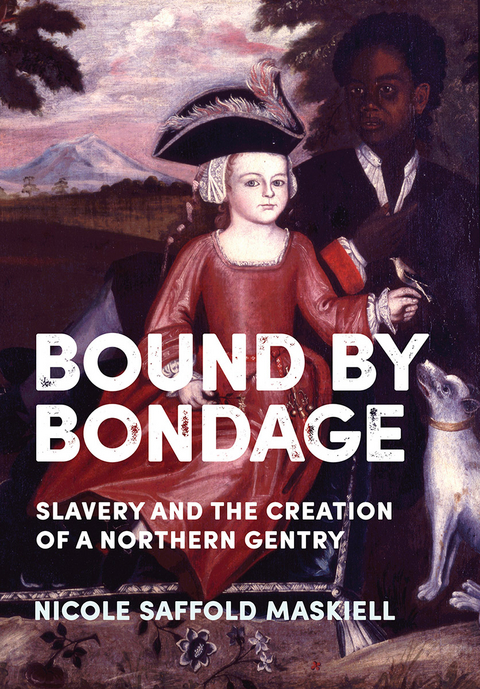
Bound by Bondage (eBook)
306 Seiten
Cornell University Press (Verlag)
978-1-5017-6426-4 (ISBN)
During the first generations of European settlement in North America, a number of interconnected Northeastern families carved out private empires. In Bound by Bondage, Nicole Saffold Maskiell argues that slavery was vital to the rise of this aristocracy, and those dynastic families built prestige through mastery, creating manorial estates and expansive trading networks from the Northeast to the South, the Caribbean, and beyond. Members of this elite class, including mayors, governors, and presidents, were among the largest slaveholders in the North, with power aspirations uniting Anglo and Dutch families.
Using original research drawn from archives across several continents in multiple languages, Maskiell traces the origins of these private empires from the founding of Northeastern colonies to the eve of the Revolutionary War. She reveals a multiracial Early America, where enslaved traders, woodsmen, millers, maids, bakers, and groomsmen developed expansive networks of their own that challenged the power of the elites, helping in escapes, in trade, and in simple camaraderie.
Bound by Bondage adds a new chapter to early North American history, linking Northern networks of merit to slavery.
Nicole Saffold Maskiell is Associate Professor of African and African American Studies at Dartmouth College and the winner of the 2023 Henricks Award for best book-length manuscript relating to New Netherland and the Dutch colonial experience.
Introduction: Manhunt
1. Neger: Race, Slavery, and Status in the Dutch Northeast (1640s–60s)
2. Kolonist: Slaveholding and the Survival of Expansive Anglo-Dutch Elite Networks (1650s–90s)
3. Naam: Race, Family, and Connection on the Borderlands (1680s–90s)
4. Bond: Forging an Anglo-Dutch Slaveholding Northeast (1690s–1710s)
5. Family: Kinship, Ambition, and Fear in a Time of Rebellions (1710s–20s)
6. Market: Creating Kinship-Based Empires United by Slaveholding (1730s–50s)
7. Identity: Navigating Racial Expectations to Escape Slavery (1750s–60s)
Conclusion: Gentry
| Erscheint lt. Verlag | 15.8.2022 |
|---|---|
| Reihe/Serie | New Netherland Institute Studies | New Netherland Institute Studies |
| Zusatzinfo | 5 b&w halftones, 3 maps, 4 charts |
| Verlagsort | Ithaca |
| Sprache | englisch |
| Maße | 150 x 150 mm |
| Themenwelt | Sachbuch/Ratgeber ► Geschichte / Politik ► Regional- / Landesgeschichte |
| Geschichte ► Allgemeine Geschichte ► Neuzeit (bis 1918) | |
| Geisteswissenschaften ► Geschichte ► Regional- / Ländergeschichte | |
| Schlagworte | slavery in the north, colonial elite networks, dutch slavery, slavery among elites, livingston slavery |
| ISBN-10 | 1-5017-6426-8 / 1501764268 |
| ISBN-13 | 978-1-5017-6426-4 / 9781501764264 |
| Informationen gemäß Produktsicherheitsverordnung (GPSR) | |
| Haben Sie eine Frage zum Produkt? |
 EPUB (Adobe DRM)
Kopierschutz: Adobe-DRM
Adobe-DRM ist ein Kopierschutz, der das eBook vor Mißbrauch schützen soll. Dabei wird das eBook bereits beim Download auf Ihre persönliche Adobe-ID autorisiert. Lesen können Sie das eBook dann nur auf den Geräten, welche ebenfalls auf Ihre Adobe-ID registriert sind.
Details zum Adobe-DRM
Dateiformat: EPUB (Electronic Publication)
EPUB ist ein offener Standard für eBooks und eignet sich besonders zur Darstellung von Belletristik und Sachbüchern. Der Fließtext wird dynamisch an die Display- und Schriftgröße angepasst. Auch für mobile Lesegeräte ist EPUB daher gut geeignet.
Systemvoraussetzungen:
PC/Mac: Mit einem PC oder Mac können Sie dieses eBook lesen. Sie benötigen eine
eReader: Dieses eBook kann mit (fast) allen eBook-Readern gelesen werden. Mit dem amazon-Kindle ist es aber nicht kompatibel.
Smartphone/Tablet: Egal ob Apple oder Android, dieses eBook können Sie lesen. Sie benötigen eine
Geräteliste und zusätzliche Hinweise
Buying eBooks from abroad
For tax law reasons we can sell eBooks just within Germany and Switzerland. Regrettably we cannot fulfill eBook-orders from other countries.
aus dem Bereich