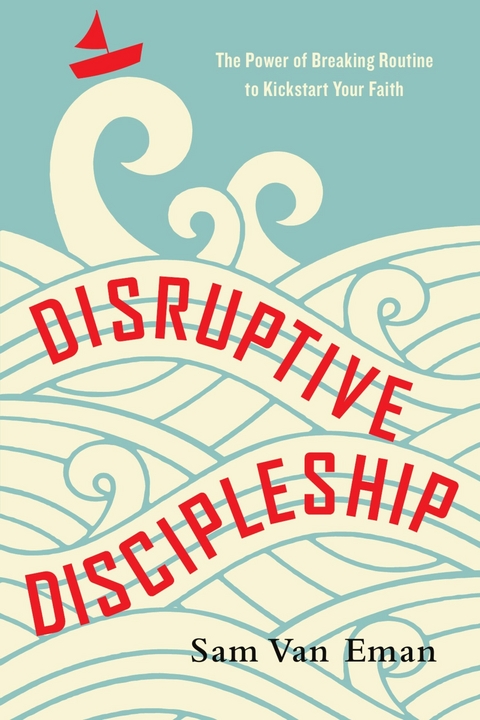
Disruptive Discipleship (eBook)
InterVarsity Press (Verlag)
978-0-8308-9081-1 (ISBN)
Sam Van Eman is a resource specialist for the CCO's Experiential Designs team, where he cocreates transformational experiences for college students, professionals, and organizations. As a public speaker and facilitator, he has taught (and played) in barns and board rooms, canyons, classrooms, and auditoriums. Sam has contributed to PRISM Magazine, the Center for Parent/Youth Understanding, Christianity Today's Faith in the Workplace, and was highlighted in the decade's best at Catapult Magazine. He is the author of On Earth as It Is in Advertising? and lives with his wife and daughters in central Pennsylvania.
Sometimes in the Christian life we get stuck. Something seems off, and we don't know why. We may not even notice it at first. But we feel like God is far from our daily lives, or we lose hope for the future, or we don't treat others in loving ways. What can we do?Sam Van Eman has found that our spiritual lives need disruptive experiences, which can jolt and reorient us for greater spiritual maturity. Out-of-the-ordinary activities can challenge our assumptions and give us space to consider new perspectives. And when we intentionally choose to pursue designed experiences, we stretch our faith in new and unexpected ways. Filled with concrete examples of how ordinary people are shaped by disruptive experiences, this book provides a path to deeper faith on purpose. Jesus disrupted his disciples with invitations to get out of their boats, leave their nets, and follow him. Have courage, and discover what those kinds of disruptions might look like for you.
Sam Van Eman is a resource specialist for the CCO's Experiential Designs team, where he co-creates transformational experiences for college students, professionals, and organizations. He is the author of On Earth as It Is in Advertising? Moving from Commercial Hype to Gospel Hope.As a public speaker and facilitator, Sam has taught (and played) in barns and boardrooms, canyons, classrooms, and auditoriums. His years on campus resulted in numerous Christian Service awards for his student leaders and a Greek Life brotherhood award named in his honor. He has contributed to PRISM Magazine, the Center for Parent/Youth Understanding, Christianity Today's Faith in the Workplace, and was highlighted in the decade?s best at Catapult Magazine. He lives with his wife and daughters in central Pennsylvania.
FAITH
Allie, a student traveling with us, had already vomited three or four times, and we were only as many hours down the mountain. The bus had two levels, and the uncirculated heat on the second floor smothered us even more than the lack of oxygen. Most of the Peruvian passengers slept soundly, but we did not—Allie especially. I had dozed off for another few minutes when a muffled commotion across the aisle stirred me awake.
“Is everything okay?” I asked quietly.
One of the college students in our group of sixteen whispered, “Allie threw up again.” She reached for a baggie from the travel attendant, who I hadn’t seen standing beside me in the dark.
“Do you need anything?” I asked.
“No. Thanks, Sam. Just pray for her to get some relief.”
I felt my way to the tiny bathroom in the back, holding each handrail as the bus careened around another mountainside curve. Nausea affected me too. We took turns going in there for the tiny window that slid open just enough to suck in a draft of cool air. Twice we had asked that the climate be adjusted, and the attendant politely refused.
We had been serving kids in an afterschool program, and Allie hadn’t adjusted well to either the altitude or the food. It simply wasn’t like home, she’d say. Now the seven-hour trip from eleven thousand feet above sea level to the edge of the Pacific Ocean threatened to break her. Heather and two others took turns pulling back her hair and offering hopeful words as they looked out into the night for an indication of morning.
My female coleader and medical point person, Steph, checked in with Allie, but only once and only long enough to assess the situation before returning to her seat up front to sleep. There was nothing more for her to do. Yet that particular interaction hurt Allie. It didn’t matter that I sat across the aisle with my own medical certifications or that the girls stayed up to assist her for hours. It didn’t matter that we prayed to God for comfort. What mattered was that on that midnight bus ride, 3,500 miles from home with yet another sick bag in hand, and isolated from healthy, fresh air and familiar language, Steph was the symbol of a mother for Allie, and Steph had just gone back to bed. Allie felt abandoned.
HOPE
When Jen lagged behind our hiking group in the Great Smoky Mountains of Tennessee, I asked if everything was okay. “Yes, everything’s fine,” she said. She didn’t seem fine, so I asked again.
“I’ve got a little headache, that’s all.”
I went through a few of the questions I normally ask as a leader: How long have you had it? Does it feel like a typical headache? On a pain scale of one to ten, how bad is it? How much have you had to drink today? After all, our group would be a day’s hike away from the van for the weekend, and little things can become big things quickly in a remote place, despite being just a few hours from the city.
Then I found the right question: “When was the last time you ate?”
“About four hours ago.”
“Aren’t you mildly hypoglycemic?” I asked.
“Yes.”
“Do you think your headache is related to this?”
“Probably.”
“Do you have any snacks on you?”
“I have a bag of M&M’s in my backpack.”
Meanwhile, we were continuing to hike along the trail, falling farther behind with each step.
“Do M&M’s help your headache when your sugar is low?”
“Yes.”
(Cue baffled tone.) “Well, Jen—we should get them out. Hold on while I tell the group to—”
Jen’s nails dug into my arm. “Don’t you dare,” she pleaded. “I’m fine, and I’ll get them out when we get to the campsite.”
What was going on there? A valiant resolve to push through with the confident expectation that she would make it? Or a refusal of help because she didn’t want to be exposed as weak to her peers?
LOVE
I heard my mother-in-law’s voice downstairs, so I went down to say hello. As I entered the kitchen, I saw a dozen freshly baked pumpkin chocolate chip scones cooling on the table. The room smelled like every room should in the fall. And those scones were ours.
But Julie’s mom had stopped by, and Julie was quick to tell her that she had been baking and “Here, you should take a couple for you and Dad.” I love my mother-in-law, but my gut tightened at the offer, and I passed through the room.
A few minutes later, they asked for my opinion about this or that, and I glanced at the container in my mother-in-law’s hand. We talked, and I stole another look, not quite able to get an accurate count of the scones in it. Back in the kitchen, I peeked again as we—the kids too—exchanged a few pleasantries and saw her out the back door.
She’s a lovely woman. Easy to be around, caring, playful, the kind of person who makes you believe you’re her best friend. She even bakes a special cake for me at Christmas, just because she knows I like it. But the second I closed the door behind her, I asked Julie why she had given her mom three, not two, scones. It came out in a lighthearted, passive-aggressive way, matching (superficially, at least) the mood of the house at the moment: singing children, dinner on its way to the table, and the lingering smell of the remaining scones. “Mom is having somebody over tonight,” she replied.
I concentrated on the little twist in my stomach and tried to assess how to be generous while also honest about my disappointment. I couldn’t think of anything, so we sat down at the table. I began to pray out of habit, “Lord, thank you for all that you provide—” and then, like a good boy, I inserted, “and please help me to be generous.”
I couldn’t continue. I rushed an amen and blurted to the family, “I don’t actually want to pray that!”
The girls laughed in surprise, and I went on, saying mostly to Julie, “I don’t feel generous right now, and I don’t even want to be generous. And here’s the irony: I came down the steps this evening thinking about Emma’s new braces and how we’ll all have to cut back in various ways in order to pay for them and how we should talk at dinner about seeing this as an opportunity to bless Emma because that’s what families do—we sacrifice for each other. And then you went ahead and gave away the scones. Our scones. My scones! I felt so generous and in a flash so not generous.”
At that point, eleven-year-old Alice, still laughing and also overlooking my quandary, jumped in. “Yeah, Mom, you’re always giving away our scones.” Yes, I was whining like a little brat, and yet the conflict was real to me.
Then I remembered something Julie did when her mom was in the kitchen: she paid her mom twenty dollars for a wedding shower gift they purchased together. (Her mom covered the bigger portion, by the way.) I remembered this and asked, “When you gave your mom that twenty dollars, I didn’t bat an eye. But the scones—why did that make me angry?”
HOW CAN YOU BE SO BLIND?
Jesus often asked, in one manner or another, “How can you be so blind?” When the disciples huddled together to try to make sense of the parable of the four soils in Mark 4, the meaning seemed plain enough, but Jesus had to spell it out for them in detail.
And when Jesus cautioned them in Matthew 16 against the “yeast of the Pharisees and Sadducees” (v. 6), and the disciples thought he was referring to them forgetting to take bread along for the trip, he had to ask, “How is it you don’t understand that I was not talking to you about bread?” (v. 11). I imagine being right there with them in their blindness. I hear him, but I don’t get what he’s saying.
As frustrating as it can be, this is one of the genius points about the Son of God—and one of the chief approaches he employed to get people unstuck. Throughout the Gospels, he behaved and spoke in a way that disrupted his listener’s routine. Leave your nets, heal the sick, come down immediately, go make disciples. Who do you say I am? Whose portrait is this? You give them something to eat. Over and over, he pushed people into the open, where their blindness could be exposed. (See appendix A: “What Jesus Knew About Experiential Education.”)
Did the response he often received cause his face to contort in frustration or his eyebrows to raise in bewilderment? The disciples couldn’t have understood as he did, so I tend to believe he was less exasperated than compassionate about their plight, though it had to be difficult for him to have perfect clarity and simultaneously surround himself with people who either couldn’t see or weren’t willing to see. I think of friends who work as emergency room doctors and face a particular lot of patients every weekend. These caregivers ask themselves, When will you realize that this food disorder will have you back in here again? When will you understand that drinking this hard is going to kill you?
When I was fifteen, I found an aluminum lawn chair in the woods behind my grandfather’s house. I assumed by its condition that it was being discarded, so I asked Grandpa if I could carry it to the trash pile. He said, “Sammy, there’s nothing wrong with that chair.”
I responded with what I saw as the obvious: “But it’s out in the woods, the metal is corroding, and the only webbing left is where it’s attached to the frame. And the little pieces of webbing that are still attached have completely rotted.”
He sat up proudly, as he had learned to do as the child of a once-upstanding family—chest out, chin...
| Erscheint lt. Verlag | 8.8.2017 |
|---|---|
| Verlagsort | Lisle |
| Sprache | englisch |
| Themenwelt | Sachbuch/Ratgeber ► Gesundheit / Leben / Psychologie ► Psychologie |
| Religion / Theologie ► Christentum ► Kirchengeschichte | |
| Religion / Theologie ► Christentum ► Moraltheologie / Sozialethik | |
| Religion / Theologie ► Christentum ► Pastoraltheologie | |
| Schlagworte | Adventure • Christian mission trip • disciplemakers • disciplemaking • discipleshipexperiential • Disruption • Education • Faith • getting unstuck • Hiking • Hope • learning • Love • mission trip • service trip • spiritual growth • spiritual maturity • Stuck • Training • TRIP • Wilderness |
| ISBN-10 | 0-8308-9081-5 / 0830890815 |
| ISBN-13 | 978-0-8308-9081-1 / 9780830890811 |
| Informationen gemäß Produktsicherheitsverordnung (GPSR) | |
| Haben Sie eine Frage zum Produkt? |
 EPUB (Adobe DRM)
Kopierschutz: Adobe-DRM
Adobe-DRM ist ein Kopierschutz, der das eBook vor Mißbrauch schützen soll. Dabei wird das eBook bereits beim Download auf Ihre persönliche Adobe-ID autorisiert. Lesen können Sie das eBook dann nur auf den Geräten, welche ebenfalls auf Ihre Adobe-ID registriert sind.
Details zum Adobe-DRM
Dateiformat: EPUB (Electronic Publication)
EPUB ist ein offener Standard für eBooks und eignet sich besonders zur Darstellung von Belletristik und Sachbüchern. Der Fließtext wird dynamisch an die Display- und Schriftgröße angepasst. Auch für mobile Lesegeräte ist EPUB daher gut geeignet.
Systemvoraussetzungen:
PC/Mac: Mit einem PC oder Mac können Sie dieses eBook lesen. Sie benötigen eine
eReader: Dieses eBook kann mit (fast) allen eBook-Readern gelesen werden. Mit dem amazon-Kindle ist es aber nicht kompatibel.
Smartphone/Tablet: Egal ob Apple oder Android, dieses eBook können Sie lesen. Sie benötigen eine
Geräteliste und zusätzliche Hinweise
Buying eBooks from abroad
For tax law reasons we can sell eBooks just within Germany and Switzerland. Regrettably we cannot fulfill eBook-orders from other countries.
aus dem Bereich