


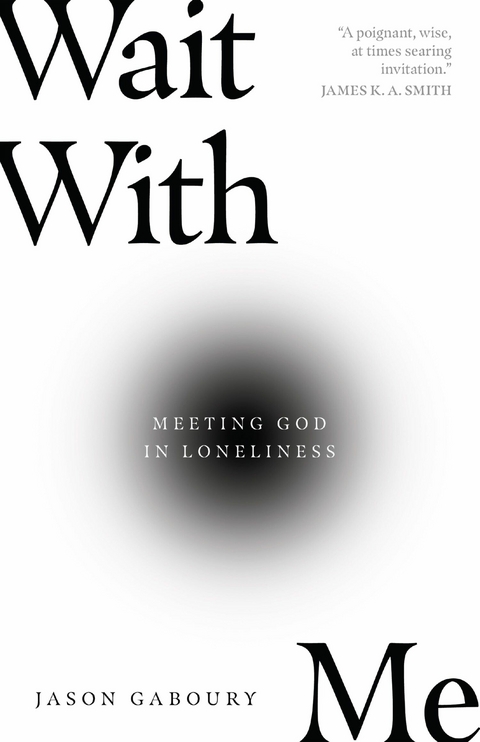
Wait with Me (eBook)
176 Seiten
IVP Formatio (Verlag)
978-0-8308-4388-6 (ISBN)
Jason Gaboury is a regional ministry director with InterVarsity Christian Fellowship. He's also an Anglican friar (Anglican Order of Preachers). He has contributed to a number of books, including Drama Team Handbook. He and his wife, Sophia, live in New York City with their two children.
Jason Gaboury is a regional ministry director with InterVarsity Christian Fellowship. He's also an Anglican friar (Anglican Order of Preachers). He has contributed to a number of books, including Drama Team Handbook. He and his wife, Sophia, live in New York City with their two children.
1
See
TO be human is to be lonely,” Friar Ugo said to me, his voice cracking with age.
For forty years he served as a Jesuit missionary on the African continent. Now he was sitting across from me, a thirty-something campus minister trying to make sense of God and my deep loneliness. Despite the gentleness, even fragility, of his appearance, Friar Ugo’s words pierced the space between us like a spiritual searchlight.
My heartbeat sounded in my ears, and I pressed my lips together waiting, Say something else, I thought. Anything.
I’ve wrestled with loneliness ever since I can remember, perhaps before I can remember. Growing up, my mother would tell stories about our separation at the hospital during the first six weeks of my life, or about times when, as a baby, I’d cry inconsolably for hours. Exasperated, Mom got in the habit of turning up the stereo and leaving me to cry it out. I don’t know what impact either of these situations had on my emerging sense of connection, but I can remember feeling lonely.
That sense of loneliness dogged me through childhood, college, and into adulthood. If Friar Ugo had observed my life from the outside, lonely would not be the adjective quick to mind. With two girls in elementary school, our home was filled with Play-Doh, colored paper, and playdates. Sophia and I parented together and partnered in ministry. Our home was often full of students, friends from church, and neighbors from our building. I even had a reputation in our church for being an expert on building community.
Still, loneliness persisted. Washing dishes late on a Tuesday night after a group of friends had gone home, I’d feel strangely lonely, isolated, unknown, and unloved. Clearly, something wasn’t working. If anyone could help me, I thought, Friar Ugo could. I made an appointment to talk to him, determined to resolve this sense of isolation.
For twenty minutes I’d talked about the ache of loneliness I felt even though it didn’t make sense. Ugo didn’t interrupt. He sat still as the furniture, his eyes dancing with something I couldn’t place: insight, amusement, wisdom?
That conversation would change my life.
“Loneliness is all around us,” Friar Ugo said. Of course, I knew that. Why else would I be sitting in this chair across from this old friar? You know it too. Perhaps you’ve picked up this book because you know the ache of loneliness in your situation. A friend who lived alone for many years said, “The hardest thing for me was just coming home and not having anyone to ask, ‘How was your day?’” Perhaps it seems as if all the friends you used to talk with into the early morning hours have moved away or gotten married. Perhaps you’re a young parent caught in the valley of diapers, isolated from other adults, and emotionally exhausted. Perhaps you’re in a new job or school and miss the familiar faces and relationships.
The technological solution to our loneliness seems to be in our grasp. Social media platforms like Facebook, Twitter, and Instagram are changing the way we see ourselves and the way we have relationships. We can create online communities or chat groups and instantly communicate with people across the world. With access to so many human connections you’d think loneliness would be a thing of the past.
We’ve never been lonelier.
Katherine Hobson, citing a study released in 2017, reports,
It turns out that the people who reported spending the most time on social media—more than two hours a day—had twice the odds of perceived social isolation than those who said they spent a half hour per day or less on those sites. And people who visited social media platforms most frequently, 58 visits per week or more, had more than three times the odds of perceived social isolation than those who visited fewer than nine times per week.
A friend said recently, “We can have a thousand friends on Facebook, but based on how we spend our time, it seems like Facebook is worth a thousand friends.”
It’s wrong though to place the blame for our social dislocation squarely on the shoulders of social media. Robert Putnam’s famous book Bowling Alone describes the fragmentation and isolation of American community before the rise of social media. He says, “Americans are right that the bonds of our communities have withered and we are right to fear that this transformation has very real costs.” Increasing loneliness, according to Putnam, has to do with the decrease in neighborhood societies, civic organizations, religious communities, and social clubs.
Loneliness is not just a modern problem. It’s an ancient problem because it’s a human problem. Ultimately, loneliness is a spiritual problem.
Not Good
A quick theological consideration of the problem of loneliness demonstrates its significance. In Genesis 2:18, God said, “It is not good that the man should be alone.” The weight of this statement is even stronger when we remember the poetry of Genesis 1 that contains the refrain “God saw that it was good” seven times.
The repetition of the phrase alone is striking, but there are two additional amplifiers that we may not be aware of. First is the number of repetitions. In Hebrew the number seven is sheba‘, a word identical in its consonantal root with shaba‘, which means “to swear, as in to swear an oath.” Seven is the sum of three (a biblical number suggesting glory, weightiness, or perfection) and four (a biblical number suggesting creation). In Isaiah 6, the cherubim sing “holy, holy, holy” to signify God’s perfection in holiness, while the four corners of the earth and the four rivers flowing out of Eden signify the created order. The sum of three and four is thus meant to summon our attention. God saw and said that it was good seven times. The repetition and connotation emphasize and underline creation’s goodness in the eyes of God. It’s almost impossible to get a more emphatic statement, but we do.
Just in case we didn’t catch the poem’s refrain as it sang “it was good” seven times, we have a second amplifier, what in English is translated “very good.” The English term very is a weak translation of the Hebrew term me’od. Me’od is defined first as “force, might” and second “to express the idea of exceedingly, greatly, very . . . Genesis 1:31 . . . good exceedingly.” Creation is not just good. It is exceedingly, abundantly, greatly, forcefully good. This phrase gathers up all the earlier refrains from each “day” of creation that has come before. The Creator God beholds creation and describes it as exceedingly good.
Now consider again, “It is not good that the man should be alone” in Genesis 2:18. The contrast is like a verbal slap. The action breaks. It’s the first point of tension in the whole narrative of Scripture. For humans to be alone is not good.
Anyone who has experienced loneliness knows this. Loneliness is a primal disorientation. Quiet anxiety gives way to restlessness. We look for distractions to numb ourselves and take the edge off. Anger and resentment simmer in successive waves.
Loneliness is no joke. Isolation is so powerfully disorienting that solitary confinement is classified as a form of torture.
As I sat in that chair across from Friar Ugo, I could feel the primordial weight of loneliness pressing in on me. I knew the story of Genesis 2. Not good that the man should be alone. So I thought, God, fix it! I wanted Friar Ugo to tell me how God was going to take the isolation away. Instead, he started talking about something else.
“Have you ever considered,” he asked, “that the loneliness you’re experiencing is an invitation to grow your friendship with God?”
I hadn’t.
Friar Ugo went on, “Loneliness is part of the human condition. It is the experience of many around the corner who are living on the street. It is the experience of many around the world, separated from home, family, and land because of war or disease. And,” he paused, “it was often the experience of our Lord himself. You can look to me . . . or to something else . . . even to religion to try to make you feel better. Or,” he said, clearing his throat, “you could see this as the beginning of God’s work of transformation in you.”
And then we sat there in silence.
I pressed my lips together again, but something in his invitation had already stirred inside me. What if loneliness was a doorway to a deeper life with God? What would that mean? How might this idea reshape the experience?
After a short prayer our conversation ended. Friar Ugo didn’t share stories of his isolation in ministry. He didn’t talk, for example, about being forced to leave a country and a context he loved and not being allowed to return despite years of continued effort. He didn’t describe his experience of returning to New York after forty years on the mission field. He simply prayed, and then I stepped out into the cold New York City morning with lots of questions. What would it look like to respond to God’s invitation in the midst of loneliness? Was this a biblical idea? If so, what might Scripture have to teach about loneliness as a place of transformation?
To my surprise, the Old and New Testaments are full of examples of women and men who met God in the midst of loneliness or isolation.
-
Abraham experienced loneliness in his desire for family: “Oh that Ishmael might live in your...
| Erscheint lt. Verlag | 19.5.2020 |
|---|---|
| Verlagsort | Lisle |
| Sprache | englisch |
| Themenwelt | Sachbuch/Ratgeber ► Gesundheit / Leben / Psychologie ► Esoterik / Spiritualität |
| Religion / Theologie ► Christentum ► Moraltheologie / Sozialethik | |
| Schlagworte | alone • alone with god • anglican • Anxiety • anxious • deeper life with god • feeling alone • feeling isolated • feeling lonely • friar • Friendship • friendship with God • how to heal loneliness • isolated • Isolation • loneliness • lonely • relationships • Solitude • Spiritual Formation • Spirituality • what to do when you feel alone • what to do when you feel lonely • where is god when i'm lonely |
| ISBN-10 | 0-8308-4388-4 / 0830843884 |
| ISBN-13 | 978-0-8308-4388-6 / 9780830843886 |
| Informationen gemäß Produktsicherheitsverordnung (GPSR) | |
| Haben Sie eine Frage zum Produkt? |
 EPUB (Wasserzeichen)
DRM: Digitales Wasserzeichen
Dieses eBook enthält ein digitales Wasserzeichen und ist damit für Sie personalisiert. Bei einer missbräuchlichen Weitergabe des eBooks an Dritte ist eine Rückverfolgung an die Quelle möglich.
Dateiformat: EPUB (Electronic Publication)
EPUB ist ein offener Standard für eBooks und eignet sich besonders zur Darstellung von Belletristik und Sachbüchern. Der Fließtext wird dynamisch an die Display- und Schriftgröße angepasst. Auch für mobile Lesegeräte ist EPUB daher gut geeignet.
Systemvoraussetzungen:
PC/Mac: Mit einem PC oder Mac können Sie dieses eBook lesen. Sie benötigen dafür die kostenlose Software Adobe Digital Editions.
eReader: Dieses eBook kann mit (fast) allen eBook-Readern gelesen werden. Mit dem amazon-Kindle ist es aber nicht kompatibel.
Smartphone/Tablet: Egal ob Apple oder Android, dieses eBook können Sie lesen. Sie benötigen dafür eine kostenlose App.
Geräteliste und zusätzliche Hinweise
Buying eBooks from abroad
For tax law reasons we can sell eBooks just within Germany and Switzerland. Regrettably we cannot fulfill eBook-orders from other countries.
aus dem Bereich


