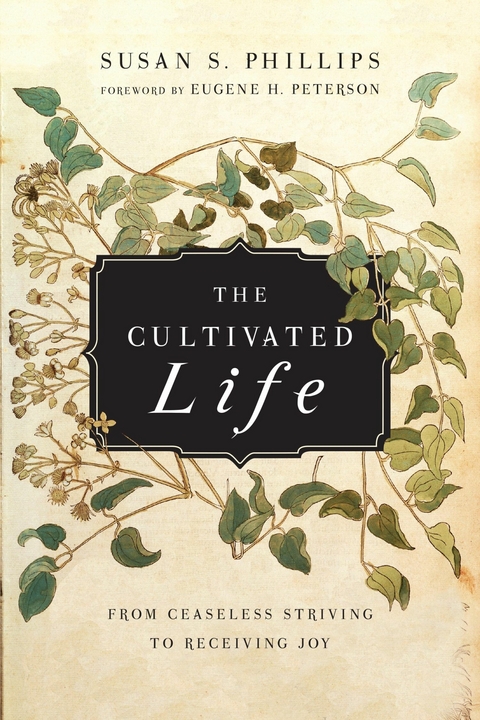
The Cultivated Life (eBook)
256 Seiten
IVP Formatio (Verlag)
978-0-8308-9766-7 (ISBN)
Susan S. Phillips (PhD, University of California, Berkeley) is executive director and professor of sociology and Christianity at New College Berkeley. She is a sociologist and trained spiritual director. Phillips is the author of several books, including Candlelight: Illuminating the Art of Spiritual Direction. In addition to lecturing internationally and leading retreats for churches and organizations, Phillips also teaches at Regent College in Vancouver, Canada, and Fuller Theological Seminary.
Peterson, now retired, was for many years James M. Houston Professor of Spiritual Theology at Regent College in Vancouver, British Columbia. He also served as founding pastor of Christ Our King Presbyterian Church in Bel Air, Maryland. In addition to his widely acclaimed paraphrase of the Bible, The Message (NavPress), he has written many other books. Susan S. Phillips (PhD, University of California, Berkeley) is executive director and professor of sociology and Christianity at New College Berkeley, where she previously served as academic dean. She is a sociologist and trained spiritual director who also serves as supervisor for spiritual directors and consultant for Christian organizations. Drawing insight from the diverse fields of the social sciences, biblical spirituality and practical theology, Phillips has authored books such as the award-winning The Crisis of Care: Affirming and Restoring Caring Practices in the Helping Professions and Candlelight: Illuminating the Art of Spiritual Direction. In addition to lecturing internationally and leading retreats for churches and organizations, Phillips also teaches at Regent College (Canada), Fuller Theological Seminary and the Diploma in the Art of Spiritual Direction program at San Francisco Theological Seminary. She sits on the editorial boards of Radix and Presence magazines and the journal Reflective Practice. Along with her husband Steve, she has two sons and worships at First Presbyterian Church of Berkeley, where she has served as an elder.
Foreword
Susan Phillips has been for many years my writer of choice in matters of spiritual direction and maturing a robust Christian life. Her earlier work Candlelight: Illuminating the Art of Spiritual Direction is the book that I most often refer to others. This latest offering continues to develop perceptions and insights that keep our attention and participating obedience focused and alert and listening—maybe mostly listening.
One of the strengths of her imagination is her skill in using metaphors, words that occur at the intersection of the visible and invisible. This is especially necessary when we take seriously the life of faith in the circumstances of ordinary day-by-day living, circumstances in which the visible and invisible are continuously contiguous. Jesus used a lot of metaphors. A metaphor is literally a lie. One of Jesus’ well-known metaphors is “You are the salt of the earth.” It requires an imagination to comprehend it. I know that I am not salt, neither are you salt. I do not sprinkle myself on my eggs at breakfast. Nor can I enter a laboratory and put myself under a microscope and analyze the chemical parts of my body to find out what I am made of. But even a child knows that Jesus is not saying anything about what we look like or how I taste or what a surgeon might find if she was performing open-heart surgery. With metaphors, literal gets us nowhere.
The two prominent metaphors around which this book is organized are cultivation and circus. Cultivation is an agricultural metaphor: working the soil to prepare it to grow something useful—planting and watering seeds, weeding and pruning, harvesting. Everyone knows what is involved in cultivation; when it is used to refer to our lives, it needs neither explanation nor definition. Circus is a social metaphor that brings to mind the complexity of activity in a three-ring setting under the big tent, everything going on at once. A circus is the place to see performers doing funny things, dangerous things, clowns and trapeze artists, lion tamers and people shot out of a cannon—all of this without our participation. It turns out to be a powerful metaphor to bring to mind the mindless absorption in entertainment and business that has infiltrated our daily lives, but almost entirely as spectators.
In an age of self-absorption, cultivation is a metaphor that can keep us aware that we are not merely individuals defined by what we consume or possess or do but by our relationships, our values and our faith, all of which require attentiveness. In an age of distraction that proliferates with every new technical device, the circus metaphor keeps us aware of the necessity of making alert discernments that will keep us from depending on entertainment and frenzy to compensate for an inner emptiness.
This is a book written specifically for those of us who are assigned the task of developing an imagination for living the Christian faith with insight and skill in and for a society that is disconnected from the biblical revelation and the Jesus incarnation. But it is equally useful for all of us who are committed to following Jesus with our families and coworkers and neighbors.
When some of our ancient Israelite predecessors in this life of faith were being led by Moses in the wilderness, they noticed that two of their neighbors were “prophesying” (preaching and teaching) without authorization, and they complained to Moses that “Eldad and Medad are prophesying in the camp.” Moses famously replied, “Would that all the Lord’s people were prophets” (Numbers 11:26-29). The same, I think, might be said of spiritual directors and spiritual friends.
In addition to skill in using metaphors, another conspicuous feature of this book is the use of personal names and stories in the narration. Eugen Rosenstock-Huessy, the impressive language scholar of an earlier generation, held that “names are . . . the most important grammatical form in language, any language.” All other parts of speech are, or can be, lifeless, dealing objectively with what is. But “names are vehicles of spirit: they reveal social functions; separate people and unite them.”1
Susan Phillips includes herself in the naming. Her word for it is self-implicating—she herself is implicated in what she is writing in relation to others and God. One of the delights in reading this book is that we come into the presence of a person who is not just giving us information but has been, all the time she is writing, living what she is writing: “The hope behind this book is that as you read about a spirituality of cultivation (while immersed in a circus of distractions) you will be formed by God’s grace, as I have been formed while I have written it. My own experience is written into the book, and writing the book has been part of God’s cultivation of my life.”
There is also this: names are seeds. When they germinate they become stories. A seed that is not buried in the ground remains nothing but a seed. But planted it becomes, in Jesus’ self-prophecy, “much fruit” (John 12:24). This was anticipated half a millennium earlier in the prophet Isaiah’s vision of the “holy seed” (Isaiah 6:13) embedded in the stump of the devastated Jerusalem temple that became the “branch” that turned out to be Jesus Christ (Isaiah 11:1).
Life has a story shape. The life of the Spirit is necessarily relational, always relational. The names develop into stories. The most adequate rendering of the way things are is through storytelling. It is the least specialized and most comprehensive form of language. Everything and anything can be put into the story. And from the moment it is in the story it develops meaning, participates in plot, becomes, somehow or other, significant. The entire biblical revelation comes to us in the form of story. Nothing less than story is adequate to the largeness and intricacy of the truth of creation and redemption.
Our biblical ancestors in the faith were magnificent storytellers. The stories they told reverberate down through the corridors of worshiping communities and resonate in our hearts as sharply in tune with reality as when they were first told. They map the country of our humanity, show its contours, reveal its dimensions. Mostly what they show is that to be human means to deal with God. And that everything we encounter and experience—birth and death, hunger and thirst, money and weapons, weather and mountains, friendship and betrayal, marriage and adultery, every nuance and detail of it—deals with God.
It is enormously significant that stories and storytelling are given such a prominent role in revealing God and God’s ways to us. Young and old love stories. Literate and illiterate alike tell and listen to stories. Neither stupidity nor sophistication puts us out of the magnetic field of story. The only serious rivals to story in terms of accessibility and attraction are song and poetry, and there are plenty of these also in our Scriptures. When it came time for Matthew, Mark, Luke and John to give their witness, mostly they had Jesus telling stories, and then he became the Story.
There is another reason for the appropriateness of story as a major means of bringing us God’s Word. Story doesn’t just tell us something and leave it at that—it invites our participation. A good storyteller gathers us into the story. We feel the emotions, get caught up in the plot, identify with the characters, see into the nooks and crannies of life that we had overlooked, realize that there is more to this business of being human than we had yet explored. If the storyteller is good, doors and windows open. Our biblical storytellers were good in both the artistic and the moral sense, as is Dr. Phillips.
One of the characteristic marks of our biblical storytellers is a certain reticence, and the stories told here continue that reticence. There is an austere, spare quality to these stories. They don’t tell us too much. They leave a lot of blanks in the narration, an implicit invitation to hear the story ourselves just as we are and find how we fit into it. These are stories that respect our freedom. They don’t manipulate, don’t force. They show us a spacious world in which God creates and saves and blesses. First through our imagination and then through our faith—imagination and faith are close kin here—they offer us a place in the story, invite us into this large story that takes place under the broad skies of God’s purposes, in contrast to the gossipy anecdotes that we cook up in the stuffy closet of the self.
Storytelling that arises between friends working things out in conversation doesn’t abstract an episode in life into a moral lesson. Such friends don’t use the story as a platform for shouting “God!” at us. They don’t bully us with moral cudgels. They gently “story” our seemingly plotless lives and open our ears and eyes to the real story, the real world, so that we can live in it with all our heart, soul, mind, and strength.
Stories suffer misinterpretation when we don’t submit to them simply as stories. We are caught off guard when divine revelation arrives in such ordinary garb and think that it’s our job to dress it up in the latest Paris silk gown of theology or outfit it in a sturdy three-piece suit of ethics before we can deal with it. The simple, or not so simple, story is soon, like David outfitted in Saul’s armor, so encumbered with moral admonitions, theological constructs and scholarly debates that it can hardly...
| Erscheint lt. Verlag | 22.5.2015 |
|---|---|
| Vorwort | Eugene H. Peterson |
| Verlagsort | Lisle |
| Sprache | englisch |
| Themenwelt | Sachbuch/Ratgeber ► Gesundheit / Leben / Psychologie ► Esoterik / Spiritualität |
| Religion / Theologie ► Christentum ► Kirchengeschichte | |
| Religion / Theologie ► Christentum ► Moraltheologie / Sozialethik | |
| Religion / Theologie ► Christentum ► Pastoraltheologie | |
| Schlagworte | Bible • Christian • Circus • cultivate • Cultivation • disciplines • Drive • Driven • drivenness • Following Jesus • Formation • Friendship • God • Grace • Jesus • Joy • listening • Pray • Prayer • praying with scripture • Sabbath • Spectacle • Spiritual • Spiritual direction • spiritual director • Spirituality • walking tree |
| ISBN-10 | 0-8308-9766-6 / 0830897666 |
| ISBN-13 | 978-0-8308-9766-7 / 9780830897667 |
| Informationen gemäß Produktsicherheitsverordnung (GPSR) | |
| Haben Sie eine Frage zum Produkt? |
 EPUB (Wasserzeichen)
DRM: Digitales Wasserzeichen
Dieses eBook enthält ein digitales Wasserzeichen und ist damit für Sie personalisiert. Bei einer missbräuchlichen Weitergabe des eBooks an Dritte ist eine Rückverfolgung an die Quelle möglich.
Dateiformat: EPUB (Electronic Publication)
EPUB ist ein offener Standard für eBooks und eignet sich besonders zur Darstellung von Belletristik und Sachbüchern. Der Fließtext wird dynamisch an die Display- und Schriftgröße angepasst. Auch für mobile Lesegeräte ist EPUB daher gut geeignet.
Systemvoraussetzungen:
PC/Mac: Mit einem PC oder Mac können Sie dieses eBook lesen. Sie benötigen dafür die kostenlose Software Adobe Digital Editions.
eReader: Dieses eBook kann mit (fast) allen eBook-Readern gelesen werden. Mit dem amazon-Kindle ist es aber nicht kompatibel.
Smartphone/Tablet: Egal ob Apple oder Android, dieses eBook können Sie lesen. Sie benötigen dafür eine kostenlose App.
Geräteliste und zusätzliche Hinweise
Buying eBooks from abroad
For tax law reasons we can sell eBooks just within Germany and Switzerland. Regrettably we cannot fulfill eBook-orders from other countries.
aus dem Bereich