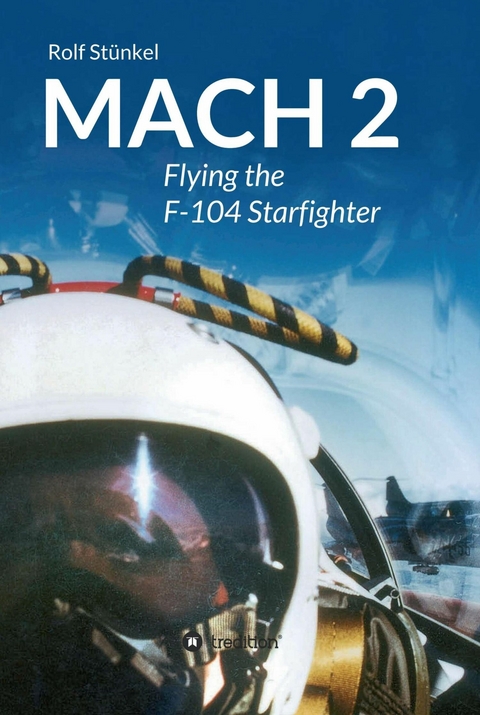
MACH 2 (eBook)
264 Seiten
tredition (Verlag)
978-3-347-13034-0 (ISBN)
Rolf Stünkel, born in 1954 and a native of Hildesheim, Germany, joined the navy at the age of 18. After officer´s training, sea duty, fighter pilot training in the USA at Britain and years on Starfighter and Tornado jets, he joined Lufthansa and flew long haul as an Airbus captain until retirement. The sevenfold father runs seminars on relaxed flying and works as a freelance author for aviation, naval and military history magazines. His books focus on fighter planes, air traffic control, airports and airline flying.
Rolf Stünkel, born in 1954 and a native of Hildesheim, Germany, joined the navy at the age of 18. After officer´s training, sea duty, fighter pilot training in the USA at Britain and years on Starfighter and Tornado jets, he joined Lufthansa and flew long haul as an Airbus captain until retirement. The sevenfold father runs seminars on relaxed flying and works as a freelance author for aviation, naval and military history magazines. His books focus on fighter planes, air traffic control, airports and airline flying.
Jets for Beginners
Lone Star State Texas
A WONDERFUL year in Bavaria had gone by, and we were looking forward to the land of opportunity. January 12, 1977 was an icy day. Our fully loaded air force Boeing B707 took off sluggishly from Cologne towards America, soldiers and their families on board. Thirteen months of Texas lay ahead of us. After the Undergraduate Pilot Training, everyone would continue his aircraft-type training in a different place in the U.S. or Germany. Our contract would only be extended upon successful completion of the next hurdle.
After a short stopover at the Washington/Dulles airport, the B707 landed at Sheppard Air Force Base in Texas. We had already heard a lot about the rich oil state; its residents supposedly swore by their Lone Star State and did not seem interested in the rest of North America. In some ways, they were said to closely resemble our Bavarians, self-assured and speaking a broad dialect.
Sheppard AFB, a former site of the Strategic Air Command (SAC), was located just outside Wichita Falls, close to the Oklahoma border. It housed some 18,000 soldiers in countless quarters, among them our 89th Flying Training Wing and the neighboring 1st German Airforce Training Squadron USA. Runways, aprons, training jets, administration offices and sports facilities were just around the corner.
We were accommodated in German Town, a mini village with small, four-man bungalows, conveniently located near the officers’ club. To our delight, hundreds of young female flight nurse students, destined for medical evacuation flights, had their quarters nearby. The women learned to march before being transferred to their deployment airports, and Germans seemed to fit into their planned pickings. We were never bored: German town parties on the weekend, late afternoons by the pool… the only reasons to leave the compound were to buy a massive stereo system at Audio Tech or head for the local disco with one of the pretty female first lieutenants.
Sheppard Air Force Base, Main Apron, in 1977.
In the “Tweet“
I WAS assigned to C flight for training on the twin-jet subsonic Cessna T-37. My very first jet, promising elegance and power… as if! The T-37 was not a bit of it. An ugly duckling, it had strange stocky proportions and a tiny, deafeningly piercing engine sound. But who cared? Student pilots and instructors lovingly called the T-37 Tweet or Tweety Bird, sometimes Slingshot. After a few rides, we novices were enormously proud of the noisy little bird.
My first instructor pilot, Captain Heath, had come straight from powerful B-707 tankers and considered flying the T-37 a vilification. He felt the same as several other instructors who had been transferred to Air Training Command (ATC) from heavy transport planes or glamorous fighter jets. They all had to grit their teeth and flew whatever was given to them. Captain Heath was a nice guy and let me get adjusted to the new physical challenge. One day, after seemingly endless spinning exercises with the Tweet, I stowed my full sick bag into the map compartment, which he politely ignored.
Even in the 1970s, advanced academic learning tools were being used. All flight results were recorded on computer readable sheets. The instructor assessed the mission by blackening little boxes with a pencil. The marks ranged from E - excellent to U - unsatisfactory, i.e., insufficient. The training program had one big peril: presuming consistent learning progress. What had been graded excellent yesterday was no more than minimum standard on the following day. One day later, the same performance hardly achieved a fair (adequate) result. A single U was permitted, two of them cancelled the flight and you were pinked. This expression originated from the pink slips in times when bad grades were given on pink paper. One pink flight could generally be repeated, the second one caused the assignment of another instructor pilot. Still no progress, and a board hearing with a panel of instructors and superiors decided whether or not the candidate merited any further training.
A T-37 crew chief and his aircraft, ready for flight.
The concept of constant progress was merciless. Whoever couldn't keep up was a has-been within days. Some collected their first Pink on a Monday and were packing their bag the following Friday. Six of our fourteen classmates went home early; most of them had failed in a certain training phase after showing good initial success. A handful of students with overall good results, but isolated weaknesses (e.g., formation flying or aerobatics) were allowed to continue training as transport pilots.
A bright spot was the informal conversation with our instructors. The Yanks could take a joke, and after a while we were on first-name basis. They hammered the line Cooperate and Graduate home to us, meaning: work as a team and you'll make it. In fact, teamwork helped many of us get over phases of weakness. Pilot training had no place for oddballs. If someone wouldn't be helped, he had only himself to blame.
Months had gone by. I was still in the running, hoping I would be lucky and flying as well as I possibly could. The U.S. Air Force as our host provided the training along with the German training squadron, and our instructors came from both countries. Among them were young Americans, Vietnam War veterans, Air Force Academy college graduates, deadpan North Germans and down-to-earth Bavarians – mostly hand-picked pilots, wherever they came from.
Speaking German in the flight room was strictly prohibited. The Yanks laughed at our bumpy English and in exchange, we teased them about their sketchy knowledge of European history and politics. On Fridays, everyone met at Duffy's bar in the officers' club, ready to relax after a tough week and celebrate that we were still in the program. “Are you German?” the pretty nurses from the neighboring table asked, and the weekend took its course.
The cockpit of the T-37 was retro: nothing but round dial instruments, ancient radio equipment and bulky switches. But despite its stone-age equipment, the vintage jet got us from A to B, as long as the small provision of fuel sufficed. We sat next to each other on simple ejection seats. They could save our hide, as long as minimum altitude and speed were observed. The emergency procedure for ejection read:
Arming handles…. raise. Trigger(s)…. squeeze.
We carried parachutes as we had done in the Piaggio. Above 10,000ft, a Zero Delay Lanyard safety line had to be disconnected. Its purpose was to open the parachute right after an emergency exit. Above 10,000ft, however, the pilot would hang under the parachute without oxygen for an excessive time. Disconnecting the Zero Delay Lanyard guaranteed that the pilot would fall into a denser atmospheric layer first before the altitude regulator automatically opened the parachute.
The author in his T-37, ready for engine start.
Tweets had been in service since the late 50's. Some air forces in Central America even operated an armed version, the A-37. Totally camouflaged, it was supposed to impress guerilla troops and smugglers but looked even uglier than the trainer version. Our unarmed white Tweet with barely three tons take-off weight was without a doubt a small, toothless dwarf, but an honest training aircraft: easy to fly, great to spin and merciful in lousy landings.
Sheppard Air Force base shared the complex with Wichita Falls International Airport, KSPS. That meant heavy mixed traffic - T-38 trainers, “real” fighter jets, bombers, private and liaison aircraft, helicopters and airliners. Among the civilian aircraft were some interesting types: ancient Convair 440s, tiny Beech-18s and DC-8 freighters, the latter discretely picking up or unloading mysterious cargo under governmental contract.
The control tower was operated by the U.S. Air Force and busy enough handling the regular air traffic. To observe additional student pilot landings, observation booths had been erected near the touchdown zones of the three main runways. The overall traffic was quite different from that of a civilian airport – at times, a whole bunch of different planes showed up almost simultaneously for landing. Fighter jets, for instance, generally show up over the airfield at high speed and in formation. After a hand signal, the leader breaks away towards the traffic pattern side. In intervals of a few seconds, the other planes follow. On downwind, they lower the landing gear, switch on the landing lights and extend the flaps. Soon everyone is on final approach for a touch-and-go or a full-stop landing.
Propeller aircraft fly a rectangular box-type pattern, whereas airliners mostly come in on a straight-in approach, guided by radar and ILS. Without routine, this mixed traffic demanded our full attention. If anyone missed a radio call from the tower or deviated from the prescribed pattern, he could be forced to break out. Big airports made me nervous; my hands got clammy in my fire-resistant gloves as soon as I neared the base on my homeward flights.
T-38 on a formation approach to Sheppard AFB.
Training According to Schedule
TYPICAL U.S. Air Force jet training always began with the contact phase, i.e., takeoffs and landings, aerobatic and solo flights. To practice landings extensively, we flew to godforsaken,...
| Erscheint lt. Verlag | 16.4.2021 |
|---|---|
| Verlagsort | Ahrensburg |
| Sprache | englisch |
| Themenwelt | Sachbuch/Ratgeber ► Natur / Technik ► Naturwissenschaft |
| Technik | |
| Schlagworte | Cold War • F-104 Starfighter • fast jets • German Navy • military aviation • Naval Aviation • pilot training • Supersonic Aircraft |
| ISBN-10 | 3-347-13034-0 / 3347130340 |
| ISBN-13 | 978-3-347-13034-0 / 9783347130340 |
| Informationen gemäß Produktsicherheitsverordnung (GPSR) | |
| Haben Sie eine Frage zum Produkt? |
 EPUB (Wasserzeichen)
DRM: Digitales Wasserzeichen
Dieses eBook enthält ein digitales Wasserzeichen und ist damit für Sie personalisiert. Bei einer missbräuchlichen Weitergabe des eBooks an Dritte ist eine Rückverfolgung an die Quelle möglich.
Dateiformat: EPUB (Electronic Publication)
EPUB ist ein offener Standard für eBooks und eignet sich besonders zur Darstellung von Belletristik und Sachbüchern. Der Fließtext wird dynamisch an die Display- und Schriftgröße angepasst. Auch für mobile Lesegeräte ist EPUB daher gut geeignet.
Systemvoraussetzungen:
PC/Mac: Mit einem PC oder Mac können Sie dieses eBook lesen. Sie benötigen dafür die kostenlose Software Adobe Digital Editions.
eReader: Dieses eBook kann mit (fast) allen eBook-Readern gelesen werden. Mit dem amazon-Kindle ist es aber nicht kompatibel.
Smartphone/Tablet: Egal ob Apple oder Android, dieses eBook können Sie lesen. Sie benötigen dafür eine kostenlose App.
Geräteliste und zusätzliche Hinweise
Buying eBooks from abroad
For tax law reasons we can sell eBooks just within Germany and Switzerland. Regrettably we cannot fulfill eBook-orders from other countries.
aus dem Bereich