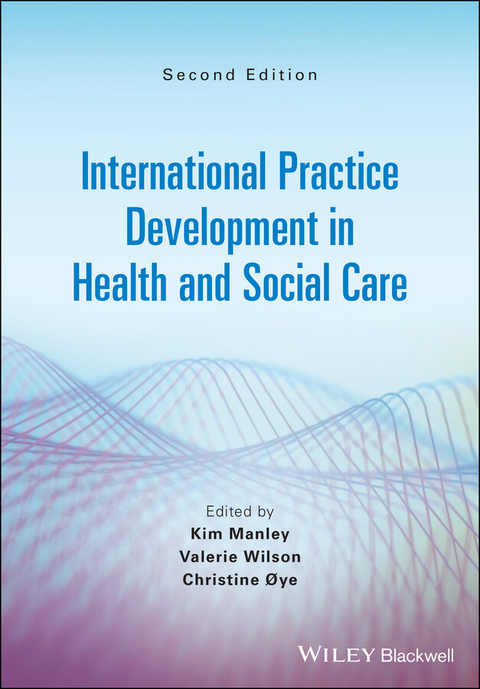
International Practice Development in Health and Social Care (eBook)
John Wiley & Sons (Verlag)
978-1-119-69850-0 (ISBN)
The second edition of International Practice Development in Health and Social Care remains the definitive resource for all those responsible for facilitating innovation and change in health and social care practice at every level. Fully revised and updated throughout, this new edition preserves its focus on developing person-centred, safe and effective evidence-based care that reflects the most recent health service modernisation agendas, clinical governance strategies, and quality improvement initiatives worldwide.
In recent years, practice development (PD) supported by the International Practice Development Collaborative and the International Practice Development Journal has become increasingly interdisciplinary and globally focused. Accordingly, the second edition places greater emphasis on integrated health and social care, as well as on person-centred and community-focused approaches. New and updated chapters explore future challenges for practice development, readiness for transforming maternity services, new strategies for facilitating knowledge translation, education models for using the workplace as the main resource for learning, developing, and improving, and more. Designed to empower multi-professional healthcare teams to transform both the culture and context of care, this invaluable guide:
- Offers an accessible, interactive approach to a variety of complementary improvement approaches that integrate learning, development, improvement, knowledge translation and inquiry
- Delivers practical PD strategies guided by values of compassion, safety, efficacy, and person-centredness
- Provides recommendations for prioritising wellbeing in the workplace, enabling team effectiveness, and fostering collaboration and inclusion across health and social care systems
- Includes numerous real-world examples that connect theory with practice and illustrate field-tested PD methods
- Features contributions from Australia, Scandinavia, the UK, Germany, New Zealand, Switzerland, and the Netherlands, underscoring the text's international focus
International Practice Development in Health and Social Care is essential reading for multi-professional
Professor Kim Manley CBE is Emeritus Professor at Canterbury Christ Church University, Professor in Practice Development and Co-Director of the ImpACT Research Group at University of East Anglia for System Transformation. Formerly Co-Director and Professor, Practice Development, Research and Innovation, at the England Centre for Practice Development, Canterbury Christ Church University, and Joint Clinical Chair, East Kent Hospitals University NHS Foundation Trust, UK. Kim has an international reputation for the development of effective workplace cultures in healthcare, linked to the provision of quality services, clinical leadership and systems transformation that focuses on what matters to people. She is an active founding member of the International Practice Development Collaborative.
Professor Valerie Wilson is Professor of Nursing and manager of the Nursing & Midwifery Research Unit at Illawarra Shoalhaven Local Health District and at Prince of Wales Hospital, Randwick. She holds a joint appointment as Professor of Nursing at the University of Wollongong, Australia. Her work focuses on development of person-centred learning, research and practice. She is a founding member of the International Practice Development Collaborative.
Professor Christine Øye is a social anthropologist and Professor of Health and Care Services Research at the Western Norway University of Applied Sciences, Bergen, Norway. Her research interests include facilitating workplace learning using ethnography and action research in various health and social care settings.
International Practice Development in Health and Social Care International Practice Development in Health and Social CareThe second edition of International Practice Development in Health and Social Care remains the definitive resource for all those responsible for facilitating innovation and change in health and social care practice at every level. Fully revised and updated throughout, this new edition preserves its focus on developing person-centred, safe and effective evidence-based care that reflects the most recent health service modernisation agendas, clinical governance strategies, and quality improvement initiatives worldwide.Designed to empower multi-professional healthcare teams to transform both the culture and context of care, this invaluable guide:Offers an accessible, interactive approach to a variety of complementary improvement approaches that integrate learning, development, improvement, knowledge translation and inquiryDelivers practical practice development (PD) strategies guided by values of compassion, safety, efficacy, and person-centrednessProvides recommendations for prioritising wellbeing in the workplace, enabling team effectiveness, and fostering collaboration and inclusion across health and social care systemsIncludes numerous real-world examples that connect theory with practice and illustrate field-tested PD methodsFeatures contributions from Australia, Scandinavia, the UK, Germany, New Zealand, and the Netherlands, underscoring the text s international focusInternational Practice Development in Health and Social Care is essential reading for multi-professional healthcare practitioners including nurses, midwives, allied healthcare and medical practitioners, clinical educators, PD coordinators, health and social care leaders, managers and commissioners, and students and trainees from all the healthcare professions.
Professor Kim Manley CBE is Emeritus Professor at Canterbury Christ Church University, Professor in Practice Development and Co-Director of the ImpACT Research Group at University East Anglia for Practice and System Transformation. Formerly Co-Director and Professor, Practice Development, Research and Innovation, at the England Centre for Practice Development, Canterbury Christ Church University, and Joint Clinical Chair, East Kent Hospitals University NHS Foundation Trust, UK. Kim is an active member of the International Practice Development Collaborative. Professor Valerie Wilson holds a joint appointment as Professor of Nursing Research at Illawarra & Shoalhaven Local Health District and the University of Wollongong, NSW, Australia. The focus of her role is on 'working with' clinicians to develop person centred approaches to care, that are both evidence based and take into account the needs of patients and their families. Professor Christine Øye is a Professor of Health and Care Services Research at the Western Norway University of Applied Sciences, Bergen, Norway. Her research interests include facilitating workplace learning using action research in various health and social care settings.
Foreword by Cheryl Atherfold
Foreword by Michael West
Acknowledgements
Chapter 1 Transforming health and social care using practice development
Chapter 2 Shaping health services through true collaboration between professional providers and service users
Chapter 3 Turning point: curious novice to committed advocate
Chapter 4 Sustainable person-centred communities design and practice
Chapter 5 Promoting person-centred care for older people
Chapter 6 Education models embedding PD philosophy, values and impact - using the workplace as the main resource for learning, developing and improving
Chapter 7 Critical ethnography: a method for improving healthcare cultures in practice development and embedded research
Chapter 8 A global manifesto for practice development: revisiting core principles
Chapter 9 Theorising practice development
Chapter 10 Unpacking and developing facilitation
Chapter 11 Re-imagining participation in processes of facilitation: a case for 'humble assertiveness'
Chapter 12 Leadership relationships
Chapter 13 From fractured to flourishing: Developing clinical leadership for frontline culture change
Chapter 14 Systems leadership enablement of collaborative healthcare practices
Chapter 15 Recognising and developing effective workplace cultures across health and social care that are also good places to work
Chapter 16 Wellbeing at work
Chapter 17 Flourishing people, families and communities
Chapter 18 Practice development - towards co-creation, innovation and systems transformation to foster person-centred care
Conclusion
References
Index
1. Transforming Health and Social Care Using Practice Development
Kim Manley, Valerie Wilson, and Christine Øye
Setting the scene at this time of high challenge
As we write this chapter, we are in the middle of a global pandemic that is testing the resilience and values of people, communities, health and social care systems everywhere. Practice development (PD) offers practical strategies for how these challenges can be addressed founded on values‐based ways of working that are compassionate, person‐centred, safe and effective.
Despite the often unpredictable challenges faced when providing care, of which the current pandemic is an extreme example, practice guided by the values outlined above will be recognised in the workplace by the priority given to wellbeing, how teams manage challenges, and ways of working that involve everyone through collaboration, inclusion and participation to enable empowerment. The multiple perspectives and expertise resulting from this approach when applied to systematic learning and improvement that questions assumptions will enable positive and sustainable change to occur.
Regardless of setting, PD involves creating the conditions in which practitioners individually and collectively flourish. These conditions are associated with positive benefit for those who both provide and experience health and social care (West 2016; Braithwaite et al. 2017).
This introductory chapter aims to explain the relevance of PD and its potential to support health and social care at every level through focusing on what matters to people. Additionally, the chapter will outline developments since the first edition in 2008 and highlight how PD principles have driven the content of chapters and the ways in which the authors have worked together to bring you this latest edition.
Practice development: its relevance to contemporary health and social care and crisis
PD is about our individual and collective practice as health and social care practitioners in any setting. Our purpose based on what matters to people has at its heart relationships with individuals, people and communities based on a shared set of values and visions about how we work together and with those experiencing care.
However, most health and social care is provided in teams and increasingly across complex systems, where workplace culture and contexts are recognised as powerful influencers on how care is experienced by both recipients and providers. Social norms reflect the values considered to be important (either implicitly or explicitly) and through the culture experienced impact how we work and learn together.
Workplace culture influences whether assumptions are challenged, learning and shared goals are implemented, aspirations are fulfilled, and subsequently whether valued staff are retained and health outcomes achieved.
Prerequisites to achieving good workplace cultures include leadership and facilitation expertise anchored in the values that enable collective approaches built on shared direction and purpose. These prerequisites are integral to PD and for this reason, a collaborative PD journey often begins by exploring and agreeing key values ‘up front’.
A growing evidence base through PD research together with a commitment to knowledge translation has helped us to understand not just what strategies work, why they work and for whom they work (Wilson and McCormack 2006), but also how to engage people and how to embed and sustain learning and evaluation in the workplace (Dewing 2010).
The knowledge base derived from practice‐based research with people in different contexts is particularly important as frontline practitioners across all settings (individual homes, care homes, communities and hospitals) are risking their lives in relation to COVID‐19 to provide care that is not just safe but that courageously keeps people at the heart of care, both recipients and team colleagues.
The pandemic has tested the key values and person‐centred approaches championed and facilitated through PD about how we communicate. The use of protective clothing inevitably dehumanises our humanness through detracting from showing that the person we are communicating with is a unique person. Because of muffled verbal and non‐verbal communication, the message that the person is at the heart of our purpose can be lost. We have all been heartened by the innovative ways and sheer persistence in overcoming these physical barriers when committed to human values by those who care. This recognises the tremendous burden on practitioners and carers and the need for practitioners to be supported and treated in a person‐centred way too.
The notable cohesion and interprofessional teamwork that have resulted from a shared purpose and direction during the pandemic have also required total community collaboration. Powerful impact is demonstrated when people genuinely work together, breaking down the professional silos and barriers that often hinder effective collaboration.
Teams which have already learned to work together with shared values and visions will be more prepared for crisis situations, such as COVID‐19, to find effective person‐centred ways of working despite challenges experienced and ‘top‐down’ instructions. Practice developers in teams work with contextual barriers to find promising ways despite challenges, by co‐creating ways of working for innovative solutions.
The pandemic has generated a crisis in how we work together. PD theory draws on the work of Bryan Fay (1987) to understand the nature of crisis informed through critical social science to explain how such challenges can lead to creative innovations that inform both future systems and ways of working. Fay’s theory itself has been revised to capture the creativity generated through PD research (McCormack and Titchen 2006).
Creativity in response to crisis has already resulted in dramatic increases in virtual ways of working and communication supported by technology. With family members not able to be at the bedside of seriously ill relatives, technology has connected people to those important to them. Telemedicine is replacing the resource‐intensive provision of outpatient follow‐up clinics; previously perceived barriers are being recognised as assumptions, enabling them to be dismantled to free up more people‐orientated ways of working. Different teams and partners are connecting virtually to enable prompt decision‐making and action, with seismic shifts in genuine interprofessional working and learning. COVID‐19 has freed us from the taken‐for‐granted assumptions around innovations, to cut through red tape and implement new policies, procedures and practices.
It is timely to recognise in this pandemic year that it is also the year of the nurse and midwife, and that nursing has upheld the values of person‐centred, compassionate care and safety over the past century. This has particularly come to the fore in the current crisis, where it has been recognised widely and publicly that these values are important to society.
Practice development: growing scope and impact from interprofessional collaboration and working with shared values
PD as a formal methodology has been driven by nursing and midwifery across all its specialisms, but is increasingly embraced by other health and social care professionals. One of the eight revised principles of PD emphasises its increasing relevance to all:
PD is fundamentally about person‐centred practice that promotes safe and effective workplace culture where all can flourish.
Chapter 8 discusses this principle together with seven others underpinning PD methodology.
This edition of the book marks a groundswell of involvement in PD, with many other professions globally experiencing its relevance. The International Practice Development Journal, a peer‐review publication launched in 2011, has been instrumental in championing the uptake of PD concepts by different professional groups, further enabling interprofessional practice, and also disseminating its growing evidence base.
Contributions have embraced interdisciplinary and medical leadership programmes to support transformation (Akhtar et al. 2016), physiotherapists using person‐centred frameworks when caring for people with long‐term conditions (Dukhu et al. 2018), a biomedical scientist focusing on their own learning (Jackson 2013), an obstetrician and maternity team preparing for maternity transformation (Crowe and Manley 2019), a United Church minister reflecting on learning about self (Eldridge 2011), a physiotherapist reflecting on transformative learning (Owen 2016), an anaesthetist reflecting on transforming self as a leader (Adegoke 2017), an intensivist exploring the relevance of PD to quality improvement (Lavery 2016), allied health professionals drawing on PD principles (Bradd et al. 2017), therapists supporting mental health and family wellbeing (Karlsson et al. 2013), and social workers in the care of older people (Cronqvist and Sundh 2013).
Interprofessional practice is a much stronger focus of publications, with the journal publishing special issues from a range of professions that critically examine concepts relevant for the tradition of PD, for example a Special Issue on Person, Care and Aging (Øye et al....
| Erscheint lt. Verlag | 12.4.2021 |
|---|---|
| Sprache | englisch |
| Themenwelt | Sachbuch/Ratgeber ► Gesundheit / Leben / Psychologie |
| Medizin / Pharmazie ► Pflege | |
| Schlagworte | Ausbildung • Ausbildung u. Perspektiven i. d. Krankenpflege • Gesundheits- u. Sozialwesen • Health & Social Care • Krankenpflege • nursing • Nursing Education & Professional Development |
| ISBN-10 | 1-119-69850-2 / 1119698502 |
| ISBN-13 | 978-1-119-69850-0 / 9781119698500 |
| Informationen gemäß Produktsicherheitsverordnung (GPSR) | |
| Haben Sie eine Frage zum Produkt? |
 EPUB (Adobe DRM)
Kopierschutz: Adobe-DRM
Adobe-DRM ist ein Kopierschutz, der das eBook vor Mißbrauch schützen soll. Dabei wird das eBook bereits beim Download auf Ihre persönliche Adobe-ID autorisiert. Lesen können Sie das eBook dann nur auf den Geräten, welche ebenfalls auf Ihre Adobe-ID registriert sind.
Details zum Adobe-DRM
Dateiformat: EPUB (Electronic Publication)
EPUB ist ein offener Standard für eBooks und eignet sich besonders zur Darstellung von Belletristik und Sachbüchern. Der Fließtext wird dynamisch an die Display- und Schriftgröße angepasst. Auch für mobile Lesegeräte ist EPUB daher gut geeignet.
Systemvoraussetzungen:
PC/Mac: Mit einem PC oder Mac können Sie dieses eBook lesen. Sie benötigen eine
eReader: Dieses eBook kann mit (fast) allen eBook-Readern gelesen werden. Mit dem amazon-Kindle ist es aber nicht kompatibel.
Smartphone/Tablet: Egal ob Apple oder Android, dieses eBook können Sie lesen. Sie benötigen eine
Geräteliste und zusätzliche Hinweise
Buying eBooks from abroad
For tax law reasons we can sell eBooks just within Germany and Switzerland. Regrettably we cannot fulfill eBook-orders from other countries.
aus dem Bereich