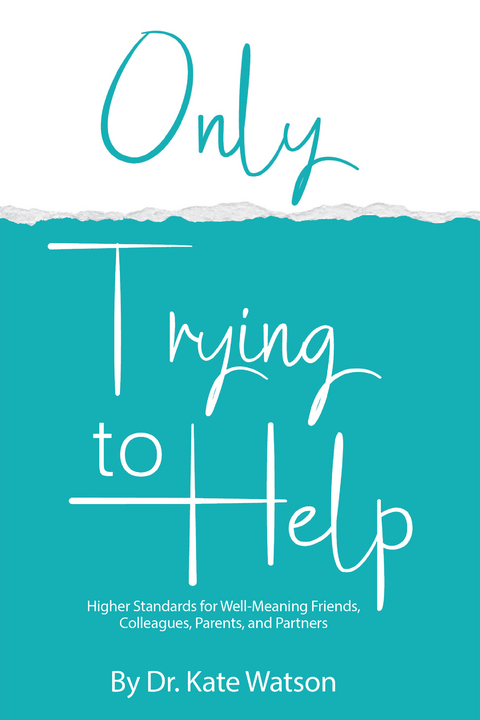
Only Trying to Help (eBook)
144 Seiten
Bookbaby (Verlag)
978-1-0983-6675-9 (ISBN)
Informal counselors walk among us. They are our best friends, bartenders, siblings, parents, God parents, mentors, neighbors, activists, volunteers, teachers, coaches, and colleagues at the watercooler. They're all people who try to help- doing their best to listen, communicate empathy, and set boundaries, despite not having a fancy credential as an advisor or therapist. If you're one of these helpers, and you're tired of winging it in your relationships, this book is for you. This book is for the people who want to support a friend who is battling cancer. This book is for the people who want to help loved ones grieve the loss of jobs, marriages, pregnancies, pets, and parents. Dr. Kate Watson merges her ten years of experience as a mental health professional with decades of research in psychology, linguistics, and sociology to develop a guide for those compassion souls who want to become more effective helpers. Through the use of storytelling, Dr. Watson explores well-meaning encouragement, well-meaning compliments, well-meaning advice, well-meaning humor, well-meaning lies, well-meaning apologies, and well-meaning gift giving. Some stories will make you laugh, and some will make you cringe, but you are likely to notice your own voice and heart reflected in these tales.
Introduction
No one is useless in this world who
lightens the burdens of another.
— Charles Dickens
For at least a portion of my childhood, my father tended bar for a hotel restaurant in Philadelphia. Given that his tenure lasted through the mid- to late 1980s, it should be no surprise that he had a thick mustache and poured his fair share of neon-colored cocktails. This was over thirty years ago, so I have long forgotten most details about the restaurant décor, the music on the stereo, and the fashions of the clientele, but I have vivid memories of watching him behind the bar, leaning against the polished oak, while I ate my weight in maraschino cherries and dangled my five-year-old legs from the barstool. I embodied Norm from Cheers before kindergarten, so no wonder I was such a fat kid while growing up.
Thirty or forty years prior to that, probably around the time my dad was born, my great-grandfather was a barber for the locals in his Philadelphia neighborhood. I obviously never had the chance to witness him cut hair, but to this day, sitting on my dad’s basement office desk is a framed photo of my great-grandfather cutting his daughter’s (my grandmother Dolores’s) hair in his barbershop in the 1950s. I know the image so well. He is only half smiling, like he knows the camera is watching and he is thinking the “photo op” is ridiculous and embarrassing. If that photo had sound effects, you’d hear a person saying, “Come on, give a smile for the camera,” and my great-grandfather would say, “Ah, geez, would youse get out here with that.” Still, he smiled.
These men—my dad and his grandfather—were there to serve others, whether with cocktails, hot towels, or the inevitable relationship advice. They were helpers. Sometimes I like to imagine that, over the years, my great-grandfather hosted hundreds, maybe thousands, of customers who came for a shave and a hot towel and to talk about their troubles, just as my dad hosted many travelers and strangers in the hotel bar of the Marriott Courtyard on City Line Avenue decades later. Both barbers and bartenders feel like American archetypes of brotherly love, not just in Philadelphia, where my family’s story is rooted, but in all corners of our country. The bartender who says, “Tell me your troubles” is, frankly, my earliest memory of friendship and kindness between adults.
So clearly, I’m not the first therapist in my family. I’m just, after thirty years of education and $100,000 in student loans, the first well-trained therapist in the family (sorry, Dad). But if you think about it, informal counselors lurk around every corner, and most of them didn’t get a degree or a fancy credential. It isn’t just the bartenders and barbers who hear about the troubles of the world but also teachers, coaches, neighbors, and colleagues we find at the watercooler. This book is for them: the everyday therapists and advisors among us. This is a book for people who like to help others but are tired of screwing it all up. They’re tired of feeling useless. They’re tired of throwing their arms in the air in exhaustion and claiming, “I’m only trying to help!”
Sure, the mom who completes her son’s book report is only trying to help. The coach who screams, “You can do better than that!” at an athlete who lost the game is only trying to help. The friend who says, “That guy is no good for you. You need to leave his ass!” is also only trying to help. The sister who casually says, “You should try Weight Watchers. It worked for my friend” is only trying to help. This book is for the people who want to confidently support a friend who has been diagnosed with cancer. This book is for the people who want to help loved ones grieve the loss of jobs, pets, marriages, and parents. This book merges what I learned over many years of advanced education with what I probably picked up from the bartenders and barbers in my bloodline to help you help others more effectively. I like to think of these highly researched skills as a form of scientific kindness.
Together, we will walk through eight chapters of well-meaning attempts at help:
- Chapter 1: Well-Meaning Encouragement
- Chapter 2: Well-Meaning Compliments
- Chapter 3: Well-Meaning Apologies
- Chapter 4: Well-Meaning Advice
- Chapter 5: Well-Meaning Tough Love
- Chapter 6: Well-Meaning Humor
- Chapter 7: Well-Meaning Gift Giving
- Chapter 8: Well-Meaning Lies
Within each chapter, you will find stories of success and failure, academic research, and tips for improving your relationships through communication, patience, and empathy. But before we dive into these categories together, I would like to introduce some themes so you can track them throughout the book. Call them the new standards of helpfulness, if you will.
Standard #1: Listen More Than You Speak
Take five minutes to peruse some online dating profiles and you will quickly notice that every prospect describes himself or herself as down to earth, funny, nonjudgmental, and a great listener. Horseshit. There are some qualities we like to think we possess, but let’s be honest: We are not all funny. We are not all down to earth. I’ve never met a person free of judgment. Even though my social circle includes hundreds of therapists and social workers, I know maybe three or four people who are truly good listeners.
My point is that listening is a skill to be practiced with diligence. It is selfless and extraordinary when someone takes the time to listen and understand because it requires you to suspend your own need to feel clever, constructive, and consequential. It’s also a really nice thing to do, dammit!
Here is the problem. Too often we try to connect with other people by talking about ourselves more than we listen, and I can identify at least four major problems with that.
- It robs the attention from the person you are trying to help.
- It dismisses the point of the person you are trying to help.
- The person you are trying to help feels obligated to take care of you rather than receive your support and love.
- You, the helper, stop listening.
A few months ago, I had a conversation with my friend Rob about my goals for health and wellness. He and I are both goal-oriented people, and we hold each other accountable in a way that doesn’t feel invasive or annoying (which is a high compliment from me since I’m an introvert and I find a lot of people invasive and annoying).
I said to Rob, “I might try intermittent fasting. It could be great for my weight loss goals. I probably need to ease into it though. I can’t just wake up tomorrow and implement this immediately, but I’m excited to try it.”
He looked excited too, and I thought he would say something like “Wow, that’s so great. Keep me posted. I’d love to hear how you feel when you get started.” Instead, like he hadn’t even heard me, he said, “I was thinking about cutting sugar out of my diet. I really think I need to look at that. I’m going to meet with a nutritionist and see what that’s all about. I’ve gotta lose these last ten pounds!”
My gut instinct, as a counselor, good listener, good friend, and overall decent human being, was to show some interest in what he said. Theoretically, if I had followed that instinct, I would have said, “Sugar, huh? Good for you! That sounds really difficult.” But I didn’t want to say that. I hadn’t finished my conversation about intermittent fasting. Eff sugar. I wasn’t sure if he had even heard me. So I said, “Well, I think the intermittent fasting will give me the sense of control that I like to feel. I thrive on that.”
I had hoped he might take the hint that I was trying to focus the conversation back on me. I mean, after all, I had initiated the conversation. Don’t I get at least five minutes of his attention?
To my disappointment, he said, “I don’t need a sense of control. I just need to see results, and that will keep me motivated. The nutritionist will help me with that. I’m probably going to meet with him on Friday. Oh, shit, I have that other meeting on Friday! I will have to reschedule.”
We went several repetitive rounds like this—with me trying to talk about myself and him trying to do the same. I won’t bore you with the details, but I was fuming. I imagined that we were performers on a stage, but there was only one spotlight, and we were fighting over the audience’s attention. Every time I stepped into the spotlight, it felt like he pushed me out to make room for himself.
I eventually just bluntly asked him, “Did you even hear what I said about intermittent fasting? Are you following me at all?”
He looked at me like I was being childish. He said, “Yeah, of course. I just wanted to share my ideas too. I thought we were having a conversation.”
In one of those laugh-to-keep-from-crying moments, I burst out in a cantankerous chuckle. After composing myself a little, I said, “All I’m asking for is some acknowledgment you heard me before you just start talking about yourself. And yes, I acknowledge a conversation is about two people sharing ideas together. But a conversation is also composed of both listeners and speakers. When I speak, you’re the listener, and when you speak, I’m the...
| Erscheint lt. Verlag | 27.5.2021 |
|---|---|
| Sprache | englisch |
| Themenwelt | Sachbuch/Ratgeber ► Gesundheit / Leben / Psychologie ► Partnerschaft / Sexualität |
| ISBN-10 | 1-0983-6675-1 / 1098366751 |
| ISBN-13 | 978-1-0983-6675-9 / 9781098366759 |
| Informationen gemäß Produktsicherheitsverordnung (GPSR) | |
| Haben Sie eine Frage zum Produkt? |
 EPUB (Adobe DRM)
Größe: 1,0 MB
Kopierschutz: Adobe-DRM
Adobe-DRM ist ein Kopierschutz, der das eBook vor Mißbrauch schützen soll. Dabei wird das eBook bereits beim Download auf Ihre persönliche Adobe-ID autorisiert. Lesen können Sie das eBook dann nur auf den Geräten, welche ebenfalls auf Ihre Adobe-ID registriert sind.
Details zum Adobe-DRM
Dateiformat: EPUB (Electronic Publication)
EPUB ist ein offener Standard für eBooks und eignet sich besonders zur Darstellung von Belletristik und Sachbüchern. Der Fließtext wird dynamisch an die Display- und Schriftgröße angepasst. Auch für mobile Lesegeräte ist EPUB daher gut geeignet.
Systemvoraussetzungen:
PC/Mac: Mit einem PC oder Mac können Sie dieses eBook lesen. Sie benötigen eine
eReader: Dieses eBook kann mit (fast) allen eBook-Readern gelesen werden. Mit dem amazon-Kindle ist es aber nicht kompatibel.
Smartphone/Tablet: Egal ob Apple oder Android, dieses eBook können Sie lesen. Sie benötigen eine
Geräteliste und zusätzliche Hinweise
Buying eBooks from abroad
For tax law reasons we can sell eBooks just within Germany and Switzerland. Regrettably we cannot fulfill eBook-orders from other countries.
aus dem Bereich