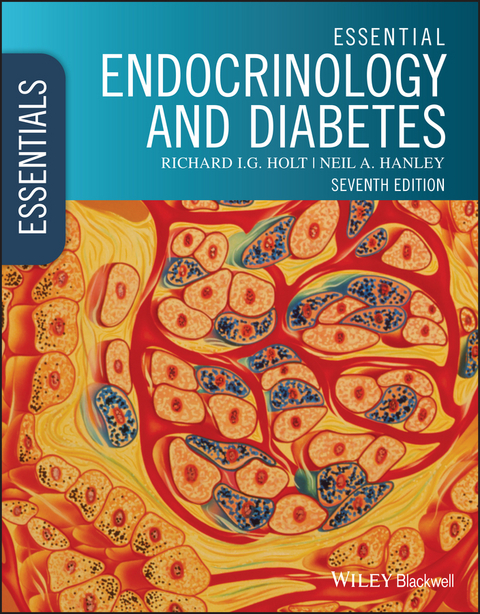
Essential Endocrinology and Diabetes (eBook)
John Wiley & Sons (Verlag)
978-1-118-76412-1 (ISBN)
Essential Endocrinology and Diabetes provides the accurate and up-to-date knowledge required for treating all areas of endocrinology and diabetes, covering the latest research, clinical guidelines, investigational methods, and therapies. This classic text explains the vital aspects of endocrine physiology in a succinct and easy-to-use format, with full-colour illustrations, clinical images, and case studies to assist readers in applying theory to practice.
The text covers the principles of endocrinology, clinical endocrinology, and clinical diabetes and obesity, and has been revised throughout to present the most recent developments in the field. The seventh edition includes new and updated material on the latest molecular techniques, approaches to clinical investigation and diagnostics, next generation sequencing technology, and positron emission tomography (PET). The treatment of type 1 diabetes and type 2 diabetes has been updated with clinical algorithms and reflects significant advances such as incretin-based therapies, SGLT2 inhibitors, the development of better insulins, and technologies that support self-management.
- Provides students and practitioners with comprehensive and authoritative information on all major aspects of endocrine physiology
- Covers diagnosis, management, and complications of clinical disorders such as endocrine neoplasia, and type 1 diabetes and type 2 diabetes
- Explains the core principle of feedback regulation, which is vital for the correct interpretation of many clinical tests
- Features case histories, learning objectives, 'recap' links to chapter content, cross-referencing guides, key information boxes, and chapter summaries
Essential Endocrinology and Diabetes, Seventh Edition is the ideal textbook for medical and biomedical students, junior doctors, and clinicians looking to refresh their knowledge of endocrine science.
Richard Holt is Professor in Diabetes and Endocrinology at the University of Southampton, UK, and Honorary Consultant in Diabetes at University Hospital Southampton NHS Foundation Trust.
Neil Hanley is Professor of Medicine at the University of Manchester, UK, and Honorary Consultant in Endocrinology at the Manchester University NHS Foundation Trust.
The Essentials are an international, best-selling series of textbooks, all of which are designed to support lecture series or themes on core topics within the health sciences. See www.wiley.com for further details. Essential Endocrinology and Diabetes provides the accurate and up-to-date knowledge required for treating all areas of endocrinology and diabetes, covering the latest research, clinical guidelines, investigational methods, and therapies. This classic text explains the vital aspects of endocrine physiology in a succinct and easy-to-use format, with full-colour illustrations, clinical images, and case studies to assist readers in applying theory to practice. The text covers the principles of endocrinology, clinical endocrinology, and clinical diabetes and obesity, and has been revised throughout to present the most recent developments in the field. The seventh edition includes new and updated material on the latest molecular techniques, approaches to clinical investigation and diagnostics, next generation sequencing technology, and positron emission tomography (PET). The treatment of type 1 diabetes and type 2 diabetes has been updated with clinical algorithms and reflects significant advances such as incretin-based therapies, SGLT2 inhibitors, the development of better insulins, and technologies that support self-management. Provides students and practitioners with comprehensive and authoritative information on all major aspects of endocrine physiology Covers diagnosis, management, and complications of clinical disorders such as endocrine neoplasia, and type 1 diabetes and type 2 diabetes Explains the core principle of feedback regulation, which is vital for the correct interpretation of many clinical tests Features case histories, learning objectives, recap links to chapter content, cross-referencing guides, key information boxes, and chapter summaries Essential Endocrinology and Diabetes, Seventh Edition is the ideal textbook for medical and biomedical students, junior doctors, and clinicians looking to refresh their knowledge of endocrine science. For more information on the complete range of Wiley medical student and junior doctor publishing, please visit: www.wiley.com To receive automatic updates on Wiley books and journals, join our email list. Sign up today at www.wiley.com/email All content reviewed by students for students Wiley Medical Education books are designed exactly for their intended audience. All of our books are developed in collaboration with students. This means that our books are always published with you, the student, in mind. If you would like to be one of our student reviewers, go to www.reviewmedicalbooks.com to find out more. This title is also available as an e-book. For more details, please see www.wiley.com/buy/9781118763964
Richard Holt is Professor in Diabetes and Endocrinology at the University of Southampton, UK, and Honorary Consultant in Diabetes at University Hospital Southampton NHS Foundation Trust. Neil Hanley is Professor of Medicine at the University of Manchester, UK, and Honorary Consultant in Endocrinology at the Manchester University NHS Foundation Trust.
Preface vii
List of abbreviations ix
Part 1: Foundations of Endocrinology 1
1 Overview of endocrinology 3
2 Basic cell biology and hormone synthesis 12
3 Molecular basis of hormone action 22
4 Investigations in endocrinology and diabetes 39
Part 2: Endocrinology - Biology to Clinical Practice 51
5 The hypothalamus and pituitary gland 53
6 The adrenal gland 80
7 Reproductive endocrinology 103
8 The thyroid gland 134
9 Calcium and metabolic bone disorders 155
10 Pancreatic and gastrointestinal endocrinology and endocrine neoplasia 175
Part 3: Diabetes and Obesity 193
11 Overview of diabetes 195
12 Type 1 diabetes 213
13 Type 2 diabetes 239
14 Complications of diabetes 265
15 Obesity 293
Index 311
CHAPTER 1
Overview of endocrinology
Key topics
- A brief history of endocrinology and diabetes
- The role of hormones
- Classification of hormones
- Control systems regulating hormone production
- Endocrine disorders
- Key points
Learning objectives
- To be capable of defining endocrinology
- To understand what endocrinology means as a basic science and a clinical specialty
- To appreciate the history of endocrinology
- To understand the classification of hormones into peptides, steroids and amino acid derivatives
- To understand the principle of how feedback mechanisms regulate hormone levels in the circulation
This chapter introduces endocrinology and diabetes including some of the basic principles that underpin the following chapters
Box 1.1 The endocrine and nervous systems are the two main communication systems in the body
| Monitor internal and external environments | Ensure homeostasis |
| Allow appropriate adaptive changes |
| Communicate via chemical messengers |
Figure 1.1 Chemical signalling in the endocrine and neural systems. (a) In endocrine communication, the producing cell secretes hormone into the blood vessel, where it is carried, potentially over large distances, to its target cell. (b) Sometimes hormones can act on the cell that produces them (autocrine, A) or nearby cells (paracrine, P) without the need for transport via the circulation. For instance, glucagon from α‐cells and somatostatin from δ‐cells can regulate insulin secretion by adjacent β‐cells within the pancreatic islet. (c) In neuroendocrine communication, neurons can secrete hormones into the surrounding blood vessels to reach a more distant target. A good example is hypothalamic regulation of the anterior pituitary. (d) In pure neural communication, neurons activate other neurons via neurotransmitters released from axonic terminals into the synaptic space. Conceptually, neurotransmitters are similar to hormones and in some instances, such as for norepinephrine/noradrenaline, can actually be the same chemical.
All organisms need to be able to analyze and respond to their surroundings in order to provide a constant internal environment. Maintaining this internal constancy is called homeostasis. For an organism comprised of a single or a few cells homeostasis is relatively easy as no cell is more than a short diffusion distance from the outside world or its neighbours. This simplicity has been lost with the evolution of more complex, larger, multicellular organisms. Diffusion alone is inadequate in larger animal species where discrete functions localize to specific organs. In humans, there are ∼1014 cells of more than 200 different types. With this compartmentalized function comes the need for effective communication to disseminate information throughout the whole organism – only a few cells face the outside world, yet all need to respond to it. Two communication systems facilitate this: the endocrine and nervous systems (Box 1.1).
Whereas gastrointestinal cells tend to secrete chemicals into ducts, the specialized cells that make up the glands and tissues of the endocrine system release their chemical messengers, called hormones, into the extracellular space, from where they enter the bloodstream. Historically, this blood‐borne transit of hormones was what defined ‘endocrinology’; however, the principle is identical for hormone action on a neighbouring cell (called a paracrine effect) or, indeed, the endocrine cell itself (an autocrine or intracrine effect) (Figure 1.1).
The nervous and endocrine systems interact. Endocrine glands can be under nervous control; the adrenal medulla is an excellent example (Chapter 6). Conversely, neural cells can themselves release hormones into the bloodstream. This is particularly relevant in the hypothalamus (Chapter 5). Indeed, this interplay between the body's two main communication systems has led to the composite specialty of ‘neuroendocrinology’ (Figure 1.1).
A brief history of endocrinology and diabetes
The term ‘hormone’, derived from the Greek word ‘hormaein’ meaning ‘to arouse’ or ‘to excite’, was first used in 1905 by Sir Ernest Starling in his Croonian Lecture to the Royal College of Physicians. However, endocrinology is built on foundations that are far older. Although Aristotle described the pituitary, gigantism, caused by excess growth hormone (GH) from the somatotrophs of the anterior pituitary, was referred to in the Old Testament. It was only two millennia or so later in the 19th century that the gland’s anterior and posterior components were appreciated by Rathke, and Pierre Marie connected GH‐secreting pituitary tumours to acromegaly and excess growth.
Diabetes was recognized by the ancient Egyptians. Areateus later described the disorder in the second century AD as ‘a melting down of flesh and limbs into urine’. Consequently, diabetes comes from the Greek word meaning ‘siphon’. The pancreas was only implicated relatively recently when Minkowski realized in 1889 that the organ’s removal in dogs mimicked diabetes in humans.
The roots of reproductive endocrinology are equally long. The Bible refers to eunuchs and Hippocrates recognized that mumps could result in sterility. Oophorectomy in sows and camels was used to increase strength and growth in ancient Egypt. The dependence of endocrinology on technology is also long standing. It took the invention of the microscope in the 17th century for Leeuwenhoek to visualize spermatozoa and later, in the 19th century, for the mammalian ovum to be discovered in the Graafian follicle.
During the last 500 years, many endocrine organs and systems (‘axes’) have been identified and characterized. In 1564, Bartolomeo Eustacio noted the presence of the adrenal glands. Almost 300 years later (1855), Thomas Addison, one of the forefathers of clinical endocrinology, described the consequences of their inadequacy. Catecholamines (epinephrine/adrenaline and norepinephrine/noradrenaline) were identified at the turn of the 19th century, in parallel with Oliver and Schaffer’s discovery that these adrenomedullary substances raised blood pressure. This followed shortly after the clinical features of myxoedema were linked to the thyroid gland, when, in 1891, physicians in Newcastle‐upon‐Tyne treated hypothyroidism with sheep thyroid extract. This was an important landmark, but long after the ancient Chinese recognized that seaweed, as a source of iodine, held valuable properties in treating swelling of the thyroid gland (‘goitre’).
These early aspects of clinical endocrinology and diabetes tended to rely on recognition and description. Since then our understanding has advanced through:
- Successful quantification of circulating hormones
- Molecular unravelling of complex hormone action
- Mechanistic identification of pathophysiology underlying endocrine dysfunction
- Molecular genetic diagnoses
Some of the landmarks from the last 100 years are shown in Box 1.2. Endocrinology and diabetes is notable for researchers who have been awarded the Nobel Prize for Medicine, Physiology or Chemistry for their landmark discoveries (Table 1.1).
Box 1.2 Some landmarks in endocrinology over the last century or so
| 1905 | First use of the term ‘hormone’ by Starling in the Croonian Lecture at the Royal College of Physicians |
| 1909 | Cushing removed part of the pituitary and saw improvement in acromegaly |
| 1914 | Kendall isolated an iodine‐containing substance from the thyroid |
| 1921 | Banting and Best extracted insulin from islet cells of dog pancreas and used it to lower blood glucose |
| Early 1930s | Pitt‐Rivers and Harrington determined the structure of the thyroid hormone, thyroxine |
| 1935–1940 | Crystallization of testosterone |
| 1935–1940 | Identification of oestrogen and progesterone |
| 1940s | Harris recognized the relationship between the hypothalamus and anterior pituitary in the ‘portal‐vessel chemotransmitter hypothesis’ |
| 1952 | Gross and Pitt‐Rivers identified tri‐iodothyronine in human serum |
| 1955 | The Schally and Guillemin laboratories showed that extracts of hypothalamus stimulated adrenocorticotrophic hormone (ACTH) release |
| 1950s | Adams and Purves identified thyroid stimulatory auto‐antibodies |
| Gonadectomy and transplantation experiments by Jost led to the discovery of the role for testosterone in rabbit sexual development |
| 1955 | Marcel Janbon and colleagues... |
| Erscheint lt. Verlag | 2.3.2021 |
|---|---|
| Reihe/Serie | Essentials |
| Essentials | Essentials |
| Sprache | englisch |
| Themenwelt | Sachbuch/Ratgeber ► Gesundheit / Leben / Psychologie |
| Medizin / Pharmazie ► Medizinische Fachgebiete ► Innere Medizin | |
| Schlagworte | Diabetes • endocrinology • Endokrinologie • medical education • Medical Science • Medizin • Medizinstudium |
| ISBN-10 | 1-118-76412-9 / 1118764129 |
| ISBN-13 | 978-1-118-76412-1 / 9781118764121 |
| Informationen gemäß Produktsicherheitsverordnung (GPSR) | |
| Haben Sie eine Frage zum Produkt? |
 EPUB (Adobe DRM)
Kopierschutz: Adobe-DRM
Adobe-DRM ist ein Kopierschutz, der das eBook vor Mißbrauch schützen soll. Dabei wird das eBook bereits beim Download auf Ihre persönliche Adobe-ID autorisiert. Lesen können Sie das eBook dann nur auf den Geräten, welche ebenfalls auf Ihre Adobe-ID registriert sind.
Details zum Adobe-DRM
Dateiformat: EPUB (Electronic Publication)
EPUB ist ein offener Standard für eBooks und eignet sich besonders zur Darstellung von Belletristik und Sachbüchern. Der Fließtext wird dynamisch an die Display- und Schriftgröße angepasst. Auch für mobile Lesegeräte ist EPUB daher gut geeignet.
Systemvoraussetzungen:
PC/Mac: Mit einem PC oder Mac können Sie dieses eBook lesen. Sie benötigen eine
eReader: Dieses eBook kann mit (fast) allen eBook-Readern gelesen werden. Mit dem amazon-Kindle ist es aber nicht kompatibel.
Smartphone/Tablet: Egal ob Apple oder Android, dieses eBook können Sie lesen. Sie benötigen eine
Geräteliste und zusätzliche Hinweise
Buying eBooks from abroad
For tax law reasons we can sell eBooks just within Germany and Switzerland. Regrettably we cannot fulfill eBook-orders from other countries.
aus dem Bereich