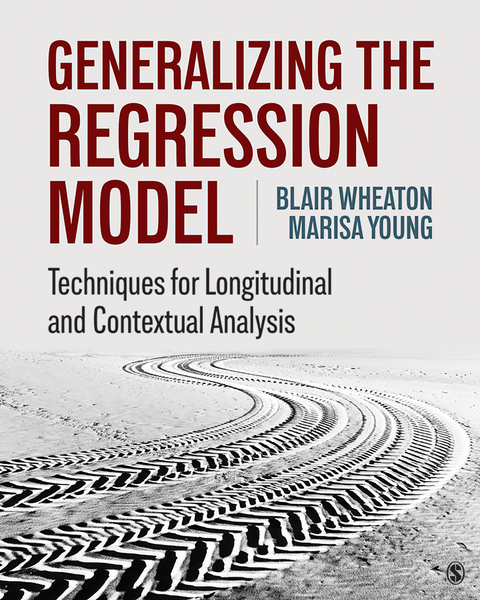
Generalizing the Regression Model (eBook)
688 Seiten
Sage Publications, Inc (Verlag)
978-1-5063-4211-5 (ISBN)
Reviewer Acknowledgements
Preface
About the Authors
Chapter 1: A Review of Correlation and Regression
Introduction
1.1 Association in a Bivariate Table
1.2 Correlation as a Measure of Association
1.3 Bivariate Regression Theory
1.4 Partitioning of Variance in Bivariate Regression
1.5 Bivariate Regression Example
1.6 Assumptions of the Regression Model
1.7 Multiple Regression
1.8 A Multiple Regression Example: The Gender Pay Gap
1.9 Dummy Variables
Concluding Words
Practice Questions
Chapter 2: Generalizations of Regression 1: Testing and Interpreting Interactions
2.0.1 Limitations of the Additive Model
2.1 Interactions in Multiple Regression
2.2 A Three-Way Interaction Between Education, Race, and Gender
2.3 Interactions Involving Continuous Variables
2.4 Interactions Between Categorical Variables: The N-Way Analysis of Variance
2.5 Cautions In Studying Interactions
2.6 Published Examples
Concluding Words
Practice Questions
Chapter 3: Generalizations of Regression 2: Nonlinear Regression
Introduction
3.1 A simple example of a quadratic relationship
3.2 Estimating Higher-Order Relationships
3.3 Basic Math for nonlinear models
3.4 Interpretation of Nonlinear Functions
3.5 An Alternative Approach Using Dummy Variables
3.6 Spline Regression
3.7 Published Examples
Concluding Words
Practice Questions
Chapter 4: Generalizations of Regression 3: Logistic Regression
4.1 A First Take: The Linear Probability Model
4.2 The logistic Regression MODEL
4.3 Interpreting Logistic Models
4.4 Running a Logistic Regression in Statistical Software
4.5 Multinomial Logistic Regression
4.6 The Ordinal Logit Model
4.7 Estimation of Logistic Models
4.8 Tests for Logistic Regression
4.9 Published Examples
Concluding Words
Practice Questions
Chapter 5: Generalizations of Regression 4: The Generalized Linear Model
5.1 The Poisson Regression Model
5.2 The Complementary Log-Mog Model
5.3 Published Examples
Concluding Words
Practice Questions
Chapter 6: From Equations to Models: The Process of Explanation
6.1 What is Wrong With Equations?
6.2 Equations versus Models: Some Examples
6.3 Why Causality?
6.4 Criteria For Causality
6.5 The analytical roles of Variables in causal models
6.6 Interpretating an association using controls and mediators
6.7 Special Cases
6.8 From Recursive to Non-Recursive Models: What to do about reciprocal Causation
6.9 Published Examples
Concluding Words
Practice Questions
Chapter 7: An Introduction to Structural Equation Models
7.1 Latent Variables
7.2 Identifying the Factor analysis Model
7.3 The Full Sem model
7.4 Published Examples
Concluding Words
Practice Question
Chapter 8: Identification and Testing of Models
8.1 Identification
8.2 Testing And Fitting Models
8.3 Published Examples
Concluding Words
Practice Questions
Chapter 9: Variations and Extensions of SEM
9.1 The Comparative SEM framework
9.2 A Multiple Group Example
9.3 SEM for Nonnormal and Ordinal Data
9.4 Nonlinear Effects in SEM Models
Concluding Words
Chapter 10: An Introduction to Hierarchical Linear Models
10.1 Introduction to the Model
10.2 A Formal Statement of a Two-Level HLM Model
10.3 Sub-Models of the Full HLM Model
10.4 The Three-Level Hierarchical Linear Model
10.5 Implications of Centering Level-1 Variables
10.6 Sample Size Consideations
10.7 Estimating Multilevel Models IN SAS and STATA
10.8 Estimating a Three-Level Model
10.9 Published Examples
Concluding Words
Practice Questions
Chapter 11: The Generalized Hierarchical Linear Model
11.1 Multilevel Logistic Regression
11.2 Running the Generalized HLM in SAS
11.3 Multilevel Poisson Regression
11.4 Published Example
Concluding Words
Chapter 12: Growth Curve Models
12.1 Deriving the Structure of Growth Models
12.2 Running Growth Models in SAS
12.3 Modeling The Trajectory of Net Worth From Early to Mid-Adulthood
12.4 Modeling the Trajectory of Internalizing Problems over Adolescence
12.5 Published Examples
Concluding Words
Practice Questions
Chapter 13: Introduction to Regression for Panel Data
13.1 The Generalized Panel Regression Model
13.2 Examples of Panel Eegression
13.3 Published Examples
Concluding Words
Practice Questions
Chapter 14: Variations and Extensions of Panel Regression
14.1 Models for the Effects of events between Waves
14.2 Dynamic Panel Models
14.3 Fixed Effect Methods For Logistic Regression
14.4 Fixed-Effects Methods For Structural Equation Models
14.5 Published Example
Concluding Words
Chapter 15: Event History Analysis in Discrete Time
15.1 Overview of Concepts and Models
15.2 The Discrete-Time Event History Model
15.3 Basic Concepts
15.4 Creating and Analyzing A Person-Period Data Set
15.5 Studying Women’s Entry into the Work Role After Having a First Child
15.6 The Competing Risks Model
15.7 Repeated Events: The Multiple
15.8 Published Example
Concluding Words
Practice Questions
Chapter 16: The Continuous Time Event History Model
16.1 The Proportional Hazards Model
16.2 The Complementary Log-Log Model
Concluding Words
References
| Erscheint lt. Verlag | 22.1.2021 |
|---|---|
| Verlagsort | Thousand Oaks |
| Sprache | englisch |
| Themenwelt | Sachbuch/Ratgeber ► Natur / Technik ► Natur / Ökologie |
| Schlagworte | Blair Wheaton • Event History Analysis • Generalized Linear Model • Generalizing the Regression Model: Statistics for Longitudinal and Contextual • Hierarchical linear models • regression models • Structural Equation Modeling • WHEATON |
| ISBN-10 | 1-5063-4211-6 / 1506342116 |
| ISBN-13 | 978-1-5063-4211-5 / 9781506342115 |
| Informationen gemäß Produktsicherheitsverordnung (GPSR) | |
| Haben Sie eine Frage zum Produkt? |
 EPUB (Adobe DRM)
Kopierschutz: Adobe-DRM
Adobe-DRM ist ein Kopierschutz, der das eBook vor Mißbrauch schützen soll. Dabei wird das eBook bereits beim Download auf Ihre persönliche Adobe-ID autorisiert. Lesen können Sie das eBook dann nur auf den Geräten, welche ebenfalls auf Ihre Adobe-ID registriert sind.
Details zum Adobe-DRM
Dateiformat: EPUB (Electronic Publication)
EPUB ist ein offener Standard für eBooks und eignet sich besonders zur Darstellung von Belletristik und Sachbüchern. Der Fließtext wird dynamisch an die Display- und Schriftgröße angepasst. Auch für mobile Lesegeräte ist EPUB daher gut geeignet.
Systemvoraussetzungen:
PC/Mac: Mit einem PC oder Mac können Sie dieses eBook lesen. Sie benötigen eine
eReader: Dieses eBook kann mit (fast) allen eBook-Readern gelesen werden. Mit dem amazon-Kindle ist es aber nicht kompatibel.
Smartphone/Tablet: Egal ob Apple oder Android, dieses eBook können Sie lesen. Sie benötigen eine
Geräteliste und zusätzliche Hinweise
Buying eBooks from abroad
For tax law reasons we can sell eBooks just within Germany and Switzerland. Regrettably we cannot fulfill eBook-orders from other countries.
aus dem Bereich