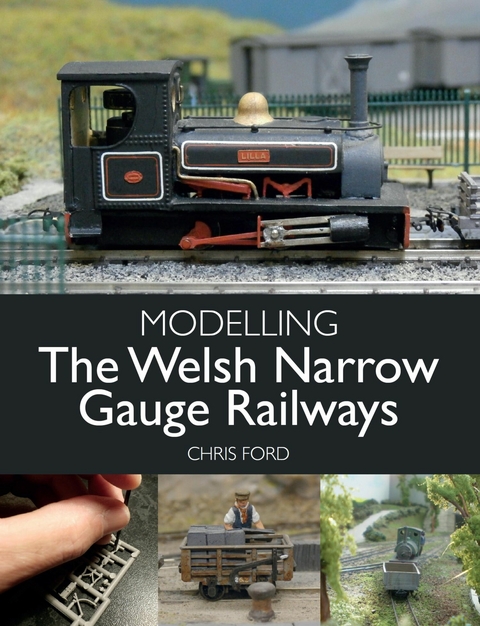
Modelling the Welsh Narrow Gauge Railways (eBook)
343 Seiten
Crowood (Verlag)
978-1-78500-801-6 (ISBN)
Chris Ford has been a modeller since childhood starting with simple plastic and balsa wood kits. By his teens he had become almost exclusively interested in railway modelling and by adulthood he had developed a particular interest in railway modelling and by adulthood he had developed a particular interest in more 'quirky' railway prototypes, especially the narrow gauge lines. Chris has built many model railway layouts over the years both for private home use and for public exhibition display. Most of these layouts have featured in articles published in the model railway press and he has won the Reiner Hendriksen award twice. This is his fourth book for Crowood.
The Welsh narrow gauge railways, with their colourful histories and vital role in local industry, are an extremely popular subject for both railway enthusiasts and modellers. This book is for anyone interested in modelling the Welsh narrow gauge railways and includes the historical background to the railways; useful reference photographs to help achieve accurate and realistic models; full listings of all the tools, equipment and material required, and, finally, step-by-step modelling guides with helpful tips and suggestions. A graduated series of projects, starting with a simple plastic wagon kit and progressing to a complete layout is also included.
Chris Ford has been a modeller since childhood starting with simple plastic and balsa wood kits. By his teens he had become almost exclusively interested in railway modelling and by adulthood he had developed a particular interest in railway modelling and by adulthood he had developed a particular interest in more 'quirky' railway prototypes, especially the narrow gauge lines. Chris has built many model railway layouts over the years both for private home use and for public exhibition display. Most of these layouts have featured in articles published in the model railway press and he has won the Reiner Hendriksen award twice. This is his fourth book for Crowood.
CHAPTER ONE
INTRODUCTION
Welcome to Modelling the Welsh Narrow Gauge Railways. You may well have picked this book up after visiting one of the preserved Welsh narrow gauge lines. You may be an existing modeller who fancies something a little different, or you may already be a modeller of narrow gauge railways who has bought this book to add to your collection. Modelling the Welsh Narrow Gauge Railways contains a graduated set of numbered projects, starting with a simple plastic wagon kit through to a series of thoughts and suggestions on how you may wish to build a complete (but quite compact) layout.
There are some historical background notes on each individual item along the way, followed by a set of instructions on how you may wish to build it. These are by no means hard-and-fast rules, and in most cases it would be possible to deviate from the instructions by at least a small amount and to use other techniques that you may be more comfortable with. Those that are included here are very much personal techniques which have been built up over a number of years and are presented only as suggestions. You may well find different ways that suit you better. Allied to this there are ‘Tip boxes’ scattered throughout the text of each section, adding an idea or two to the fundamental build structure.
Probably most people’s mental image of the Welsh narrow gauge: slate wagons, small trains and beautiful scenery.
The overall aim of this book is to inspire those who are just beginning, those who are ‘stalled’ in their modelling, or these looking for something different. It’s often recognized that one of the hardest things in modelling is to decide what to do and then actually to begin. Coupled with this is the fear of messing up during the building process. Hopefully this volume will help to nudge you into breaking through that barrier and making a start.
WHY CHOOSE THE WELSH NARROW GAUGE RAILWAY?
Why narrow gauge and why Wales? Fairly high on the list of reasons for building any model railway layout will come the line’s surroundings and atmosphere and the way that this attracts the modeller at a personal and somewhat emotional level. The scenery and landscape around the Welsh narrow gauge lines is generally accepted to be some of the most beautiful and spectacular in the British Isles. Add to that the cute’ element of the comparatively tiny locomotives with compact rolling stock and this makes the area and its lines highly attractive to everyone – not just the ardent rail enthusiast.
The big advantage of narrow gauge is the ability to run in challenging geological surroundings.
The attractive nature of Welsh narrow gauge demonstrated by this view on the Tal-y-llyn Railway.
There is of course a little ‘kidology’ at work here: most people stumble across the Welsh narrow gauge lines as part of the modern tourist trail of the area when they are already in relaxed holiday mood and this ‘pretty’ and ‘cute’ element can easily mask the often harsh climate and arduous industry that make up the history of the area and its railways. It may look pretty at first glance, but there was – and to a certain extent still is – a gritty postindustrial undercurrent. The lush green mountains may not resemble black satanic mills, but this is a hard-working environment, still inhabited by the sons and daughters of the men and families that worked the hill farms, the unforgiving slate quarries and the railways and shipping that took the grey rock of Wales to all points of the globe. Yes, the little railways are very attractive, but the only reason that they, and many of the old families, are there is because of a heavy industrial base that is all but gone. Where once the railways mainly carried the valuable slivers of cleanly split rock, they now carry children, parents, dogs, buggies and the detritus of the British holiday trade.
A SMALLER DOMESTIC REQUIREMENT
Despite the visually vast surrounding scenery of the Welsh narrow gauge railway, it will soon become apparent that it is possible in model and domestic terms to be able to think somewhat smaller. For the railway modeller, domestic space is always the elephant in the room – no matter how big the layout in your mind’s eye, there is always the lack of domestic space to bring your dreams down to earth with a bump. However, Wales, with its rolling hills, its mountains and its deep quarries and mines, is a railway landscape that will surprisingly fit this space in a much more forgiving way. It does this successfully in model form simply because it does it so well in real life. These are railways that fit into their environment, rather than cutting straight across it, bending and weaving among the green hillsides and through small holes in the rock, challenging nature to stop them. The modeller of the main-line standard gauge railway is always limited in terms of space; possibly to a single station arrangement. The Welsh narrow gauge gives an overwhelming advantage – you can often take the same sort of household space and with a little careful planning and selective compression, model the whole line. So where do you start?
WHAT SCALE AND GAUGE?
This book is designed to take a notional novice or armchair modeller from an almost zero baseline to a point where a Welsh narrow gauge layout is completed. It also aims to offer the more experienced modeller a few different ways of looking at what he or she already does. The text and projects all feature the most popular 4mm scale (OO9) – the same scale as the models mass-produced by Hornby, Bachmann and so on. This means that any of the included projects could be run or placed alongside these OO gauge items if you so wish. This is not to say that the techniques included here and some of the materials could not be used for other modelling scales such as 7mm scale (Gauge O), or one of the slightly more specialist in-between scales such as 5.5mm scale or S scale. In fact, S scale would be a highly recommended upward jump, giving you something which would be very different. In crude terms with S, you would just need to increase any of the building sizes from a scale of 4mm to 1ft to 4.74mm to 1ft. However, the rolling stock would be another matter and would require some very canny thinking and scratch-building (making items from mostly raw materials such as plastic sheet or metal), but it would not be impossible and would create a very individual model railway.
The Baldwin, one of the new high-quality RTR products from Bachmann.
Much of what determines the choice of scale and gauge will often come down to two factors: firstly, a personal desire to model in the scale; and, secondly, the availability of kits/parts/figures produced in that scale. Unless you are a keen scratch- or kit-builder, you may first look to the availability of ready-to-run (RTR) locomotives and rolling stock. The situation in 4mm scale narrow gauge (usually referred to as OO9) has always been good with regard to locomotive and rolling-stock kits and is now seeing a boom time with various RTR items from PECO, HELJAN and Bachmann. The choices in 7mm scale are much more swayed towards kit building, as RTR items for British lines are virtually non-existent. Working outside these two modelling scales does put you very much out on your own. There are societies such as the S Gauge Society and the 5.5 Association which support other scales and help to supply certain parts and kits, but once outside the 4 and 7mm camps, it is frequently the case of having to make your own parts and adapt kits from other scales. For many modellers this is part of the attraction – working on the scale periphery keeps them from spending too much on commercial models and forces them into old-fashioned model making, rather than model buying. As a breed, modellers – especially narrow gauge modellers – tend to be notoriously careful with their money, opting to make as much as they can in the home workshop for the lowest financial outlay.
THE TRACK GAUGE
Modellers of 4mm-scale narrow gauge lines usually run their trains on 9mm gauge model track. This is usually referred to as OO9, that is, OO scale on 9mm track. It represents an exact prototype gauge of 2ft 3in (686mm), making it perfect for both the Tal-y-llyn and the Corris Railways, a shade under-scale for the Glyn Valley Tramway (2ft 4in [711mm]), a little too wide for the Festiniog Railway’s 1ft 11.5in (597mm) gauge and a scale 3in (76mm) too small for the Welshpool and Llanfair’s 2ft 6in (762mm). A few pedantic modellers work on 8mm gauge and there is at least one Dutch modeller working on 7.9mm gauge for close to exact scale 1ft 11.5in. Overall, though, most people are happy to accept the compromise between these close, but different, prototype gauges and mix them all on the 9mm gauge OO9 track made by the British track manufacturer PECO.
The situation is very similar with 7mm scale. An exact 2ft (51mm) gauge is represented by 14mm gauge track for an increasing number of modellers, but the vast majority will accept the compromise and use 16.5mm gauge track – the same as the standard OO systems and which is roughly equivalent to the Glyn Valley Tramway’s 2ft 4in gauge in 7mm scale. Here again a dedicated track range is also available from PECO with the 0-16.5 labelling.
For those unfamiliar with the terms scale and gauge, the confusion can easily be explained by saying that they are different measurements. Gauge is...
| Erscheint lt. Verlag | 25.1.2021 |
|---|---|
| Verlagsort | London |
| Sprache | englisch |
| Themenwelt | Sachbuch/Ratgeber ► Freizeit / Hobby ► Modellbau |
| Natur / Technik ► Fahrzeuge / Flugzeuge / Schiffe ► Schienenfahrzeuge | |
| Schlagworte | 009 • carriages • Colonel Stephens • Corris • Diorama • display models • Ffestiniog and Blaenau • Granite • Heritage • James Spooner • local industry • Locomotive • Miniatures • Mining • model painting • narrow gauge • Padran • painting • quarries • quarry • railway history • railway modelling • severn • Slab wagon • Slate mines • Slate wagon • standard gauge • Tracks • Trains • Wales • weathering • Welsh Highland |
| ISBN-10 | 1-78500-801-3 / 1785008013 |
| ISBN-13 | 978-1-78500-801-6 / 9781785008016 |
| Informationen gemäß Produktsicherheitsverordnung (GPSR) | |
| Haben Sie eine Frage zum Produkt? |
 EPUB (Adobe DRM)
Kopierschutz: Adobe-DRM
Adobe-DRM ist ein Kopierschutz, der das eBook vor Mißbrauch schützen soll. Dabei wird das eBook bereits beim Download auf Ihre persönliche Adobe-ID autorisiert. Lesen können Sie das eBook dann nur auf den Geräten, welche ebenfalls auf Ihre Adobe-ID registriert sind.
Details zum Adobe-DRM
Dateiformat: EPUB (Electronic Publication)
EPUB ist ein offener Standard für eBooks und eignet sich besonders zur Darstellung von Belletristik und Sachbüchern. Der Fließtext wird dynamisch an die Display- und Schriftgröße angepasst. Auch für mobile Lesegeräte ist EPUB daher gut geeignet.
Systemvoraussetzungen:
PC/Mac: Mit einem PC oder Mac können Sie dieses eBook lesen. Sie benötigen eine
eReader: Dieses eBook kann mit (fast) allen eBook-Readern gelesen werden. Mit dem amazon-Kindle ist es aber nicht kompatibel.
Smartphone/Tablet: Egal ob Apple oder Android, dieses eBook können Sie lesen. Sie benötigen eine
Geräteliste und zusätzliche Hinweise
Buying eBooks from abroad
For tax law reasons we can sell eBooks just within Germany and Switzerland. Regrettably we cannot fulfill eBook-orders from other countries.
aus dem Bereich