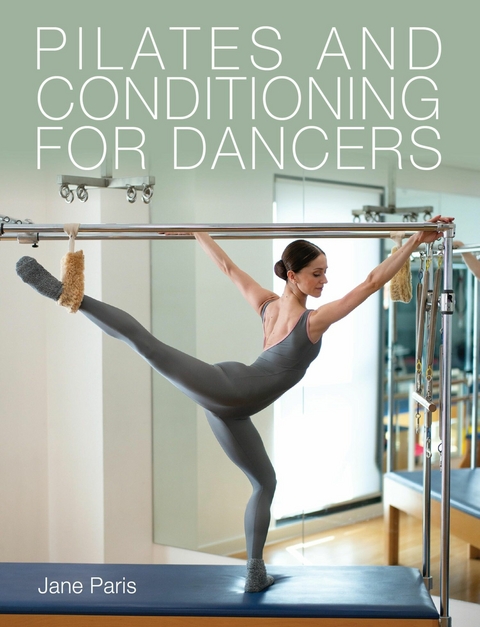
Pilates and Conditioning for Dancers (eBook)
176 Seiten
Crowood (Verlag)
978-1-78500-837-5 (ISBN)
Jane Paris is the Pilates and Conditioning Coach for the Royal Ballet Company. Having taught Pilates for over thirty years, she teaches workshops in dance companies around the world, and also presents at dance medicine and sport conferences internationally. Jane is also a consultant in the technical and motor control department of the Norwegian Olympics.
Professional dance is an exciting but demanding career to choose, and the dancer of today needs to be physically prepared for the stress on the body that a performing life entails. Pilates and Conditioning for Dancers is a practical guide to exercises designed specifically for dance students and professionals alike. The focus on how to choose exercises that suit the individual offers dancers the freedom to optimize their performance potential in a flexible environment. Key topics covered are Core Control; Turnout; The Healthy Spine; Footwork; Jumping and Landing. This new book covers each area of the body, relating the exercises closely to dance technique and providing movement solutions for dancers of al styles and at all stages of their performing career.
INTRODUCTION: HOW ARE YOU TODAY?
If you were coming in to my Pilates studio, my first question to you would be, ‘How are you today?’ It is not simply a matter of being polite; it is the starting point for us working constructively together. Whatever level you dance at, and in whatever dance form, this moment of reflection and analysis is where we all begin. I will come back to this thought later.
My own work has been almost entirely with elite-level professional dancers and athletes. However, whilst I hope those people will read it and gain practical advice from it, this book is specifically aimed at dancers who do not usually enjoy the same extensive support system as elite performers. For those dancers, it is always going to be more difficult to answer the ‘how are you’ question – or at least more difficult to translate the right answer into positive action. I want to help any dancer in any dance form who does not have ready access to Pilates practitioners or conditioning coaches, and those who would like to gain a deeper understanding of a professional conditioning programme. This book is for students preparing for a professional career, for freelance contemporary or theatre dancers, and anyone in a small ballet or touring company. All these individuals need to be able to make their own informed choices about how they can best support and enhance their technique and reach their full performance potential. It is vitally important in a career where time is precious for dancers to know that what they are doing to improve or rehabilitate themselves will make a positive difference.
This book sets out some self-help strategies for all those who do not have access to a high level of help, to enable them to ask more informed questions of themselves. It will hopefully also benefit dance teachers, as they seek to support their dancers’ development.
In selecting the exercises shown in this book, I have tried to pick those that, over twenty-five years of working with some of the world’s best dancers and athletes, I have found to be the most useful to the most people. They represent a ‘tool box’ to fix common problems and a ‘pick and mix’ selection, to improve movement patterns that will enhance technique. Not all of them require equipment or access to a studio or gym; some can be done using only a few small props.
The exercises should not place too great a demand on time either. Every dancer I know has very little spare time, nor do they have excess energy to waste. As a result, no dancer should be doing any exercise that does not have a specific benefit at that particular moment. Going back to my original question – ‘How are you today?’ – it means that everyone needs to identify the most effective and beneficial way to work, given all the other demands of their day.
I hope this book will interest both the Pilates novice and the seasoned professional and that it will provide simple, practical support in times of need. Dancers are constantly striving to improve their technique, but at the same time they need to protect themselves from the extremely high toll taken on the body that a career in dance inevitably involves. Every dancer will sustain an injury at some time, so having an understanding of the workings of the body and some reliable exercises and strategies to hand will be a real asset. This knowledge is often gained through training with great dance teachers, but supplementary training methods such as Pilates are an invaluable additional educational tool.
There are many excellent books on anatomy, physiology and dance technique available, and it is worth searching them out and learning from them. Knowledge of anatomy will certainly help you have a better understanding of Pilates work and you will find it helpful if you sustain an injury to study the joints and muscles involved as you rehabilitate, but it is a vast topic. As it is not practical to try to cover it in any detail here, a list of key terms and anatomical notes can be found at the back of the book, in addition to further recommended reading. Anatomical terms will be kept to a minimum in describing the chosen exercises, but sometimes it is impossible to avoid using the name of a particular muscle or muscle group, as it saves time. If you are unsure about any of the anatomical terms that are used, please look them up in a reference book to clarify them for yourself.
There are times when I am working face to face with a dancer when we have to discuss the anatomical focus – especially in injury rehabilitation. Clearly, in those cases, anatomical terms have to be used. It is vital when talking about injuries with medical professionals, but it is not essential to achieving the aims of this book. Some dancers are interested in the anatomical aspect of Pilates and that is great, but for many it is unnecessary information and they learn better from a more sensory-based teaching.
However, dance terms will be used throughout, on the assumption that everyone who reads this will be familiar with the terminology. This book is, after all, aimed at those who are dedicated to a career in dance and who will have grown up with this language.
There is another reason why I prefer to avoid including too much anatomical information – one that I consider to be of great importance. Dance is an art form. Despite being compared for some decades now to elite athletes, dancers are artists. Too much focus on the physical components of a movement can lead to an over-analytical attitude and a lack of spontaneity in their approach to the work. In experiencing Pilates and other somatic therapies, I feel it is better to focus on the feel and the intention of the movement. The quality and control of the action should be cued with visual imagery, imagination and kinesthetic awareness. This is why in the exercise instructions you will find a separate cue of ‘Focus’, which will sometimes provide an image or thought to aid the quality of movement or to refine the intention beyond the physical execution.
At other times, the ‘Focus’ box might have a more practical element, reminding you, for example, to ‘check your hip to knee alignment’. In these instances, I have included them because, when observing a particular action, I have identified a correction that is commonly needed.
This book is not intended to be a comprehensive guide to everything the Pilates method offers. There are a number of good textbooks on Pilates, some of which are listed later. My writing is aimed at the individual dancer who needs help now, today and in the moment. It will provide ideas on how to decide what is appropriate for each individual in the moment. I almost feel that there are no bad exercises. It is always about the way in which they are approached and executed and the movement quality that results from doing them that is either good or bad. Dance is an art not a sport, and quality and intention must always underpin the movement.
One of the enduring traits of dancers is that the competitive nature of their profession means that they tend to seek immediate help anywhere, without always applying much quality control on the advice they find. Their sense of urgency – that a step has to be perfected ‘now’ – is understandable, but the information should always be filtered, and reliable sources identified. When I look at blogs and podcasts from inexperienced if well-meaning individuals offering their advice on how to achieve higher extensions or better arches in the feet, I shudder to think of the damage that could be caused to the body of a dancer who follows it – especially a young dancer, whose determination to excel may cause them to act unwisely.
It is essential to say that there are no magic exercises. Simple, regular and non-extreme consistent work based on sound knowledge is the only beneficial way forward. There are no short-cuts.
WHY CHOOSE PILATES?
I have worked alongside many excellent Pilates practitioners, as well as outstanding people in other areas of training and the wider fitness industry. I still have not found an exercise method that is as appropriate for dancers as Pilates. It does not answer all training needs, in that it always needs to be combined with, for example, some work to improve cardiovascular fitness. However, in other respects it is almost perfect. Many aspects of dance technique can be improved through Pilates exercises and no rule of dance technique is ever ignored as the principles of both are similar.
A Pilates studio.
Many dancers seem to think that the method was devised specifically for their profession, but that is not the case. When the German-born Joseph Pilates (1883–1967) developed the Pilates Method of Mental and Physical Conditioning, he had begun by formulating his ideas during the First World War and had originally been inspired to help sick and injured soldiers and prisoners of war.
When Joseph Pilates later moved to New York, he quickly attracted dancers to his studio. Legendary choreographers Georges Balanchine and Martha Graham – significant influencers of classical ballet and contemporary dance – both sent their dancers to Pilates. His method seemed to be effective for rehabilitation and could also, it was hoped, prevent further injury. Pilates was soon inspired to add many movements from dance technique alongside his already established exercise programmes, and this is where the method’s long association with dance began.
In the late twentieth century, the Pilates Method became much more widely known and increasingly accessible and widespread in the general population. After decades of being a niche exercise for dancers, it suddenly became very fashionable.
The...
| Erscheint lt. Verlag | 22.3.2021 |
|---|---|
| Verlagsort | London |
| Sprache | englisch |
| Themenwelt | Kunst / Musik / Theater ► Theater / Ballett |
| Sachbuch/Ratgeber ► Sport ► Tanzen / Tanzsport | |
| Schlagworte | abdominal muscles • abduct • Adduct • Adductor muscles • Alignment • Anterior • Arabesque • Ballet • battement • body conditioning • cambré • Cervical • Concentric • core control • Corps de Ballet • cou de pied • Dance • Dance Medicine • Derrière • devant • développé • Dorsiflexion • eccentric • en l’air • epaulement • erector spinae • Exercises • Femur • Fondue • footwork • Gastrocnemius • Gluteal • Grand • Hallux • Hamstrings • Iliopsoas • Intrinsic muscles • Joseph Pilates • Jumping • kinesthetic • Landing • Lateral • Lumbar • Marcelino Sambé • Marianela Nunez • Martha Graham • medial • Metatarsals • Motor Control • Nadia Mullova • passé • Pelvic Floor • Peroneal muscles • Pilates • Pirouette • plantar flexion • Plié • port de bras • Posterior • prone • proprioception • Quadriceps • Rhomboids • rond de jambe • royal ballet company • Royal Ballet School • Sartorius • Scapula • Soleus • Somatic • spine • strength and conditioning • supine • Thoracic • Tibia • Tibialis anterior • Tibialis posterior • Turnout |
| ISBN-10 | 1-78500-837-4 / 1785008374 |
| ISBN-13 | 978-1-78500-837-5 / 9781785008375 |
| Informationen gemäß Produktsicherheitsverordnung (GPSR) | |
| Haben Sie eine Frage zum Produkt? |
 EPUB (Wasserzeichen)
DRM: Digitales Wasserzeichen
Dieses eBook enthält ein digitales Wasserzeichen und ist damit für Sie personalisiert. Bei einer missbräuchlichen Weitergabe des eBooks an Dritte ist eine Rückverfolgung an die Quelle möglich.
Dateiformat: EPUB (Electronic Publication)
EPUB ist ein offener Standard für eBooks und eignet sich besonders zur Darstellung von Belletristik und Sachbüchern. Der Fließtext wird dynamisch an die Display- und Schriftgröße angepasst. Auch für mobile Lesegeräte ist EPUB daher gut geeignet.
Systemvoraussetzungen:
PC/Mac: Mit einem PC oder Mac können Sie dieses eBook lesen. Sie benötigen dafür die kostenlose Software Adobe Digital Editions.
eReader: Dieses eBook kann mit (fast) allen eBook-Readern gelesen werden. Mit dem amazon-Kindle ist es aber nicht kompatibel.
Smartphone/Tablet: Egal ob Apple oder Android, dieses eBook können Sie lesen. Sie benötigen dafür eine kostenlose App.
Geräteliste und zusätzliche Hinweise
Buying eBooks from abroad
For tax law reasons we can sell eBooks just within Germany and Switzerland. Regrettably we cannot fulfill eBook-orders from other countries.
aus dem Bereich