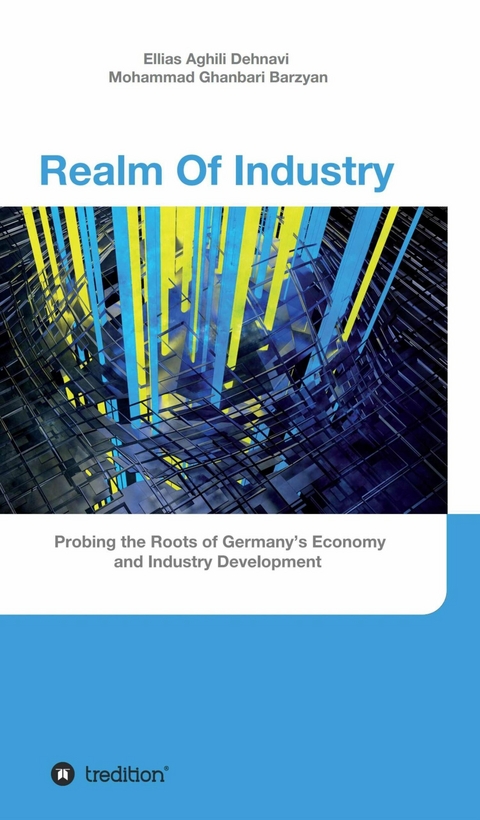
Realm Of Industry (eBook)
208 Seiten
tredition (Verlag)
978-3-347-20192-7 (ISBN)
Born on the 28th of January, 1996, in a family that loves art, literature and history. Ellias soon found his taste in literature and especially poetry. He wrote his first limerick when he was 12 years old. Later on, when he was 14, books like "the peace book" by Todd Parr, "let there be peace on earth: and let it begin with me" by Jill Jackson and Sy Miller, and "What does peace feel like?" by Vladimir Radunsky helped him to get familiar with the essence of peace. Reading poems by Calude Mckay, Wendell Berry and Robert Frost at that age inspired him to start writing poems in a more serious way. Sonnets of Shakespeare were also good sources of inspiration for him. So when he was 16, Ellias wrote a book called "International Poems Collection". The book got the first provincial place in the most famous competition of inventions in Iran, "Kharazmi", and the fifth place in the country competition, yet to be the only project of its kind. This book received confirmations from the University of Isfahan and now is being preserved in the ministry of science and research and technology. The next year, Ellias with the cooperation of two hardworking and creative friends (Hosein Heidari and Hooman Danesh), wrote another poetry book called "A Path to Salvation". This book also won Kharazmi awards. His Excellency, Dr. Zarif, wrote a thanks letter for Ellias for the book since it includes some nice and extraordinary elements of literature, humanity, peace and international relations. In 2015, he was the only Asian representative in the second anniversary of Mandela, in Johannesburg, and it was after this event that he published the book "Peace Poems" which was confirmed by the archive center of the aforementioned institute. Before his trip, during a personal meeting with the South Africa minister of art and culture, his projects were praised and he was given the Robben Island Treasure-icon in advance. Returned to Iran, he was invited to give a lecture on the Mandela and their project in the United Nation, Iranian Branch in Tehran with the presence of the Iranian minister of art and culture and other officials. Later on, he and Paul Amrod collaborated on the longest modern epic in the history of English literature called "Adventures of two captains, volume one". The book has been published by the most credible publishing house in Iran named Janagl Javidan. They are currently working on the second volume and even write an opera based on the series.
Born on the 28th of January, 1996, in a family that loves art, literature and history. Ellias soon found his taste in literature and especially poetry. He wrote his first limerick when he was 12 years old. Later on, when he was 14, books like "the peace book" by Todd Parr, "let there be peace on earth: and let it begin with me" by Jill Jackson and Sy Miller, and "What does peace feel like?" by Vladimir Radunsky helped him to get familiar with the essence of peace. Reading poems by Calude Mckay, Wendell Berry and Robert Frost at that age inspired him to start writing poems in a more serious way. Sonnets of Shakespeare were also good sources of inspiration for him. So when he was 16, Ellias wrote a book called "International Poems Collection". The book got the first provincial place in the most famous competition of inventions in Iran, "Kharazmi", and the fifth place in the country competition, yet to be the only project of its kind. This book received confirmations from the University of Isfahan and now is being preserved in the ministry of science and research and technology. The next year, Ellias with the cooperation of two hardworking and creative friends (Hosein Heidari and Hooman Danesh), wrote another poetry book called "A Path to Salvation". This book also won Kharazmi awards. His Excellency, Dr. Zarif, wrote a thanks letter for Ellias for the book since it includes some nice and extraordinary elements of literature, humanity, peace and international relations. In 2015, he was the only Asian representative in the second anniversary of Mandela, in Johannesburg, and it was after this event that he published the book "Peace Poems" which was confirmed by the archive center of the aforementioned institute. Before his trip, during a personal meeting with the South Africa minister of art and culture, his projects were praised and he was given the Robben Island Treasure-icon in advance. Returned to Iran, he was invited to give a lecture on the Mandela and their project in the United Nation, Iranian Branch in Tehran with the presence of the Iranian minister of art and culture and other officials. Later on, he and Paul Amrod collaborated on the longest modern epic in the history of English literature called "Adventures of two captains, volume one". The book has been published by the most credible publishing house in Iran named Janagl Javidan. They are currently working on the second volume and even write an opera based on the series.
1. Industriousness and Social Capital
For the success of the Industrious Revolution, actors of economy that were most active in household leisure and production, specifically females, had to have freedom for shifting into market employments. Moreover, these agents had to be provided with compensations and payments motivating them for making this shift. As mentioned by historians of England and the Netherlands, for occurrence of this goal, two institutional prerequisites were needed: a family system that permits females working out of the household, and labor markets available for two genders, which satisfies both genders under the European Marriage Pattern. However, other institutions also influenced the degree of females move from household to market, with widening the analysis to other European regions.
According to Table 1, Württemberg contained all the symbols of the European Marriage Pattern: low fertility, high female abstinence from sexual activity, simple and small nuclear-family households, late female marriage, Marriage age and female celibacy rates actually showed an increase in the early modern era, with soaring emigration of males. With the significance of the family system, high female celibacy and low sex ratios had to cause high opportunities in labor market for females.
Table 1. Females & the European Marriage Pattern in Pre-Industrial Württemberg
Sources: Knodel (1988), 122-3; Maisch (1992), 226-33; Medick (1996), 319, 633; Ogilvie (1997), 225-307; Ogilvie (2003), 40-78; Sabean (1998), 218.
In Württemberg, women could have a job the market, which we described it in other work, and as can be observed in Table 3. However, institutions other than market and family influenced their jobs and their earned wages. As ordered by Württemberg’s community authorities and courts, females often had to work inside homes for their husbands, parents, or bosses instead of working in market. Various obstacles were imposed by communities on females in all marital status as they started to shift from household work to market employment. One of these was the married female that their shift from household work to market work was significant in any Industrious Revolution. For example, as ordered by the Ebhausen village court in 1742, wife of a knitter, which had independent work, had to come back to her spender husband.
Similarly, a Wildberg citizen in 1793 pose a complaint on a nomadic basket-maker wife that collected shreds for a rural paper-miller and had no permit, and therefore, the community assembly allowed ejection of this couple by the village people.
Moreover, the Industrious Revolution was dependent on unmarried females that shifted from household work for their masters or fathers (and also made their edibles and clothes) to market work where they could gain wages for themselves (and could have control over their consumption choices). However, these independent unmarried females in Württemberg were addressed in a belittling name – Eigenbrötlerinnen (own-breader), they often experienced harassment. They were tolerated by communities as long as not encroaching on privileges of guild, not asking wages above the legal fixed rates, not depriving male relatives of household labor, not taking risks for the welfare system, not annoying creditable citizens, or not violating social norms. For instance, in 1646, a Wildberg citizen criticized unmarried females, complaining that they lodged with other citizens. This citizen argued that they should be trained to that they are hired by masters. The community assembly then issued an order to all Eigenbrötlerinnen for taking service within three weeks with a penalty of 3 Gulden (equal to earnings of about one year for a female servant).21 To be ordered to enter into service or get married was common for an Eigenbrötlerin, like Barbara Waltz in 1687.22 If an Eigenbrötlerinnen did not accept to return to household work from market work, the community could order on her leaving the community. For example, the Ebhausen church court in 1687 charged Barbara Hilber for her Eigenbrötlen [own-breading], and issued an order for ejecting her out of the hamlet, three Ebhausen Eigenbrötlerinnen in 1717 were ordered to leave within 8 days”, or landlord of Barbara Kleiner in 1752 reported her to the Wildberg court because of independent working as a renter, though Barbara could work as a maidservant, and she was immediately mandated to leave Eigenbrötlen and find work as a servant; otherwise the authorities could order her ejection out of the city”. Communities also imposed constraints on market works even for unmarried women. For example, Friderika Mohlin (45 years old) went to a hostel in 1796 for earning her money and working as a tailor. However, the community court ordered to return to her father’s home.26 Many women in Württemberg worked in the market. In contrast, many other women were not permitted to work in market by the authorities, assemblies, and courts of the communities where they stayed. These institutional hinders constrained ability of females for any industrious revolution.
Even when permitted to work, the potential earnings of women were limited by institutional controls. There were fixed legal wage limits for laborers and servants also in Württemberg, like many other societies in pre-modern Europe. The state issued the legislation. However, each community set its specific rates of wage– i.e., by male employers, because the community institutions were armed by them.28 These wage limits were also enforced by communal courts. For instance, Hans Drescher in 1619 asked the Wildberg community court to punish wife of Burckhard Schlaiffer based on the national ordinance as she tempted a [maid]servant of Drescher for several years in the inflation period.It is not surprising that with these community enforcements, comparisons between actual paid wages and ordinances show few violations.
Table 2. Female-Male Wage Ratios, Physical Productivity, & Calorie Consumption, different Economies
Sources
a Ogilvie (2003), 111; HSAS A573 Bü. 5593.
b HSAS A572 Bü. 56, Nro. 3.
c Dürr (1995), 151.
d Hartinger (1975), 612-13.
e Bardsley (1999), p. 27.
f Kussmaul (1981), 37, 143-4.
g Roberts (1979), 19; Roberts (1981), 189.
h Burnette (1997), 270, 275.
i Cooper, personal communication 2003; Ogilvie (2003), 111.
j Bekaert (1991), 638.
k Sen (1984), 250-1.
l Vogel & Friedl (1992), 93.
m Woodward (1995), 112.
Similar to other certain economies in pre-modern Europe, in Württemberg there was also fixed wage limits for both genders. However, these wage ceilings were unfairly lower for females.31 According to Table 2, wage rules in Württemberg and other southern German areas stipulated a ratio of almost 0.3 between wages of women and men. This table also indicates surviving wage records, showing that this was almost the paid ratio, considerably smaller than the 0.6-0.7 female-male productivity ratio in manual labor or the 0.64 female-male calorie consumption ratio prescribed in other developing economies, both modern and historical. Besides, it was considerably smaller than the 0.6-0.7 ratio of wages that was given in early modern England, closely corresponding to the calorie consumption and labor productivity ratios between the genders.
Moreover, the authorities enforced wage ceilings in the spinning works, which was the main market employment for females in Württemberg. Male employers, both dyers and weavers, fixed legal limits on piece-rates for spinners, using their federated organizations. Yarn of spinners that received wages above the ceiling was confiscated. Some weavers gave wages above the ceilings to spinners for securing insufficient spinning labor or obtaining finer yarn. However, they had to whisper campaigns in the community and the guild fined them.
Thus, guild institutions and community empowered employers for setting fixed wages and reduce potential income. Thus, it decreased the motives for wage-workers, specifically females, to spend their time to market working. Hence, their capacity for consuming market goods was reduced.
Social capital also influenced “industriousness” in Württemberg by controlling permits for doing special works and jobs. Due to their domestic responsibilities and physical capacity, women have higher productivity in service and industrial activities compared to activities related to laboring and farming. However, guilds in early modern Europe imposed limitations on females’ working in a large number of trades and crafts. The guilds in Württemberg imposed ban on female apprentices and denied formal vocational training for women. They also banned practicing any trade or craft by widowed or married women unless their husbands had a license from the guild. Moreover community courts could order fines and punishment on women if they practiced these works illegally. Even the household of a master, female servants and daughters were excluded from main dimensions of craft works by guilds. For example, the community assembly in 1669 fined Wildberg weaver Hannß Schrotter by earnings of 3 weeks because setting his maidservant behind the loom and having her weave.
In essence, the opportunities provided by textile proto-industries for females increased their “industriousness” in physically easy and fairly low-skilled works, like yarn-spinning,...
| Erscheint lt. Verlag | 30.11.2020 |
|---|---|
| Verlagsort | Ahrensburg |
| Sprache | englisch |
| Themenwelt | Sachbuch/Ratgeber ► Beruf / Finanzen / Recht / Wirtschaft ► Bewerbung / Karriere |
| Sachbuch/Ratgeber ► Beruf / Finanzen / Recht / Wirtschaft ► Wirtschaft | |
| Wirtschaft | |
| Schlagworte | economical progress • economy • EU • Eurozone • German Economy • german industry • industrial progress • Industry • Johannes Schmitt • Schmitt plus Sohn |
| ISBN-10 | 3-347-20192-2 / 3347201922 |
| ISBN-13 | 978-3-347-20192-7 / 9783347201927 |
| Informationen gemäß Produktsicherheitsverordnung (GPSR) | |
| Haben Sie eine Frage zum Produkt? |
 EPUB (Wasserzeichen)
DRM: Digitales Wasserzeichen
Dieses eBook enthält ein digitales Wasserzeichen und ist damit für Sie personalisiert. Bei einer missbräuchlichen Weitergabe des eBooks an Dritte ist eine Rückverfolgung an die Quelle möglich.
Dateiformat: EPUB (Electronic Publication)
EPUB ist ein offener Standard für eBooks und eignet sich besonders zur Darstellung von Belletristik und Sachbüchern. Der Fließtext wird dynamisch an die Display- und Schriftgröße angepasst. Auch für mobile Lesegeräte ist EPUB daher gut geeignet.
Systemvoraussetzungen:
PC/Mac: Mit einem PC oder Mac können Sie dieses eBook lesen. Sie benötigen dafür die kostenlose Software Adobe Digital Editions.
eReader: Dieses eBook kann mit (fast) allen eBook-Readern gelesen werden. Mit dem amazon-Kindle ist es aber nicht kompatibel.
Smartphone/Tablet: Egal ob Apple oder Android, dieses eBook können Sie lesen. Sie benötigen dafür eine kostenlose App.
Geräteliste und zusätzliche Hinweise
Buying eBooks from abroad
For tax law reasons we can sell eBooks just within Germany and Switzerland. Regrettably we cannot fulfill eBook-orders from other countries.
aus dem Bereich