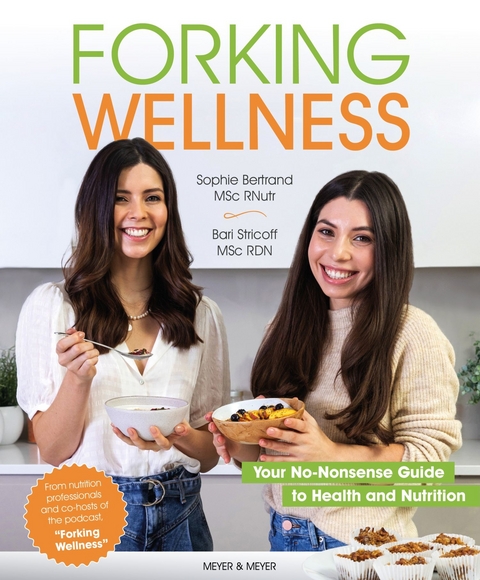
Forking Wellness (eBook)
232 Seiten
Meyer & Meyer Sport (Verlag)
978-1-78255-499-8 (ISBN)
SOPHIE BERTRAND is a Registered Nutritionist (RNutr) with a BSc Psychology degree, an MSc in Clinical Nutrition, and is the founder of Sophie's Healthy Kitchen. She has also obtained a diploma in Nutritional Interventions for Eating Disorders accredited by the British Psychological Society (BPS) and an additional diploma in Intuitive Eating. Sophie has worked with leading brands in the food industry and currently works with clients at the Rhitrition clinic on Harley St in London. Sophie is a non-diet nutritionist and believes it is possible to find the right balance between eating well, enjoying the food you love, and supporting your health at the same time. BARI STRICOFF is a Registered Dietitian (RD) from New York, who moved to London to complete her Masters in Eating Disorders and Clinical Nutrition at University College London (UCL). As a dietitian, Bari has worked in both the clinical and private sectors and with in- and out-patient clients, helping them achieve their nutrition-related goals. She now works full-time in a health-tech start-up that is devoted to helping others achieve positive behavior changes and reduce the risk for chronic disease. Bari is at her happiest in the kitchen, cooking delicious meals for her friends and family (all while enjoying a cheeky glass of wine).
With the abundance of health and nutrition information out there, it's hard to keep up and know what's fact and what's harmful. Registered nutrition professionals and co-hosts of the podcast, "e;Forking Wellness,"e; Sophie Bertrand and Bari Stricoff take an "e;all food is fit"e; approach to eating, and in this book, they use their expertise to help you navigate nutrition. How does one eat for longevity while also trying to eat for a healthy gut, reduce the risk of cardiovascular disease, all while trying to enjoy food without obsessing? These nutrition professionals are on a mission to simplify the information and make wellness a realistic and relatable topic that no longer seems so "e;all or nothing."e; In addition to breaking down the nutrition basics, Sophie and Bari will guide you through what "e;balance"e; really means when eating, how to overcome black-and-white thinking about food, and how to implement mindful eating and intuitive eating. They will also provide simple tools for eating sustainably and on a budget. As the icing on top, Sophie and Bari have provided more than 45 delicious recipes you will want to make again and again. With this book, you are guaranteed to forking understand wellness!
SOPHIE BERTRAND is a Registered Nutritionist (RNutr) with a BSc Psychology degree, an MSc in Clinical Nutrition, and is the founder of Sophie's Healthy Kitchen. She has also obtained a diploma in Nutritional Interventions for Eating Disorders accredited by the British Psychological Society (BPS) and an additional diploma in Intuitive Eating. Sophie has worked with leading brands in the food industry and currently works with clients at the Rhitrition clinic on Harley St in London. Sophie is a non-diet nutritionist and believes it is possible to find the right balance between eating well, enjoying the food you love, and supporting your health at the same time. BARI STRICOFF is a Registered Dietitian (RD) from New York, who moved to London to complete her Masters in Eating Disorders and Clinical Nutrition at University College London (UCL). As a dietitian, Bari has worked in both the clinical and private sectors and with in- and out-patient clients, helping them achieve their nutrition-related goals. She now works full-time in a health-tech start-up that is devoted to helping others achieve positive behavior changes and reduce the risk for chronic disease. Bari is at her happiest in the kitchen, cooking delicious meals for her friends and family (all while enjoying a cheeky glass of wine).
About Sophie
When I was growing up, you might have found reason to call me the fussiest eater in the world. In fact, up until about the age of 14, my diet was largely made up of plain, beige foods (i.e. chicken, chips [aka fries], and bread). But I could always count on my mum to serve me broccoli and carrots at dinnertime. My plain diet wasn’t deliberate—I just didn’t find food that exciting, and I had no interest in trying new things. I’d never really been aware of or bothered by my body, but that all changed at the age of 14, when the size 0, skinny-model look seemed like the only acceptable body type, and I started to look at my body differently. Although I wasn’t and never had been ‘fat’, that became what I saw when I looked in the mirror, so I began pursuing behaviours I believed would help me achieve the perfect body. I could write a whole book on my story alone, but I’ll try and keep it brief. By the age of 17, after three years of dedicating my life to weight loss, I was severely underweight, and my parents noticed. After being forced to commit to four months of intense therapy, by the age of 18 I was a ‘normal’ weight again—but still hugely dissatisfied with my body. So I decided I wouldn’t lose as much weight as I did last time, and I was confident I could find a balance between eating what I thought was healthy and staying thin enough to be happy with my body. Well, let me tell you—that balance doesn’t exist.
I had always been a perfectionist, a high achiever, and pretty controlling. But as I came to the end of my teenage years, I questioned what might happen if I put all that energy into something different—something that meant I wouldn’t be obsessing over my food and body every day. Because the truth was, no number on the scales or reflection in the mirror was ever good enough for me. Having left school at 16 to pursue a diploma in fashion and design, I had no A levels. At the age of 20 I made the decision to go back to full-time education, and having not done A levels, I enrolled to do a foundation degree in psychology at Regent’s University London and a year later was offered an academic scholarship. Four years later, I had a BSc in psychology under my belt and was a lot healthier (physically and mentally). Although my relationship with food wasn’t what you’d consider normal, it was better than it had been, and I’d even tried (and liked) new foods. I remember that two weeks before we had exams I’d put myself on a brain-health diet, eating foods associated with enhanced cognitive function. So, from having no interest in food and health, throughout those four years I’d actually started to look at food in a different way and understand that important functions in the body needed a variety of foods to work. I decided I wanted to blog about this, so I grew more creative in the kitchen and decided to get on Instagram to post my recipes. As I developed more of an interest in food and well-being, I considered where my degree might take me. After finishing my university degree, I set off on a three-month trip with my sister (my favourite person in the world) to the West Coast of America. The rest of my family (my mum, dad, and two brothers) hired an RV for us all to do a trip of a lifetime, and then my sister and I stayed in LA for the rest of the three months. For the three weeks we were travelling in the RV, I ate to energise myself, to feel good, and because I enjoyed it. Being in a completely different environment was a real turning point for me, and it allowed me to fully enjoy the trip of my dreams. One day in West Hollywood, I was sitting in a health café and suddenly said, ‘I want to be a nutritionist.’ My sister was like, ‘Cool, you should go for it’. She has always been incredibly supportive. At that point, I was convinced that clean eating was the only way to be healthy, and I wanted to learn more about the science behind how and what we eat. Looking back, I can say with confidence that now I know I was suffering from orthorexia.
As soon as I got home, I spent hours googling how I could go about my mission to become a registered nutritionist in the quickest way possible. But let me tell you this, qualifications aren’t achieved overnight. I soon realised that if I wanted to be a registered nutritionist and take the role seriously, I was going to have to go back to full-time further education. I thought I’d regret not going for it, so I got in touch with the governing body for nutrition in the UK and enrolled on every single accredited CPD (continuing professional development) course they recommended. A year later, I was accepted to UCL (University College London) to study a master’s in eating disorders and clinical nutrition, and I couldn’t have been more excited. The summer before I started, I went back to the US with my sister for three months, but weeks before I left for the trip, I met the love of my life, Ash. After not seeing him for three months, I came back from the best trip of my life, and two months later, he moved down from Manchester, and I moved out of my rented flat in London, back to my parents’ house so he and I could save for our own place. One evening we sat and, between us, ate a whole box of chocolates (something we now do often!). I remember thinking how even a year before that I’d have felt very guilty, but I didn’t that night. I was so incredibly happy in life, it didn’t even bother me.
When I started my master’s, I realised I definitely didn’t know as much about nutrition as I thought I did. It was the toughest year of my life, and I was working part-time and couldn’t keep up with the amount of information there was to take in. Long days, weekends dedicated to studying, countless assignments, sporadic exams, hospital placements, and a lot of breakdowns later—I’d qualified as a nutritionist. And met Bari.
After finishing my studies, I reached out to (you could say stalked) my wonderful friend and mentor Rhiannon Lambert, desperate for her to give me work experience and train me on how to work with clients—something you’re not taught in a degree programme. My persistence worked, and she hired me three months later to work for her company Rhitrition. Still building my Instagram page, I decided to turn what I called Sophie’s Healthy Kitchen into a business. I was doing my best to build it alongside working with Rhiannon, but nine months later, I decided to take the plunge and go at my own business full-time, whilst still seeing clients at Rhitrition on a freelance basis. I emailed companies I wanted to work with, attended events, and networked as much as I could to start bringing in enough work to support my own business. I have to say, I couldn’t have done any of this without Ash, who supported the both of us whilst I found my feet, and we managed to buy our first property, where we now live with our gorgeous cavapoo, Bear. Now, as well as successfully running my own business, I see clients at Rhitrition, and Rhiannon (RNutr) remains a treasured friend and mentor with regard to my nutrition work.
Having had such an unhealthy relationship with food growing up, I’ve realised that being happy within yourself is more important than obsessing over trying to be the ‘perfect’ version of healthy, and in my eyes, all food is fit. We’re all just trying to make the most of our lives, and seeing food as an enemy makes everything more difficult. You can have your brownies, chocolate, and ice cream, and you can also have your buddha bowls, greens, and casseroles—food should be about enjoyment as well as supporting your overall health. And what fun is it eating only what we think we should be eating? No fun at all!
About Bari
For anyone who knew me as a child, my career choice comes as no surprise. I’m from a family of foodies. My grandfather is a true culinary pioneer and the only Jew from Brooklyn who can whip up an authentic Szechuan feast you wouldn’t believe. (The man can work miracles with some fresh garlic, ginger, and his cleverness.) But everything I know (both the good and the bad), I learned from my mother, Fran. I can honestly say I want to grow up to be just like her. Besides being extremely charismatic and tenacious, Fran (better known as Franny) is a classically trained chef—and a pretty good one, if I must admit (being biased, of course). While most kids were off playing sports or hanging with their friends on weekends, I was begging my mom to let me come to work with her. She even bought me my own matching chef coat when I was eight, my favourite gift to date. I’d stand on milk crates to chop vegetables, roll meatballs, and peel potatoes. My love for food and cooking started at a young age, which led to my eclectic palate. Not all 10-year-olds would opt for raw scallops or periwinkle snails over chicken nuggets.
Although I had a burning passion for food and a love for cooking, I was also an extremely self-conscious teenager and highly judgmental of my appearance. I knew I wanted to be healthy and always tried to be the best version of myself, but I didn’t quite understand what good nutrition was and what healthy truly meant. (Does anyone?) So, to learn more about portion control and how to make healthy choices, I began Weight Watchers at the ripe old age of 12 years old, with a signed...
| Erscheint lt. Verlag | 1.1.2021 |
|---|---|
| Verlagsort | Aachen |
| Sprache | englisch |
| Themenwelt | Sachbuch/Ratgeber ► Essen / Trinken |
| Schlagworte | baking • Balance • cooking • diet • Dieting • dietitian • Food • Health • healthy eating • healthy lifestyle • Healthy Living • Nutrition • Recipes • well-being • Wellness |
| ISBN-10 | 1-78255-499-8 / 1782554998 |
| ISBN-13 | 978-1-78255-499-8 / 9781782554998 |
| Informationen gemäß Produktsicherheitsverordnung (GPSR) | |
| Haben Sie eine Frage zum Produkt? |
 EPUB (Adobe DRM)
Kopierschutz: Adobe-DRM
Adobe-DRM ist ein Kopierschutz, der das eBook vor Mißbrauch schützen soll. Dabei wird das eBook bereits beim Download auf Ihre persönliche Adobe-ID autorisiert. Lesen können Sie das eBook dann nur auf den Geräten, welche ebenfalls auf Ihre Adobe-ID registriert sind.
Details zum Adobe-DRM
Dateiformat: EPUB (Electronic Publication)
EPUB ist ein offener Standard für eBooks und eignet sich besonders zur Darstellung von Belletristik und Sachbüchern. Der Fließtext wird dynamisch an die Display- und Schriftgröße angepasst. Auch für mobile Lesegeräte ist EPUB daher gut geeignet.
Systemvoraussetzungen:
PC/Mac: Mit einem PC oder Mac können Sie dieses eBook lesen. Sie benötigen eine
eReader: Dieses eBook kann mit (fast) allen eBook-Readern gelesen werden. Mit dem amazon-Kindle ist es aber nicht kompatibel.
Smartphone/Tablet: Egal ob Apple oder Android, dieses eBook können Sie lesen. Sie benötigen eine
Geräteliste und zusätzliche Hinweise
Buying eBooks from abroad
For tax law reasons we can sell eBooks just within Germany and Switzerland. Regrettably we cannot fulfill eBook-orders from other countries.
aus dem Bereich