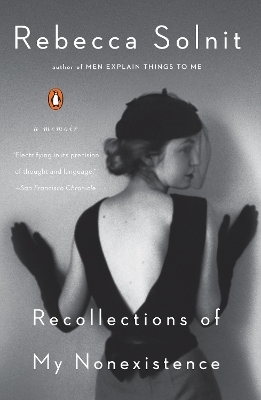
Recollections of My Nonexistence
Penguin USA (Verlag)
9780593083345 (ISBN)
Longlisted for The Orwell Prize for Political Writing
An electric portrait of the artist as a young woman that asks how a writer finds her voice in a society that prefers women to be silent, from the author of Orwell's Roses
In Recollections of My Nonexistence, Rebecca Solnit describes her formation as a writer and as a feminist in 1980s San Francisco, in an atmosphere of gender violence on the street and throughout society and the exclusion of women from cultural arenas. She tells of being poor, hopeful, and adrift in the city that became her great teacher, and of the small apartment that, when she was nineteen, became the home in which she transformed herself. She explores the forces that liberated her as a person and as a writer--books themselves; the gay community that presented a new model of what else gender, family, and joy could mean; and her eventual arrival in the spacious landscapes and overlooked conflicts of the American West.
Beyond being a memoir, Solnit's book is also a passionate argument: that women are not just impacted by personal experience, but by membership in a society where violence against women pervades. Looking back, she describes how she came to recognize that her own experiences of harassment and menace were inseparable from the systemic problem of who has a voice, or rather who is heard and respected and who is silenced--and how she was galvanized to use her own voice for change.
Rebecca Solnit is the author of more than twenty books, including A Field Guide to Getting Lost, The Faraway Nearby, AParadise Built in Hell, River of Shadows, and Wanderlust. She is also the author of Men Explain Things to Me and many essays on feminism, activism and social change, hope, and the climate crisis. A product of the California public education system from kindergarten to graduate school, she is a regular contributor to The Guardian and other publications.
1
One day long ago, I looked at myself as I faced a full-length mirror and saw my image darken and soften and then seem to retreat, as though I was vanishing from the world rather than that my mind was shutting it out. I steadied myself on the door frame just across the hall from the mirror, and then my legs crumpled under me. My own image drifted away from me into darkness, as though I was only a ghost fading even from my own sight.
I blacked out occasionally and had dizzy spells often in those days, but this time was memorable because it appeared as though it wasn't that the world was vanishing from my consciousness but that I was vanishing from the world. I was the person who was vanishing and the disembodied person watching her from a distance, both and neither. In those days, I was trying to disappear and to appear, trying to be safe and to be someone, and those agendas were at often odds with each other. And I was watching myself to see if I could read in the mirror what I could be and whether I was good enough and whether all the things I'd been told about myself were true.
To be a young woman is to face your own annihilation in innumerable ways or to flee it or the knowledge of it, or all these things at once. "The death of a beautiful woman is, unquestionably, the most poetical topic in the world," said Edgar Allan Poe, who must not have imagined it from the perspective of women who prefer to live. I was trying not to be the subject of someone else's poetry and not to get killed; I was trying to find a poetics of my own, with no maps, no guides, not much to go on. They might have been out there, but I hadn't located them yet.
The struggle to find a poetry in which your survival rather than your defeat is celebrated, perhaps to find your own voice to insist upon that, or to at least find a way to survive amidst an ethos that relishes your erasures and failures is work that many and perhaps most young women have to do. In those early years, I did not do it particularly well or clearly, but I did it ferociously.
I was often unaware of what and why I was resisting, and so my defiance was murky, incoherent, erratic. Those years of not succumbing, or of succumbing like someone sinking into a morass and then flailing to escape, again and again, come back to me now as I see young women around me fighting the same battles. The fight wasn't just to survive bodily, though that could be intense enough, but to survive as a person possessed of rights, including the right to participation and dignity and a voice. More than survive, then: to live.
The director, writer, and actor Brit Marling said recently, "Part of what keeps you sitting in that chair in that room enduring harassment or abuse from a man in power is that, as a woman, you have rarely seen another end for yourself. In the novels you've read, in the films you've seen, in the stories you've been told since birth, the women so frequently meet disastrous ends."
The mirror in which I saw myself disappear was in the apartment I inhabited for a quarter century, beginning in the last months of my teens. The first several years there were the era of my fiercest battles, some of which I won, some of which left scars I still carry, many of which so formed me that I cannot say I wish that it had all been otherwise, for then I would have been someone else entirely, and she does not exist. I do. But I can wish that the young women who come after me might skip some of the old obstacles, and some of my writing has been toward that end, at least by naming those obstacles.
2
Another mirror story: When I was about eleven there was a shoe store where my mother got me the engineer boots I favored back when I was trying not to be that despised thing, a girl, and was trying to be what seemed like a separate thing, rugged, ready for action, but something else made the store memorable. If you stepped in front of the mirrors that l
| Erscheinungsdatum | 05.03.2021 |
|---|---|
| Zusatzinfo | B&W FRONTISPIECE PHOTO |
| Sprache | englisch |
| Maße | 140 x 213 mm |
| Gewicht | 318 g |
| Themenwelt | Literatur ► Biografien / Erfahrungsberichte |
| Sachbuch/Ratgeber ► Geschichte / Politik | |
| Sozialwissenschaften ► Soziologie ► Gender Studies | |
| Schlagworte | autobiographies • Autobiography • autobiography books • best friend gifts • Biographies • Biographies and Memoirs • biographies of famous people • Biography • books for feminists • books for women • Feminism • feminist • feminist books • feminist gifts • feminist theory • gifts for women • History • History books • inspirational books • inspirational books for women • Memoir • memoir books • Memoirs • Men Explain Things to Me • San Francisco • self love books for women • sister gift • sister gifts • Sociology • sociology books • Women |
| ISBN-13 | 9780593083345 / 9780593083345 |
| Zustand | Neuware |
| Informationen gemäß Produktsicherheitsverordnung (GPSR) | |
| Haben Sie eine Frage zum Produkt? |
aus dem Bereich