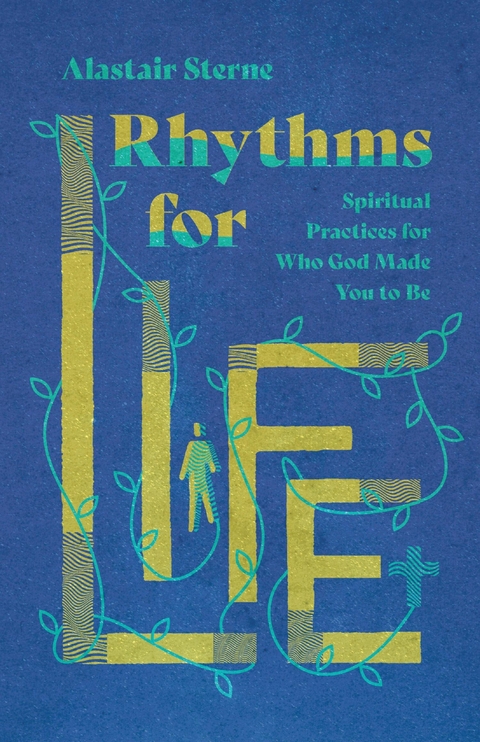
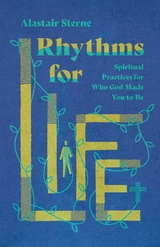
Rhythms for Life (eBook)
206 Seiten
InterVarsity Press (Verlag)
978-0-8308-3198-2 (ISBN)
Alastair Sterne is the founding and lead pastor of St. Peter's Fireside in Vancouver and serves as canon of church planting for the Anglican Network in Canada. He previously worked in communications and design. He is a graduate of Asbury Theological Seminary and is currently working on a doctorate in intercultural studies at Fuller Theological Seminary. He also serves on the board of Always Forward, the church planting initiative of the Anglican Church in North America. He lives in Vancouver with his wife and children.
Who are you becoming? And how will you get there?Spiritual transformation is not a one-size-fits-all journey. Each of us has a particular identity, gifts, values, roles, and purpose. Thus we each need distinct spiritual rhythms that are designed to help us live out that vocation and calling. In this practical book Alastair Sterne shows how we can craft a life of more intentionality, becoming Christlike in ways that fit who we are. First we discover who God made us to be, in all our distinctiveness. Then we enter into spiritual practices that flow out of that particular sense of identity, with fourfold rhythms that point us upward to God, inward to self, withward in community, and outward in mission. Our vocation is our identity uniquely lived out before God, bringing our being and doing together. You can live a life that is more aligned with who you are meant to be. Discover spiritual rhythms that move at the pace of grace, and align you with your unique identity and calling in Christ.
Alastair Sterne is the founding and lead pastor of St. Peter's Fireside in Vancouver and serves as canon of church planting for the Anglican Network in Canada. He previously worked in communications and design. He is a graduate of Asbury Theological Seminary and is currently working on a doctorate in intercultural studies at Fuller Theological Seminary. He also serves on the board of Always Forward, the church planting initiative of the Anglican Church in North America. He lives in Vancouver with his wife and children.
1
Identity
God created mankind in his own image, in the image of God he created them; male and female he created them.
Quit keeping score altogether and surrender yourself with all your sinfulness to God who sees neither the score nor the scorekeeper but only his child redeemed by Christ.
MY FIRST EXISTENTIAL CRISIS HAPPENED when I was fourteen (you can decide whether I was early or late to the game). In my bedroom I stepped in front of the full-length mirror on my closet door. My hair was dyed. I was wearing a gaudy industrial-band shirt. Nothing out of the ordinary. But as I stood and gazed at myself, something shifted. I became aware of how I was looking back at myself. I thought: I exist.
I wasn’t about to win any philosophical awards. But I was conscious of the realness of myself in a new way. It unnerved me. Because I also wondered: Who am I?
I thought of my name, my family, and my short history. I ran through my interests, friends, and dreams. They all contributed to who I am. But these facts didn’t answer the question. At least not in a way that settled me. I tried to go on with my day. But the thought followed me the way fruit flies gravitate to overripe oranges. I couldn’t swat it away.
Who am I?
This question is often on our minds or close by. You may have only begun to search for an answer. If you recently entered a new season, you may be asking, Who will I become? Or, if a transition or crisis has made you feel as if part of yourself has been lost, you might be wondering, Who am I now? It’s possible to search your soul and yet not be convinced by what you’ve found. And whether we have a satisfying answer or not, we never stop asking the question. It’s essential.
But how we ask the question affects the quality of the answer. We can learn to ask it well. After years of searching, I discovered the best form is, Whose am I? Because whether our life stories are written in pen, sketched in pencil, or painted on a canvas, questions of identity are about authorship. Who writes your story?
Misguided Stories
Many stories guide our lives. But often our stories are misguided. We can find ourselves in undesirable story lines and plot twists. Before we can untangle ourselves from misguided stories, we need to name them—and identify their authors.
One dominant story of modern Western culture is that we are our own, the authors of our fate. “No one has the right to define who you are except you; you write your own story,” or so the story goes. We’re encouraged to claim our self-authorship. But identity isn’t this simple.
We exist within the world. We determine who we are to some extent, but we are not exempt from outside influences. Countless people shape us. Friends, family, teachers, and coworkers, to name a few. The idea of self-authorship is appealing because it keeps us at the center of the story. But it’s not the whole story. There are others who wrote the script first, before we put our name on it. We are coauthors at best.
Another common story is the performance story. If you grew up in a family or culture where performance and achievements are highly regarded, you may have internalized a story that says you are only valuable if you excel and accomplish many things with your life.
Imagine a father who drives his son to school in a luxury car. As his son grabs his backpack and scoots out of the car, the father says without fail, “Be exceptional.” The tone is always positive. He intends to encourage his son. As days accumulate into years, his son internalizes this message. But what is the story?
This is a performance story. The father wants more than a son who does well in life. He wants his child to be better than the rest. He wants him to stand tall above his peers. And while the story has the capacity to motivate the son to accomplish great things, it also has the strength to crush his self-worth. What happens if he isn’t exceptional? Or when he realizes there is someone more exceptional than him? Or if he fails? Even if these negative effects were never the father’s intent, he wrote a performance story for his son.
Unfortunately, the reality is that stories can be harmful and can even contaminate. People who have been emotionally or physically traumatized often internalize a story that says they are worthless. They can even believe that they deserved what happened. These kinds of contamination stories can motivate people to prove their worth and do many good things throughout their life. But contamination stories can also have the opposite effect. Sometimes people hold back and play it safe because failure would validate the message of their misguided story: they are worthless. Contamination stories wreak havoc in our lives because they tell us we are not enough and never will be.1
We allow many stories to guide and direct our lives. We inherit them from our family and friends. We are taught them through education, popular culture, and entertainment. Whatever the source, many of our stories are hopelessly misguided. But all of them try to answer the question, “Who am I?”
Two dominant stories shaped my identity.
The first I call “almost but not enough.” I started living by this story after I was dumped for the first time at sixteen. I thought I had found everlasting love. But it wasn’t mutual. I felt something was wrong with me. “Almost but not enough.” Over the years I overcompensated for the “almost but not enough” narrative by motivating myself with different stories, such as, “Be the best. Do something impressive.” This is nothing short of a performance story. It’s how I learned to compensate.
The second I call “exciting but wrong.” Through experiences in my childhood I learned to push boundaries. I internalized a story that said the best sources of excitement are usually wrong. It started with “innocent” wrongs: stealing garden gnomes or sneaking out at night. But as I grew up, “exciting but wrong” translated into an unbounded sexual life, experimentation with many drugs, unfaithfulness in intimate relationships, and pushing healthy boundaries in friendships. This is a contamination story.
Both of my misguided stories created toxic shame in my life. I developed a deeply held belief that something was wrong with me. I knew I wasn’t enough. As a result, I was never sure who I was. It has taken years to disentangle from these stories. And I still tell them to myself occasionally. Sometimes they just start to play in my mind. But these misguided stories have progressively lost their influence and strength as I’ve answered the better question, “Whose am I?”
Our True Story
The apostle Paul had a countercultural message for the church in Corinth. It continues to challenge our own assumptions about identity. He wrote, “You are not your own; you were bought at a price” (1 Cor 6:19-20).
We belong to Christ.
This is the good news of the gospel.
Jesus Christ has written a story of redemption for the world and continues to write his story within each of us. He disentangles us from our misguided stories as we accept his invitation to follow him into the true story of God.2 Under God’s authorship we find our creational identity, our redemptive identity, and adoption.
Creational identity. The story of the Bible begins with the book of Genesis, which tells us something fundamental about all people: we are made in the image of God (Gen 1:26-27). This is our creational identity.
Imagine a mirror set at a forty-five-degree angle. If you shine light directly on it from above it will reflect horizontally out into the room. In the same way, we can imagine ourselves as mirrors. God shines on us to be reflected through us into the world. We were created to reflect the image of our triune God.
One of the greatest mysteries of faith is the Trinity.
God is one God in three persons. God the Father, the Son, and the Holy Spirit. Three persons in one nature.3 The apostle John wrote in one of his letters, “God is love” (1 Jn 4:8). The church father Saint Augustine helped us try to wrap our minds around this mystery when he said that God is at once lover, beloved, and love itself. Neither Augustine nor John intended to reduce God to the emotion of love. Instead, their words point to how love dances back and forth between the three persons of the Trinity. This is why we can say that God is love.
This means that in eternity past, God wasn’t singing, “Can anybody find me somebody to love?”4 God created us out of the abundance and overflow of his love and not out of loneliness or neediness. He created us to be loved by him and to love him.
Since we are made in God’s image, we are also created to love and be loved by others. You may have heard or sung worship songs with lyrics such as, “You’re all I need, God.” This isn’t the whole picture. In the Garden, God said to Adam, “It is not good for the man to be alone” (Gen 2:18). We are only fully human when God’s love flows back and forth between us and other people as well.
When we turn to God as the author of our story, we discover our creational identity: we were made in the image of God. We receive and reflect his love. We were made to do so in relationship. God has written our story not with pencil, ink,...
| Erscheint lt. Verlag | 29.9.2020 |
|---|---|
| Verlagsort | Lisle |
| Sprache | englisch |
| Themenwelt | Sachbuch/Ratgeber ► Gesundheit / Leben / Psychologie ► Psychologie |
| Religion / Theologie ► Christentum ► Kirchengeschichte | |
| Religion / Theologie ► Christentum ► Moraltheologie / Sozialethik | |
| Schlagworte | gifts • Grace • Habits • Identity • Intentional life • personal gifting • Personality • Purpose • rhythm of life • rhythms of life • rule of life • spiritual disciplines • Spiritual Formation • spiritual growth • spiritual practices • spiritual rhythms • Talents • Transformation • Values • Vocation • what should i do with my life |
| ISBN-10 | 0-8308-3198-3 / 0830831983 |
| ISBN-13 | 978-0-8308-3198-2 / 9780830831982 |
| Informationen gemäß Produktsicherheitsverordnung (GPSR) | |
| Haben Sie eine Frage zum Produkt? |
 EPUB (Adobe DRM)
Kopierschutz: Adobe-DRM
Adobe-DRM ist ein Kopierschutz, der das eBook vor Mißbrauch schützen soll. Dabei wird das eBook bereits beim Download auf Ihre persönliche Adobe-ID autorisiert. Lesen können Sie das eBook dann nur auf den Geräten, welche ebenfalls auf Ihre Adobe-ID registriert sind.
Details zum Adobe-DRM
Dateiformat: EPUB (Electronic Publication)
EPUB ist ein offener Standard für eBooks und eignet sich besonders zur Darstellung von Belletristik und Sachbüchern. Der Fließtext wird dynamisch an die Display- und Schriftgröße angepasst. Auch für mobile Lesegeräte ist EPUB daher gut geeignet.
Systemvoraussetzungen:
PC/Mac: Mit einem PC oder Mac können Sie dieses eBook lesen. Sie benötigen eine
eReader: Dieses eBook kann mit (fast) allen eBook-Readern gelesen werden. Mit dem amazon-Kindle ist es aber nicht kompatibel.
Smartphone/Tablet: Egal ob Apple oder Android, dieses eBook können Sie lesen. Sie benötigen eine
Geräteliste und zusätzliche Hinweise
Buying eBooks from abroad
For tax law reasons we can sell eBooks just within Germany and Switzerland. Regrettably we cannot fulfill eBook-orders from other countries.
aus dem Bereich