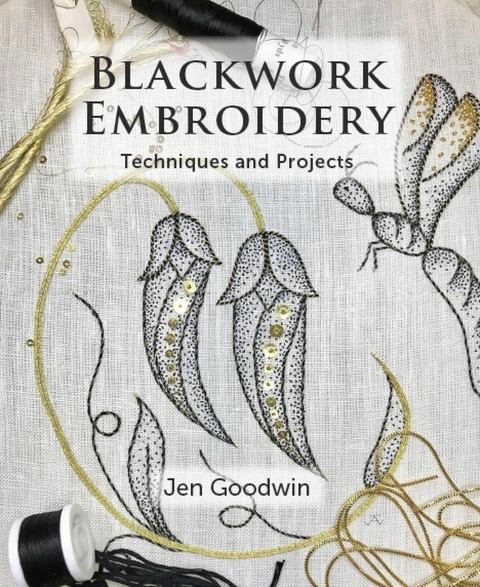
Blackwork Embroidery (eBook)
256 Seiten
Crowood (Verlag)
978-1-78500-776-7 (ISBN)
Jen Goodwin trained with the Royal School of Needlework and now works as a contemporary embroidery artist. She teaches regularly for the RSN and at her own studio in Wimborne, Dorset, where she designs and sells a wide range of beautiful embroidery kits.
Blackwork has a rich history that has developed over the years into an iconic and sophisticated style of embroidery. This practical book presents a number of ways to approach blackwork embroidery, from forming basic stitches and patterns to developing complex shaded pieces with confidence. Through an assortment of exercises, it introduces the principles of shading along with several projects to further explore the potential of blackwork. Detailed instructions on designing and developing shaded pieces of blackwork embroidery are given along with guidance on how to choose suitable images for translating into stitch. Step-by-step instructions on how to form basic stitches and how to form patterns are included as well as almost 250 shaded patterns, indicating how differing patterns appear when worked in different thicknesses of thread. Finally, patterns are grouped by family for easy identification and pattern blending.
CHAPTER 1
INTRODUCTION AND HISTORY
The history of Blackwork is a long and convoluted one with common myths surrounding its origins. It was originally considered to be derived from Spanish Blackwork which had been brought over to England by Catherine of Aragon after her marriage to Henry VIII.
However, this has been largely disproved as there is evidence of Blackwork embroidery already being present in England. The easiest reference to date with accuracy is found in Chaucer’s Canterbury Tales published in 1387, which refers to coal black silk worked both front and back on the collar of a smock; this is 114 years before Catherine arrived in England in 1501.
Spanish style embroidered cuff, 2018, graphite illustration by Katy Harald.
EARLY BLACKWORK
Sadly, there is very little evidence of early Blackwork left in existence and the pieces that have survived are often badly damaged; despite that, it is quite common for museum collections to hold fragments of embroidered textiles that have been cannibalized and salvaged from the original textiles. It is also possible to find examples of fabric which had obviously been stitched at some point; the stitches have now rotted away, leaving the bare fabric with needle marks dotted along the design lines.
This makes it challenging to accurately identify the work as Blackwork. It is possible to make an educated guess by assessing the designs marked on the fabric and comparing them to examples that do have some stitching remaining. The Victoria and Albert Museum in London holds many examples of these in their collections, mainly from the sixteenth and seventeenth centuries. It is assumed the reason that these stitches have been lost is due, in part, to the harsh dyeing process used on the silk threads.
Dr Susan Kay-Williams, Chief Executive of the Royal School of Needlework and researcher of historical dyes in textiles, says:
‘The making of the colour black was complicated and often embroidery threads were not necessarily dyed with the best dyestuffs, so making them more likely to fade or change colour.
Until the nineteenth century, black was often produced from overdyeing red, blue and then adding iron or tannins, gall nuts or walnuts. As such, these ingredients could lead to the rotting of the fibres over time.
From the nineteenth century onward most black cloth or thread was made from the heartwood of the logwood tree which was found in north America and some of the Caribbean islands.’
It was easier and slightly cheaper to source undyed silk so many embroiderers had their own recipes for the dyes used. This in turn had a knock-on effect to the longevity of the threads produced. This is also the main reason that so much of the Blackwork which has survived appears to be brown in colour as these homemade dyes were not colour-fast.
Jane Seymour, Queen of England by Hans Holbein the Younger, 1537. Holbein stitch is beautifully depicted along the edge of the cuffs. (Fine Art/Alamy Stock Photo)
BLACKWORK AND THE TUDOR COURT
It is not difficult to guess why Blackwork in England was associated with Catherine of Aragon as it appears to have become quite fashionable to wear embellished garments during the period when she was still married to Henry VIII, most notably from 1530 in the later part of their marriage.
Embroidered smock, detail from the Victoria and Albert Museum collection. Silk and cotton. England, c.1575–85. This detailed image shows many recognizable Blackwork fill patterns which are still commonly used. (© Victoria and Albert Museum, London)
True Spanish work had a distinct look which differs from the style that is now considered to be Tudor Blackwork. Whilst it was usually worked in black thread on linen, often along the edges of shirts, collars and cuffs, it was far more flowing in design compared to the more linear patterns associated with the Tudor period.
It can be assumed that this difference is due to the arabesque influences which were popular in Spain at this time, creating a mix of both interlinking elements and geometric designs. What is usually thought of first when considering English Blackwork is double running stitch. The nature of this stitch allows for identical stitching to be seen both at the front and back of the cloth being worked, which lends itself well to the decoration of collars and cuffs of clothing. As this was often depicted in paintings from this period, double running stitch has become known as Holbein stitch. It has been named for the eminent painter Hans Holbein the Younger who depicted the embroidery so well in his work that the patterns can still be accurately recreated in stitch.
Holbein came to England in 1532 and became Henry VIII’s official Court Painter by 1539 where he produced numerous portraits which featured Blackwork embroidery on the clothing. It is this wealth of paintings that have proven to be the most reliable historical reference, clearly showing how the classic linear embroidery patterns of the Tudor period had been applied to the garments being worn.
Towards the end of the Tudor period the more geometric filling patterns started to gain popularity. These were often worked as flat patterns without shading worked into motifs and surrounded with an outlining stitch. These patterns were always regularly counted over the linen and it is still possible to count out patterns accurately from historical examples held in museum collections. Interestingly, as the linen was so much finer and the thread count was far higher than the linen commonly worked with today, the patterns were often counted over a larger number of threads. Modern Blackwork patterns are usually counted over two threads of the fabric whereas historical patterns are often seen counted over four threads of the linen.
There are many different suggestions as to why Blackwork came to be worked onto garments. Some suggest that the linear patterns were worked onto gathered lengths of fabric applied to the collar and cuffs to imitate more expensive handmade lace. Others suggest that the black stitching was a good way to both strengthen and disguise dirt on these hard-wearing areas. As with most fashions though, once it became popular, Blackwork became an embellishment that indicated status and standing with the most impressive embroidery being worn by nobles and royalty to emphasize their higher status in society.
It is easy to see how the more common lace ruffs of the Elizabethan period, some of which were very grand in size and style, were inspired by the Blackwork embroidered elements popularized during the Tudor period.
BLACKWORK AND THE ELIZABETHAN COURT
Blackwork noticeably altered in style during the rule of Elizabeth I, becoming far more figurative, often featuring flowers and animals with Goldwork additions. Some of these changes are first seen in historical examples of coifs. A coif is a close-fitting cap, which was originally only worn by men who were of high standing in their professions, for example highly trained lawyers.
Common motifs often seen in surviving examples of Elizabethan embroidery, drawn by Jen Goodwin.
Historically a Serjeant-at-Law, a precursor to a barrister, would be presented with a plain linen coif when appointed. These were worn at all times in public to mark their status. This is where the phrase ‘called to the coif’ originated, and as the British justice system has developed so has the terminology used. When modern barristers are appointed, they are now called to the bar.
However, over time coifs became far more commonly worn by women to cover their hair. These were far more elaborate, and many surviving examples show shared motifs. This is in part due to the introduction of the printing press making pattern books available for the first time.
A very important book which was popular was A Schole-House for the Needle. This was written by Richard Shorleyker in 1624. The motifs depicted could be copied and transferred to fabric before being stitched depending on the embroiderers’ preferences. These floral motifs also doubled up symbolically as each flower had a common meaning.
Daisies were known for innocence, roses for love, pansies for thoughts, honeysuckle for devotion and holly for foresight, to mention a few. Other common elements were oak for steadfastness (acorns represented strength and potential), pears for fertility and abundance, and pomegranates for resurrection and chastity.
Symbology featured so strongly historically due to the amount of illiteracy amongst the population. It was far easier to convey messages visually when so many people could not read and those who could read struggled to access affordable books. It can be assumed that the reason embroidery became a pastime for upper-class ladies is due to the fact they could afford and read these new and exciting pattern books.
Quene Elizabeth’s Sleeve Unpick’d, 2010, pencil drawing by Nicola Jarvis. This illustration beautifully depicts how Blackwork fashions altered during the Elizabethan period.
The style of stitching used also altered during the Elizabethan period. Geometric fill patterns were not used as commonly but fine seeding became more popular. This seeding was often shaded to create dimension within the motifs; these are the earliest examples of shading featuring in Blackwork embroidery.
Fine gold passing threads were also worked into complex braid stitches which would be used to create slightly raised gilded...
| Erscheint lt. Verlag | 30.11.2020 |
|---|---|
| Zusatzinfo | 1018 colour photographs |
| Verlagsort | London |
| Sprache | englisch |
| Themenwelt | Sachbuch/Ratgeber ► Freizeit / Hobby ► Handarbeit / Textiles |
| Sachbuch/Ratgeber ► Freizeit / Hobby ► Heimwerken / Do it yourself | |
| Sachbuch/Ratgeber ► Freizeit / Hobby ► Kreatives Gestalten | |
| Schlagworte | advanced embroiders • basic blackwork • beginner embroiders • blackwork • blackwork embroidery • classical embroidery • contemporary blackwork • crewelwork embroidery • Embroidery • embroidery guides • embroidery student • embroidery styles • hand embroidery • historical blackwork • how to • Jen Goodwin • Jen Goodwin embroidery • learn to embroid • Monochrome • needlework • photorealistic embroidery • real life embroidery • sewing • shaded blackwork • silk thread • spanish blackwork • traditional blackwork • Tudor embroidery • types of embroidery • V&A |
| ISBN-10 | 1-78500-776-9 / 1785007769 |
| ISBN-13 | 978-1-78500-776-7 / 9781785007767 |
| Informationen gemäß Produktsicherheitsverordnung (GPSR) | |
| Haben Sie eine Frage zum Produkt? |
 EPUB (Wasserzeichen)
DRM: Digitales Wasserzeichen
Dieses eBook enthält ein digitales Wasserzeichen und ist damit für Sie personalisiert. Bei einer missbräuchlichen Weitergabe des eBooks an Dritte ist eine Rückverfolgung an die Quelle möglich.
Dateiformat: EPUB (Electronic Publication)
EPUB ist ein offener Standard für eBooks und eignet sich besonders zur Darstellung von Belletristik und Sachbüchern. Der Fließtext wird dynamisch an die Display- und Schriftgröße angepasst. Auch für mobile Lesegeräte ist EPUB daher gut geeignet.
Systemvoraussetzungen:
PC/Mac: Mit einem PC oder Mac können Sie dieses eBook lesen. Sie benötigen dafür die kostenlose Software Adobe Digital Editions.
eReader: Dieses eBook kann mit (fast) allen eBook-Readern gelesen werden. Mit dem amazon-Kindle ist es aber nicht kompatibel.
Smartphone/Tablet: Egal ob Apple oder Android, dieses eBook können Sie lesen. Sie benötigen dafür eine kostenlose App.
Geräteliste und zusätzliche Hinweise
Buying eBooks from abroad
For tax law reasons we can sell eBooks just within Germany and Switzerland. Regrettably we cannot fulfill eBook-orders from other countries.
aus dem Bereich