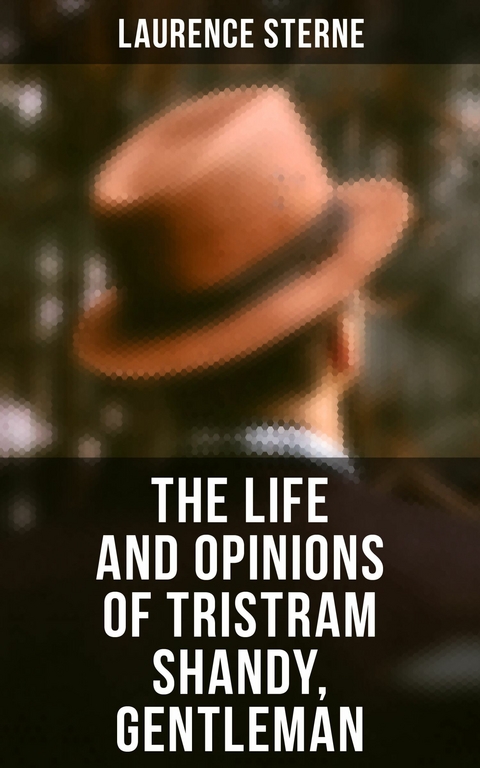
The Life and Opinions of Tristram Shandy, Gentleman (eBook)
843 Seiten
Musaicum Books (Verlag)
978-80-272-4401-0 (ISBN)
INTRODUCTION
It can hardly be said that Sterne was an unfortunate person during his lifetime, though he seems to have thought himself so. His childhood was indeed a little necessitous, and he died early, and in debt, after some years of very bad health. But from the time when he went to Cambridge, things went on the whole very fairly well with him in respect of fortune; his ill-health does not seem to have caused him much disquiet; his last ten years gave him fame, flirting, wandering, and other pleasures and diversions to his heart’s content; and his debts only troubled those he left behind him. He delighted in his daughter; he was able to get rid of his wife, when he was more than usually fatigatus et aegrotus of her, with singular ease. During the unknown, or almost unknown, middle of his life he had friends of the kind most congenial to him; and both in his time of preparation and his time of production in literature, he was able to indulge his genius in a way by no means common with men of letters. If his wish to die in a certain manner and circumstance was only bravado—and borrowed bravado—still it was granted; and it is quite certain that to him an old age of real illness would have been unmitigated torture. Even if we admit the ghastly stories of the fate of his remains, there was very little reason why any one should not have anticipated Mr. Swinburne’s words on the morrow of Sterne’s death and said, “Oh! brother, the gods were good to you,” though even then he might have said it with a sort of mental reservation on the question whether Sterne had been very good to the gods.
Nemesis, for the purpose of adjusting things, played him the exceptionally savage trick of using the intervention of his idolised daughter. Little or nothing seems to be known of “Lydia Sterne de Medalle,” as she was pleased to sign herself; “Mrs. Medalle,” as her bluff British contemporaries call her. But that she must have been either a very silly, a very stupid, or an excessively callous person, appears certain. It would seem, indeed, to require a combination of the flightiness and lack of taste which her father too often displayed, with the stolidity which (from rather unfair inference through Mrs. Shandy) is sometimes supposed to have characterised her mother, to prompt or permit a daughter to publish such a collection of letters as those which were first given to the world in 1775. Charity, not unsupported by probability, has trusted that Madame de Medalle could not read Latin, but she certainly could read English; and only an utterly corrupted heart, or an incurably dense or feather-brained head, could hide from her the fact that not a few of the English letters she published were damaging to her father’s character. Her alleged excuse—that her mother, who was then dead, had desired her, if any letters should be published under her father’s name, to publish these, and that the “Yorick and Eliza” correspondence had appeared—is utterly insufficient. For Mrs. Sterne, of whose conduct we know nothing unfavourable, and one or two things decidedly to her credit, could only have meant “such of these as will put your father in a favourable light,” else she would have published them herself. Yet though Lydia could, while taking no editorial trouble whatever, go out of her way to make a silly missish apology for publishing a passage in which her charms and merits are celebrated, she seems never to have given a thought to what she was doing in other ways. Nor were Sterne’s misfortunes in this way over with the publication of these things; for the subsequently discovered Fourmentelle correspondence sunk him, with precise judges, a little deeper. No doubt Tristram Shandy, the Sentimental Journey, and the curious stories or traditions about their author, were not exactly calculated to give Sterne a very high reputation with grave authorities. But it is these unlucky letters which put him almost hopelessly out of court. Even the slight relenting of fortune which gave him at last, in Mr. Percy Fitzgerald, a biographer very good-natured, very indefatigable, and with a natural genius for detecting undiscovered facts and documents, only made matters worse in some ways. And the consequence is, that it has become a commonplace and almost a necessity to make up for praising Sterne’s genius by damning his character. Johnson, while declining to deny him ability, seems to have been too much disgusted to talk freely about him; Scott’s natural kindliness, warm admiration for my Uncle Toby, and total freedom from squeamish prudery, seem yet to have left him ill at ease and tongue-tied in discussing Sterne; Thackeray, as is well known, exceeded all measure in denouncing him; and his chief recent critical biographer, Mr. Traill, who is probably as free from cant, Britannic or other, as any man who ever wrote in English, speaks his mind in the most unsparing fashion.
For my own part, I do not hesitate to say that I do not think letters of this kind ought to be published at all; and though it may seem paradoxical or foolish, I am by no means sure that, if they are published, they ought to be admitted as evidence. That which is not written for the public, is no business of the public’s; and I never read letters of this kind, published for the first time, without feeling like an eavesdropper.1 Unluckily, the evidence furnished by the letters fits in only too well with that furnished by the published works, by his favourite cronies and companions, and by his general reputation, so that “what the prisoner says” must, no doubt, “be used against him.”
It may be doubted whether it was accident or his usual deliberate fantasticality that made Sterne, in the well-known summary of his life which (very late in it) he drew up for his daughter, devote almost the whole space to his childhood. Perhaps it may be accounted for, reasonably enough, by supposing that of his later years he thought his daughter knew quite as much as he wished her to know, while of the middle period he had little or nothing to tell. In fact, of the two earlier divisions we still know very little but what he has chosen to tell us in one of the most characteristic and not the least charming excursions of his pen. Laurence Sterne was, with two sisters, the only “permanent child” (to borrow a pleasant phrase of Mr. Traill’s) out of a very plentiful but most impermanent family, borne in the most inconvenient circumstances possible by Agnes Nuttle or Herbert or Sterne, a widow, and daughter or stepdaughter of a sutler of our army in Flanders, to Roger, second son of Simon Sterne of Elvington, in Yorkshire, who was the third son of Dr. Richard Sterne, Archbishop of York. The Sternes were of a gentle if not very distinguished family, which, after being seated in Suffolk, migrated to Nottinghamshire. After the promotion of the archbishop (who had been a stout cavalier, as Master of Jesus at Cambridge, in the bad times), they obtained, as was fitting, divers establishments by marriage or benefice in Yorkshire itself. Very little endowment of any kind, however, fell to the lot of Roger Sterne, who was an ensign in what ranked later as the 34th regiment. Laurence, his eldest son, was born at Clonmel, in Ireland, where his mother’s relations lived, and just after his father’s regiment had been disbanded. It was shortly re-established, however, and became the most “marching” of all marching corps; for though its headquarters were generally in Ireland, it was constantly being ordered elsewhere, and Roger Sterne saw active service both at Vigo and Gibraltar. In this latter station he fought a duel of an extremely Shandean character “about a goose.” He was run through the body and pinned to the wall; whereupon, it is said, he requested his antagonist to be so kind as to wipe the plaster off the sword before pulling it out of his body. In despite of this thoughtfulness, however, and of an immediate recovery, the wound so weakened him that, being ordered to Jamaica, he took fever and died there in March 1731. As Lawrence had been born on November 24, 1713, he was nearly eighteen; and the family had meanwhile been increased by four other children who all died, and a youngest daughter, Catherine, who, like the eldest, Mary, lived. Till he was about nine or ten the boy followed the exceedingly fluctuating fortunes of his family, which he diversified further on by falling through, not a millrace, but a going mill. Then he was sent to school at Halifax, in Yorkshire, and soon after practically adopted by his cousin Sterne of Elvington, who, when the time came, sent him to Jesus College at Cambridge, the family connection with which had begun with his great-grandfather. He was admitted there on July 6, 1733, being then nearly twenty, and took his degree of B.A. in 1736, and that of M.A. in 1740. The only tradition of his school career is his own story that, having written his name on the school ceiling, he was whipped by the usher, but complimented as a “boy of genius” by the master, who said the name should never be effaced. This anecdote, as might be expected, has not escaped the aqua fortis of criticism.
We know practically nothing of Sterne’s Cambridge career except the dates above mentioned, the fact of his being elected first to a sizarship and then as founder’s kin to a scholarship endowed by Archbishop Sterne, and the incident told by himself that he there contracted his lifelong friendship with a distant relative and fellow Jesus man, John Hall, or John Hall Stevenson, of whom more presently. But Sterne had further reason to acknowledge that his family stood together. He had no sooner taken his degree, than he was taken up by a brother of his father’s, Jaques...
| Erscheint lt. Verlag | 2.11.2018 |
|---|---|
| Verlagsort | Prague |
| Sprache | englisch |
| Themenwelt | Literatur ► Comic / Humor / Manga |
| Sachbuch/Ratgeber ► Geschichte / Politik ► Neuzeit bis 1918 | |
| Schlagworte | 18th-century satire • born a crime • bossypants • British authorship • british humor • complex narrative structure • Daniel Defoe • David Hume • Enlightenment Literature • Gulliver’s Travels • Hitchhiker’s Guide to the Galaxy • Humorous character profiles • John Locke • literary classic • literary experimentation • Metafictional storytelling • Mrs Dalloway • P G Wodehouse • philosophical reflections • the song of achilles |
| ISBN-10 | 80-272-4401-3 / 8027244013 |
| ISBN-13 | 978-80-272-4401-0 / 9788027244010 |
| Informationen gemäß Produktsicherheitsverordnung (GPSR) | |
| Haben Sie eine Frage zum Produkt? |
 EPUB (Wasserzeichen)
DRM: Digitales Wasserzeichen
Dieses eBook enthält ein digitales Wasserzeichen und ist damit für Sie personalisiert. Bei einer missbräuchlichen Weitergabe des eBooks an Dritte ist eine Rückverfolgung an die Quelle möglich.
Dateiformat: EPUB (Electronic Publication)
EPUB ist ein offener Standard für eBooks und eignet sich besonders zur Darstellung von Belletristik und Sachbüchern. Der Fließtext wird dynamisch an die Display- und Schriftgröße angepasst. Auch für mobile Lesegeräte ist EPUB daher gut geeignet.
Systemvoraussetzungen:
PC/Mac: Mit einem PC oder Mac können Sie dieses eBook lesen. Sie benötigen dafür die kostenlose Software Adobe Digital Editions.
eReader: Dieses eBook kann mit (fast) allen eBook-Readern gelesen werden. Mit dem amazon-Kindle ist es aber nicht kompatibel.
Smartphone/Tablet: Egal ob Apple oder Android, dieses eBook können Sie lesen. Sie benötigen dafür eine kostenlose App.
Geräteliste und zusätzliche Hinweise
Buying eBooks from abroad
For tax law reasons we can sell eBooks just within Germany and Switzerland. Regrettably we cannot fulfill eBook-orders from other countries.
aus dem Bereich