
Field Guide to the Forest Trees of Uganda (eBook)
289 Seiten
CABI (Verlag)
978-1-78924-529-5 (ISBN)
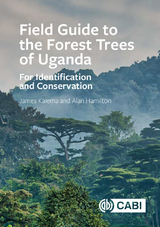
This book is a guide for the identification of the indigenous forest trees of Uganda. It will be useful for those who wish to contribute towards the conservation of the forests or to plant indigenous trees. Information is provided on how to propagate and cultivate about 80 of the most valuable species.
Indigenous trees provide numerous resources useful for welfare and development. They include many types of timber and non-timber forest products, such as craft materials, foods and medicines. The proximity of indigenous forest helps to moderate the local climate, making it more suitable for agriculture. Indigenous forests protect springs, therefore safeguarding water supplies more effectively than exotic trees such as pines and eucalyptus.
All 450 known indigenous tree species from the forests are included. Both scientific and local names are provided, the latter in 21 languages. Local names facilitate access to knowledge and values traditionally attached to the species, useful when planning pathways of development firmly rooted in local culture.
The book will be invaluable for botanists, foresters, rural development workers and members of the general public concerned about contributing to conservation and sustainable development in Uganda. Many of the species grow in neighbouring countries, so the book has relevance there too.
James Kalema and Alan Hamilton have prepared a revised and updated version of Hamilton's "A Field Guide to Uganda Forest Trees" published in 1981. The ever-growing threats to forests prompted the authors to extend the text with details on conservation status, as well as on cultivation and propagation. All in all, the book covers 451 species of which 321 are illustrated. There are 1104 tree names in 21 indigenous languages. Cultivation and propagation notes are provided for 62 species. This scholarly treatment of the Ugandan forest trees will be welcomed by botanists, foresters, conservationists and by people with an interest in forest biodiversity. I can highly recommend it.
| Erscheint lt. Verlag | 8.6.2020 |
|---|---|
| Verlagsort | Oxford |
| Sprache | englisch |
| Themenwelt | Sachbuch/Ratgeber ► Natur / Technik ► Natur / Ökologie |
| Naturwissenschaften ► Biologie ► Botanik | |
| Naturwissenschaften ► Biologie ► Ökologie / Naturschutz | |
| Technik | |
| Wirtschaft | |
| Weitere Fachgebiete ► Land- / Forstwirtschaft / Fischerei | |
| Schlagworte | tropical forestry, Tropical forest trees, tropical silviculture, African forest trees, Uganda, forest conservation, forest biodiversity |
| ISBN-10 | 1-78924-529-X / 178924529X |
| ISBN-13 | 978-1-78924-529-5 / 9781789245295 |
| Informationen gemäß Produktsicherheitsverordnung (GPSR) | |
| Haben Sie eine Frage zum Produkt? |
 EPUB (Adobe DRM)
Kopierschutz: Adobe-DRM
Adobe-DRM ist ein Kopierschutz, der das eBook vor Mißbrauch schützen soll. Dabei wird das eBook bereits beim Download auf Ihre persönliche Adobe-ID autorisiert. Lesen können Sie das eBook dann nur auf den Geräten, welche ebenfalls auf Ihre Adobe-ID registriert sind.
Details zum Adobe-DRM
Dateiformat: EPUB (Electronic Publication)
EPUB ist ein offener Standard für eBooks und eignet sich besonders zur Darstellung von Belletristik und Sachbüchern. Der Fließtext wird dynamisch an die Display- und Schriftgröße angepasst. Auch für mobile Lesegeräte ist EPUB daher gut geeignet.
Systemvoraussetzungen:
PC/Mac: Mit einem PC oder Mac können Sie dieses eBook lesen. Sie benötigen eine
eReader: Dieses eBook kann mit (fast) allen eBook-Readern gelesen werden. Mit dem amazon-Kindle ist es aber nicht kompatibel.
Smartphone/Tablet: Egal ob Apple oder Android, dieses eBook können Sie lesen. Sie benötigen eine
Geräteliste und zusätzliche Hinweise
Buying eBooks from abroad
For tax law reasons we can sell eBooks just within Germany and Switzerland. Regrettably we cannot fulfill eBook-orders from other countries.
aus dem Bereich