


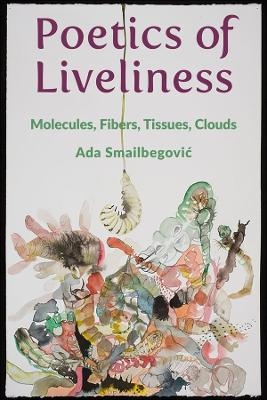
Poetics of Liveliness
Molecules, Fibers, Tissues, Clouds
Seiten
2021
Columbia University Press (Verlag)
978-0-231-19826-4 (ISBN)
Columbia University Press (Verlag)
978-0-231-19826-4 (ISBN)
Ada Smailbegović shows how twentieth- and twenty-first-century writers have intermingled scientific methodologies with poetic form to reveal unfolding processes of change. Poetics of Liveliness moves across scales to explore the realms of molecules, fibers, tissues, and clouds.
Can poetry act as an aesthetic amplification device, akin to a microscope, through which we can sense minute or nearly imperceptible phenomena such as the folding of molecules into their three-dimensional shapes, the transformations that make up the life cycle of a silkworm, or the vaporous movements that constitute the ever-shifting edges of clouds? We tend to think of these subjects as reserved for science, but, as Ada Smailbegović argues, twentieth- and twenty-first-century writers have intermingled scientific methodologies with poetic form to reveal unfolding processes of change. Their works can be envisioned as laboratories within which the methodologies of experimentation, natural historical description, and taxonomic classification allow poetic language to register the rhythms and durations of material transformation.
Poetics of Liveliness moves across scales to explore the realms of molecules, fibers, tissues, and clouds. It investigates works such as Christian Bök’s insertion of a poetic text into the DNA code of living bacteria in order to generate a new poem in the shape of a protein molecule, Jen Bervin’s considerations of silk fibers and their use in biomedicine, Gertrude Stein’s examination of brain tissues in medical school and its subsequent influence on her literary taxonomies of character, and Lisa Robertson’s studies of nineteenth-century meteorology and the soft architecture of clouds. In their attempt to understand physical processes unfolding within lively material worlds, Smailbegović contends, these poets have developed a distinctive materialist poetics. Structured as a poetic cosmology akin to Lucretius’s “On the Nature of Things,” which begins at the atomic level and expands out to the vastness of the universe, Poetics of Liveliness provides an innovative and surprising vision of the relationship between science and poetry.
Can poetry act as an aesthetic amplification device, akin to a microscope, through which we can sense minute or nearly imperceptible phenomena such as the folding of molecules into their three-dimensional shapes, the transformations that make up the life cycle of a silkworm, or the vaporous movements that constitute the ever-shifting edges of clouds? We tend to think of these subjects as reserved for science, but, as Ada Smailbegović argues, twentieth- and twenty-first-century writers have intermingled scientific methodologies with poetic form to reveal unfolding processes of change. Their works can be envisioned as laboratories within which the methodologies of experimentation, natural historical description, and taxonomic classification allow poetic language to register the rhythms and durations of material transformation.
Poetics of Liveliness moves across scales to explore the realms of molecules, fibers, tissues, and clouds. It investigates works such as Christian Bök’s insertion of a poetic text into the DNA code of living bacteria in order to generate a new poem in the shape of a protein molecule, Jen Bervin’s considerations of silk fibers and their use in biomedicine, Gertrude Stein’s examination of brain tissues in medical school and its subsequent influence on her literary taxonomies of character, and Lisa Robertson’s studies of nineteenth-century meteorology and the soft architecture of clouds. In their attempt to understand physical processes unfolding within lively material worlds, Smailbegović contends, these poets have developed a distinctive materialist poetics. Structured as a poetic cosmology akin to Lucretius’s “On the Nature of Things,” which begins at the atomic level and expands out to the vastness of the universe, Poetics of Liveliness provides an innovative and surprising vision of the relationship between science and poetry.
Ada Smailbegović is an assistant professor of English at Brown University. She is a cofounder of the digital publishing platform the Organism for Poetic Research, and she has published essays and poetic work in a variety of venues.
Acknowledgments
Part I: Textures of Change
Introduction: Poetic Cosmologies
1. Soft Matter
2. Poetry and Science
Part II: Poetic Laboratories of Matter
3. Molecules: From Code to Shape
4. Fibers: Edge Textures and Nonhuman Scales of Sense
5. Tissues: Histological Landscapes and the Substances of Character
6. Clouds: Cloud-Writing and the Movement of Qualities
Coda: Toward a Haptic Poetics
Notes
Works Cited
Index
| Erscheinungsdatum | 29.10.2021 |
|---|---|
| Verlagsort | New York |
| Sprache | englisch |
| Maße | 152 x 229 mm |
| Themenwelt | Sachbuch/Ratgeber ► Natur / Technik ► Natur / Ökologie |
| Geisteswissenschaften ► Sprach- / Literaturwissenschaft ► Anglistik / Amerikanistik | |
| Geisteswissenschaften ► Sprach- / Literaturwissenschaft ► Literaturwissenschaft | |
| ISBN-10 | 0-231-19826-4 / 0231198264 |
| ISBN-13 | 978-0-231-19826-4 / 9780231198264 |
| Zustand | Neuware |
| Informationen gemäß Produktsicherheitsverordnung (GPSR) | |
| Haben Sie eine Frage zum Produkt? |
Mehr entdecken
aus dem Bereich



aus dem Bereich
die Geschichte einer außergewöhnlichen Begegnung
Buch | Hardcover (2025)
Klett-Cotta (Verlag)
CHF 34,90
eine Geschichte der letzten 500 Jahre
Buch | Hardcover (2025)
C.H.Beck (Verlag)
CHF 47,60


